In the state of Pennsylvania, the neat little laid-back city highlighted as the state’s capitol is Harrisburg. And truly it is, the seat of government not only for the state House and Senate, but the state Supreme Court and the Governor’s office as well.
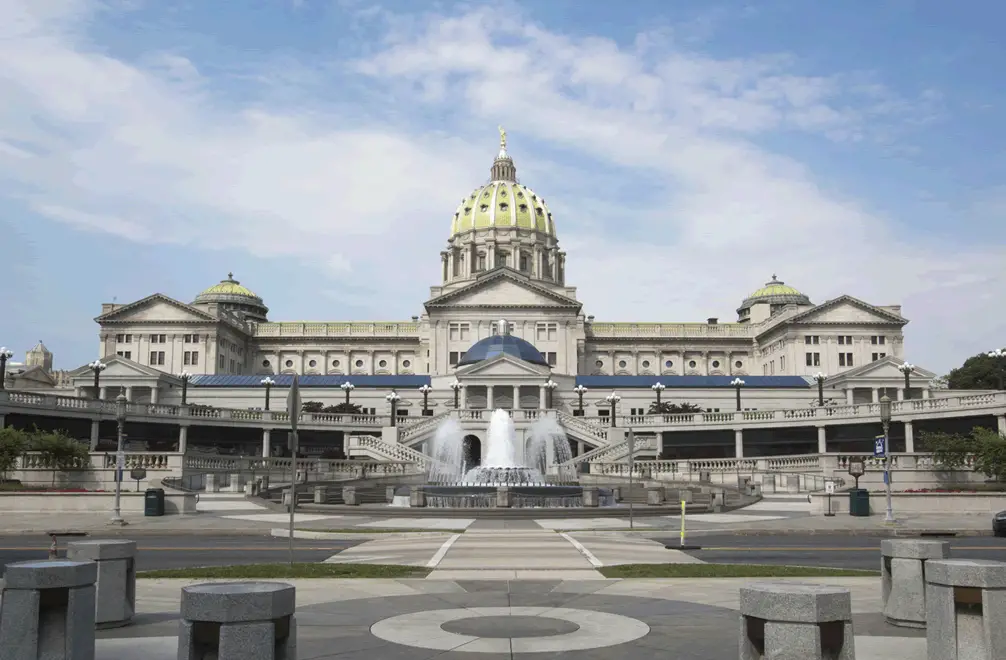
But what is more intriguing about this magnificent complex in a friendly city, is this public building is also a priceless architectural and artistic treasure that encompasses history, democracy, freedom, religion, and more.
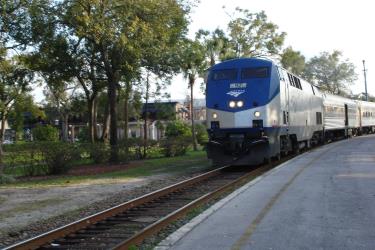
With Harrisburg a little over three hours from Newark on Amtrak, it’s a must see and visit for anyone who would enjoy seeing the blend of Italian, French and English designs blended with Greek, Roman and Victorian influences both in art and ornamentation. There are self-guided tours during the week, complete with a mobile APP to make it easier, and guide tours on both Saturdays and Sundays by appointment. Either way, it’s well worth the time.
It was President Theodore Roosevelt who was there for the building’s dedication in 1906 and described ia as “the handsomest building I ever saw.”
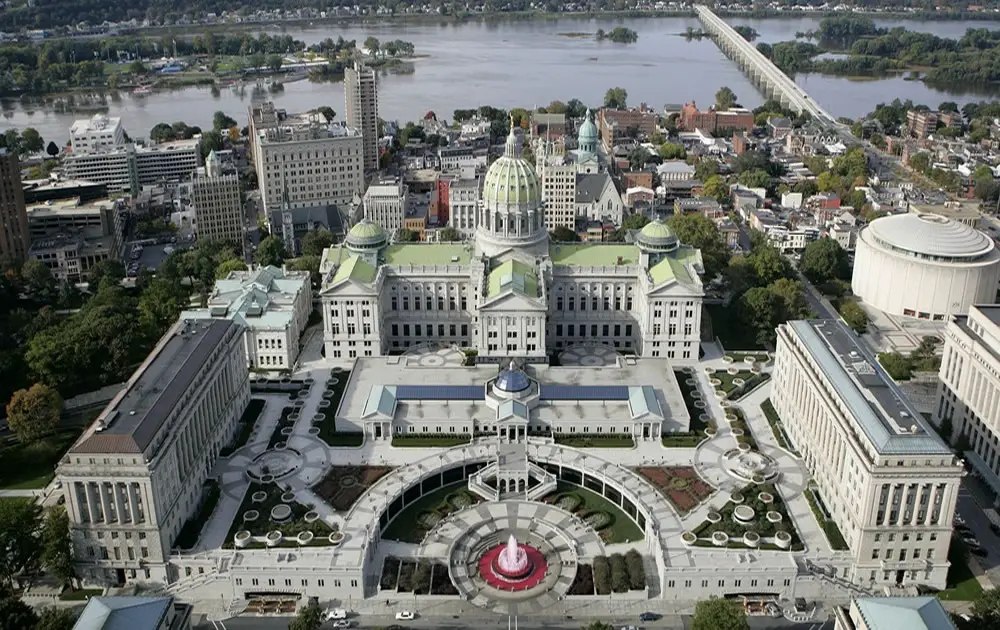
That’s because the building, holding a commanding site at the top of a hill and visible from throughout the city, was designed by local architect Joseph Huston in the American Renaissance style. The architect designed it as a Palace of Art which is obvious through the plethora of paintings, stained glass, and other furnishings that highlight everyone of the government offices.
For openers, it’s hard to miss the 52-million-pound dome that is the centerpiece of the state’s Capitol.
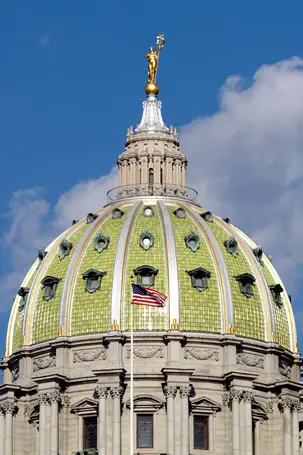
Designed after Michelangelo’s design of St. Peter’s Basilica in Rome and 272 foot high, the dome was the tallest structure between Pittsburgh and Philadelphia for nearly a century before tall buildings dotted the landscape through several counties.
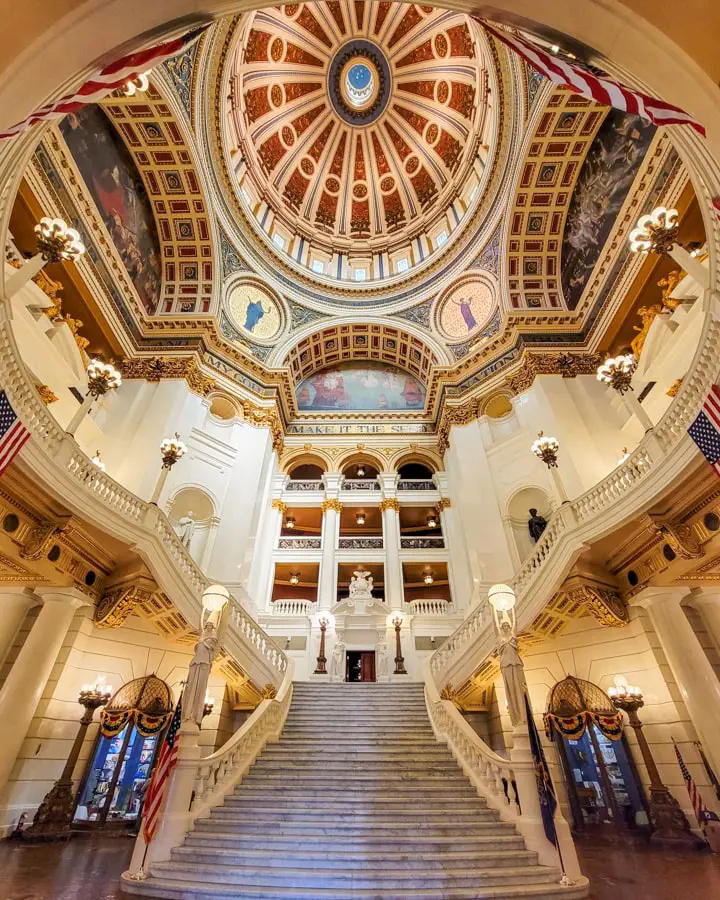
Beneath the dome in the Capitol Rotunda, you can see the 48 portholes that illuminate the dome along with 4,000 lights, and a huge circular public forum easily capable of seating 50 to 60 people amid the beauty of a grand staircase, three-tiered gallery and huge murals.
Nor do residents of the Keystone State get to forget that it was William Penn for whom the state is named, a Quaker of deep faith whose words to both legislator and citizen are wrapped around the interior walls of the Rotunda: “My God will make it the seed of a nation, that an example be set up to the nations, that we may do the thing that is truly wise and just. “
Once you take your eyes off the Rotunda and the murals, there are even more stories in the floor. It and the corridors around it, are Moravian tile blended with nearly 400 tile mosaics that depict the state’s history, occupations, modes of transportation and animals, a credit to the talent of local Pennsylvania German folk artists.
There are more than 600 rooms in the Capitol, with one side of the building for the House, the other for the Senate, and rooms for the Governor, Lieutenant Governor, Supreme Court as well as the media and public events.
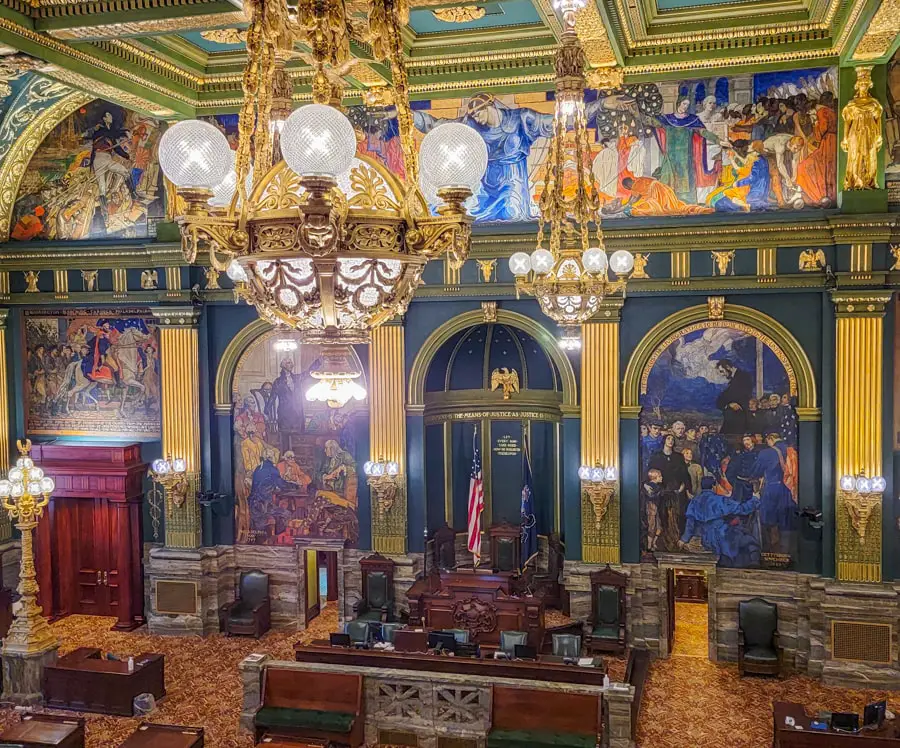
Like the rest of the facility the Senate chambers reflect not only history to when the state had 18 Senators…today there are 50….but also bronze and glass chandeliers, huge murals reminding visitors of the religious background of Penn and the people, and green floors made of Connemara marble. The Senate is divided by party, the Democrats seated on the left, the Republicans on the right, and each Senator votes by raising his hand and voting with an Aye or Nay, without any electronic tally board, unlike the House. Even the Senate desks, all made of mahogany from Belize, date back more than a century to the opening of the building.
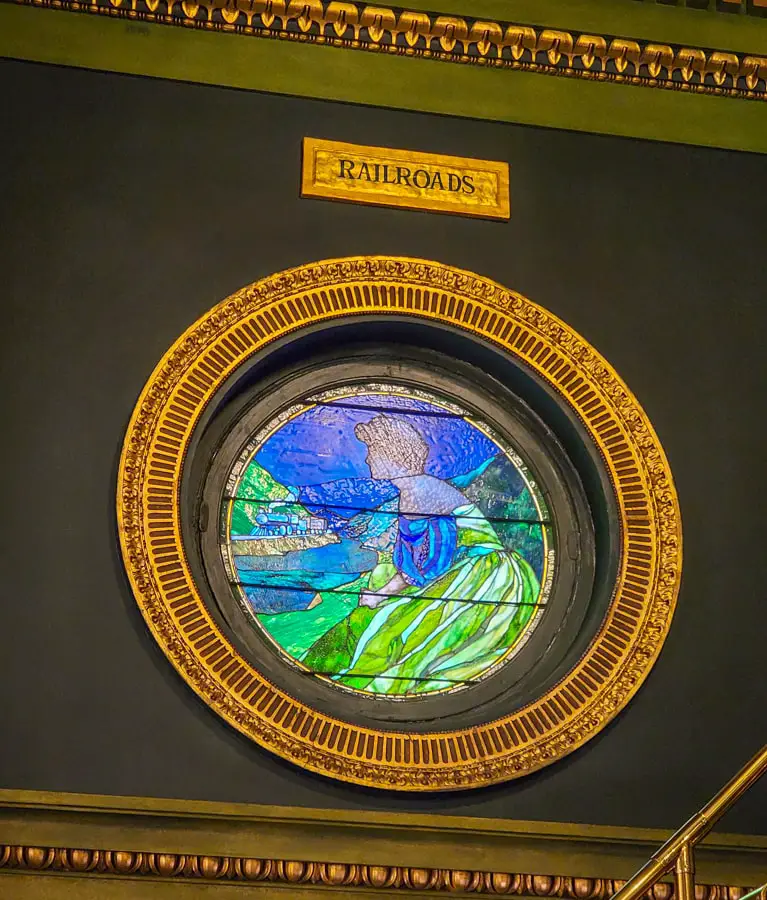
There are ten stained glass windows in the Senate, another 14 in the Assembly, all created by Philadelphia native William Van Ingen, a student of Louis Tiffany. The windows depict a variety of themes that include architecture, education, peace, library, history and justice.
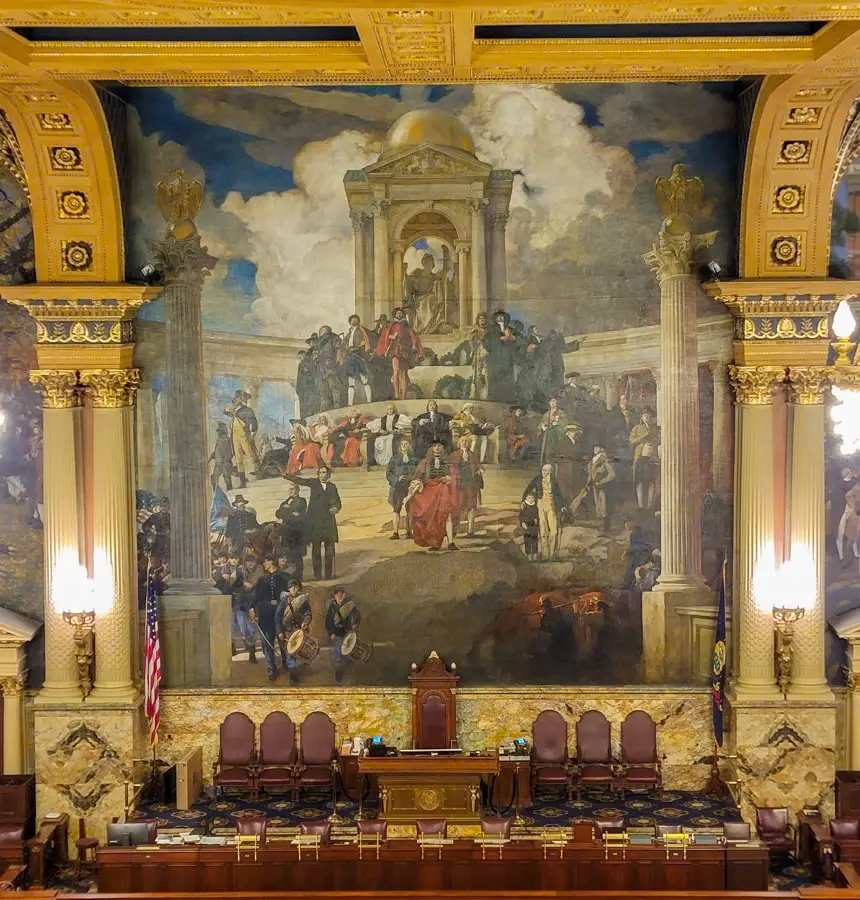
The largest mural in the entire building is in the House Chamber and can’t be missed since it is situated directly behind the Speaker’s podium. This 35-foot square painting features distinguished state residents from Penn, pictured in the middle, and Benjamin Franklin on his right, to spiritual, military leaders, explorers, pioneers and prominent legislators. Yet while Henry Hudson, Peter Minuit, who founded New Sweden after buying Manhattan, native Daniel Boone, several signers of the Declaration of Independence, and Mad Anthony Wayne of Revolutionary War fame are all included, there is no depiction of James Buchanan, the only Pennsylvanian to become President of the United States.
Currently there are 203 members of the Pennsylvania House, and their votes are taken by electronic polling with a light on the board that shows up red or green depending on the aye or nay case. As in the Senate, the walls and ceiling of the House are filled with crystal chandeliers, some weighing as much as four tons and holding more than 1,000 light bulbs, stained glass windows, art work framed in 24-karat gold leaf, and the original wooden desks from 1906.
In addition to the Office of the Governor and Lieutenant governor, reception rooms for each and the Supreme Court all in the same building, overall the Capitol Complex is an orderly, well designed and unified group of this main building and other buildings , statues, memorials, and a museum that make it easy for anyone to have business of any kind at the state level, or simply want to see a coordinated piece of the action and activities that go into state government to visit it all here in Harrisburg.
You can also Find ViniVidiScripto on the Following Platforms …
Harrisburg Harrisburg Harrisburg Harrisburg Harrisburg Harrisburg Harrisburg Harrisburg





NICE PIECE OF HISTORY. VERY INTERESTING