Honor As the Reverend Joseph Donnelly Council of the Knights of Columbus leads a series of events Sunday. October 12, honoring the 125th anniversary of the Borough of Highlands, it is interesting to see how many stories of heroism, growth, expansion, literature,
recreation, achievement and so much more are all part of the history of the borough.
In a series of articles before Sunday, October 12. Veni Vidi Scripto will highlight many
stories from many different points of view.
The knights are honoring the borough throughout the day, beginning with their regular monthly 8:30 a.m. breakfast at OLPH school hall, Mass at 9:30 a.m. followed by a ceremony at Borough Hall where the Mayor will raise a flag specially designed by and presented by the Knights, and then to the Twin Lights where the pledge of allegiance was recited for the first time in public.
The day will also honor the fact that the words “under God” were included in the pledge following a campaign by the Knights which led to President Dwight Eisenhower signing the resolution which made the words Under God officially part of the original pledge.
One of the heroes of Highlands who had a direct connection with the Twin Lights,
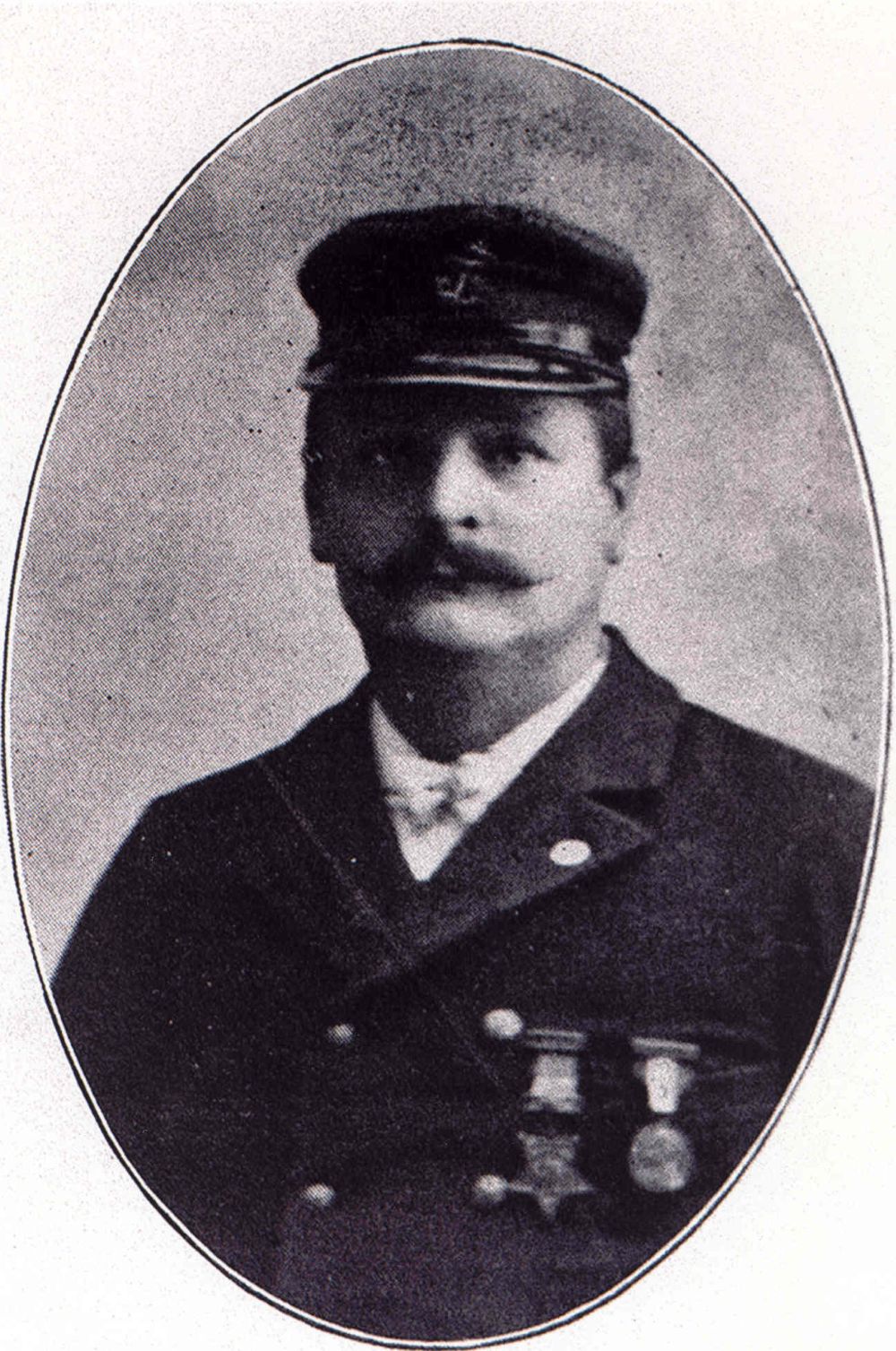
Highlands, and Our Lady of Perpetual Help Church was Chief Robert Blume, a Medal of
Honor recipient in 1898 and later a lighthouse keeper at the Twin Lights. His family lived
at the lighthouse and his daughter was baptized at Our Lady of Perpetual Help Church.
This is his story from my book, the ABCs of Highlands…”B is for Bravery.”
The wording on the citation is plain, simple and direct. In less than 35 words, it synopsizes the several early morning hours when Seaman Robert Blume and 25 other sailors and a handful of Marines put their lives on the line.
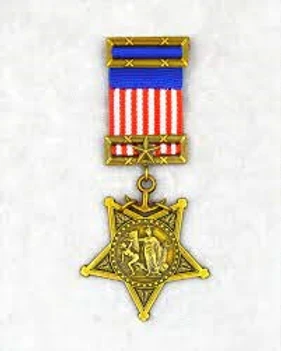
The citation reads:
On board the U.S.S. Nashville during the cutting of the cable leading from Cienfuegos, Cuba, 11 May 1898. Facing the heavy fire of the enemy, he set an example of extraordinary bravery and coolness throughout this action.
There is are identical citations for 26 others, sailors like Blume and Marines. They were part of the crew aboard the USS Marblehead who together with the 26 men from the Nashville, received Congressional Medals of Honor during the Spanish American War. It remains the only day in American history when 52 Medals of Honor were presented.
Robert Blume is Highlands’ only Medal of Honor recipient. The son of German immigrants, he was a fighter, a heavy drinker, and in between stints with the Navy, a Highlands resident and lighthouse keeper at the Twin Lights. He was also a man who could easily put both drinking and fighting aside and be the first to come forward when there was a need for help.
Born in Pittsburgh, Pennsylvania, three years after the end of the Civil War, he was six months and 16 days short of his 30th birthday on July 16, 1897 when Robert Blume enlisted in the United States Navy. It was three months since the sinking of the Battleship Maine and after the war between Spain and the United States over Cuba began. It was a short war, and the Treaty of Paris was signed 109 days after Blume enlisted.
Blume never went to school, but he could speak English, read, write and was healthy. He enlisted in Pittsburgh, the only place he had ever lived; for reasons still unknown, his enlistment in the US Navy is credited to New Jersey. At the time of his initial enlistment, he was described as being 5 feet, 10 inches tall, with brown eyes, dark brown hair, and a ruddy complexion. He also had a port wine stain on his left cheek.
Newspaper reports, official logs, and the men themselves tell the whole story of
the Battle of Cienfuegos.
As planned and agreed upon by Captains McCalla and Maynard of the USS Marblehead and USS Nashville, Blume was one of the volunteers who signed on for the unique mission, one so dangerous the captains had agreed, would only be carried out by those who willingly offered to take on the duty.
As arranged, the men from each of the two Navy vessels, Blume among them, left their ships shortly after 5 a.m. on May 10, 1898. They loaded into a steam launch and were taken closer into the harbor where their small sail boats would be dropped from the launch.
Their mission: dredge up and cut the communications cables running out of Cienfuegos, connecting communications for the Spanish on land with their ships at sea.
The men had already been advised the guns of the Spanish enemy on Cienfuegos would be active and the US Navy would be forced to respond to that activity… directly over the small boats filled with these brave volunteers. The captains also let their men in on another secret: to the best of their knowledge, nothing like this had ever been tried before. And what’s more, they didn’t know whether it could be successful.
The plan was for 12 Marines to be among the 52 volunteers to accompany the small boats in order to draw enemy fire from them and return fire as necessary. Blume’s shipmate, Marine Sgt. Philip Gaughan, was assigned to head the Marines and guards; another shipmate, Austin J. Durney, the ship’s blacksmith, was assigned to figure out how to cut through the tough communications cables.
The Marblehead’s blacksmith, Joseph E. Carter, was assigned the same duty.
The sailors didn’t mind the rough waters they faced in their little sailboats. But they were wary of the floating mines in the water in which they would be working. They all knew those mines could be detonated by the flip of a switch on shore. They were also aware of the huge rocks along the shore and the rough water that could dash their boats into them. And they could hear the guns from their own ships rising to action to protect them by aiming at the shore positions of the enemy.
It wasn’t long before the Spanish military realized the gunfire from the sea was not to provide cover for a beach landing; once they saw the sailors dropping grappling hooks, they got the idea something else was being attempted, something they had never before seen. Yet they knew it wasn’t going to be good for them.
So the barrage of gunfire from the cliffs to the water below, aimed at the small boats filled
with brave men, began.
The Marines in their launch boat were quick to react, and nine Spanish soldiers fell to the ground. Next target was the shack housing the switch for the mines. The Marines leveled it.
At the same time, the sailors were successful in hauling up one cable on the bow of their boat; Durney, the blacksmith, began trying to cut through it. He was less than 60 feet from shore, enemy shot was hitting the boat, more fire was coming from the lighthouse, and Durney tossed down his tools and picked up a hacksaw.
He knew it was the only tool that could slice the cable. He sliced and cut for more
than an hour.
Meanwhile, Sailors on the Marblehead’s boats were doing the same thing with the cable they had lifted.
One of the boats was hit by small arms fire, creating small holes below the waterline. Marines used bullets to patch the holes, then continued their firing at the enemy. As one Marine from the Marblehead told it later on, “Large shells dropped around us, nearly lifting us out of the water. Shells from our own ship and the Spanish batteries passed overhead.”
But the Marines and sailors stayed their course, the Marines protecting the men in the small boats cutting cables. The Nashville and Marblehead continued trading fire with the enemy on shore. Captain Maynard sustained a gunshot wound and had to be relieved. First Lieutenant Albert C. Dillingham took command of the Nashville.
Diligent and working as quickly as possible under fire, the sailors managed to cut through one cable, and one of the Marblehead boats towed the severed half out to sea. But first, they cut it again, just to make it more difficult to reconnect should the cable be found and raised by the Spanish.
Gunshots continued from the shore; one of the sharpshooter Marines was struck, his jaw shattered; he was struck again, this time with a bullet that entered his head and exited behind his ear.
Still in their boats, the men were successful in cutting through the second cable, then decided against continuing activity on a third, smaller cable, confident they had accomplished their mission. They were badly beaten by weather, rough water and firing all around them; their boats were all but sinking, and the enemy was homing in on them even closer.
It was time to leave.
Lt. Dillingham, on the bridge of the Nashville, recognized what was happening, and immediately turned his ship towards shore, making the broadsides a target between the enemy and the boats heading back to the ship. It was yet another risk, one never taken before. But the young officer felt it was essential in order to save the lives of the returning seamen.
There were wounded, many of them. They were rushed aboard their ships and given immediate medical attention. Though many endured later hospitalizations, surgeries, and long years of recovery, there wasn’t a single sailor or Marine lost in the Battle of Cienfuegos.
Medals of Honor were issued to each of the 52 men. For the 12 Marines who received the Medal, it remains the only time in American history that number Marines were honored on a single day in a single act of bravery.
For Seaman Blume, the 30-year old German immigrant, it was the first of two Medals of Honor for which he would be considered. It was the only one he would receive.
Throughout his years in the Navy, Seaman Blume was a bit of a tippler and enjoyed a good time. More than once, actually many more times than once, he was busted in rank for a variety of reasons, each having to do with alcohol or a good time. He was brought up and found guilty of smuggling alcohol aboard ship, of drinking on duty, overstaying leave, or fighting while under the influence.
In spite of this he had attained the rank of Chief Petty Officer, lost it for his less than
perfect conduct, left the Navy several times, and re-enlisted several more. His second feat of heroism that gained him the respect of his peers and anothernomination for the Medal of Honor came a couple of years after Cienfuegos, and a couple of years before he came to Highlands to be the lighthouse keeper.
It was at a time when Blume had been reduced in rank from the prestigious rank of Chief. He was stationed aboard the USS Raleigh, a Cincinnati class protected cruiser, along with shipmate, Robert Klein, who had also served in the Spanish American War and then served as a carpenter’s mate on the Raleigh.
Two other sailors were working in the double bottom compartment of the ship when they were overcome by turpentine fumes and lack of air; a fuse burned out and shut down the safety blower, leaving the men to suffocate. Known as a big man, and strong, with “the utmost fearlessness,” Blume went into what was described as inaccessible compartments at the bottom of the ship where the unconscious duo were being smothered by the poisonous fumes. Wrapping ropes around the unconscious men, Blume was able to hand them over to Klein who pulled them both to safety.
Both rescuers were nominated for a Congressional Medal by the ship’s executive officer, Lt. W.J. Terhune; Klein received his Medal January 25,1904.
Rather than the Medal of Honor, Blume asked instead that he be reinstated to his rank as Chief. His request was approved.
Had it not been for Mr. Blume’s penchant for alcohol, he would be included today among one of only 20 men who have earned not one, but two Congressional Medals of Honor.
After seven years in the Navy, his rank restored because of the Raleigh heroism, Blume requested discharge from the Navy, and arrived in Highlands with his wife to set up residence here. He began employment at the Twin Lights, as third assistant lighthouses keeper, working under Principal Keeper Ole Anderson, a position he held from 1906 to 1910.
While one of four keepers of the lights, Blume and his family lived in the Keepers’ Quarters at the lighthouse. The first of his three daughters was born there and later baptized at Our Lady of Perpetual Help Church.
Whether he yearned once more for the sea, or whether he had more to prove to himself about shipboard life, Chief Blume decided to leave lighthouse work and applied to the Chief of the Bureau of Navigation for permission to reenlist in the Navy, saying in his letter of request, “I would like very much to reenter the service and promise faithfully to live up to rules and regulations,” a promise he had made in the past. But this time, he added, “I am a Medal of Honor man and have a few lives to my credit.”
His request was granted.
Still the story of America’s hero does not end. Though Chief Blume died in 1937,his Medal of Honor was advertised for sale on eBay in 2003 in strict violation of federal law. Through cooperative work between the FBI and Canada’s law enforcement departments, police investigated, set up a sting, recovered the Medal of Honor and saw the criminals found guilty and serve time in prison.
With no living relatives of Chief Blume found, the Medal of Honor rests today in the
MOH Museum in Charleston, S.C.
The Chief, the Sailor, the Hero, the Highlands lighthouse keeper, is buried in
Arlington National Cemetery.
You can also Find ViniVidiScripto on the Following Platforms …
Honor Honor Honor Honor Honor honor honor honor