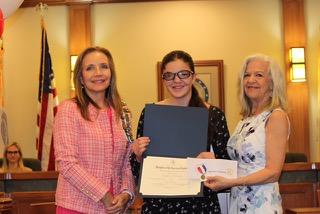
St. Leo’s Elementary school graduate Madeline Dougherty credits all the writing students were encouraged to do at St. Leo’s with her winning the state award for 8th grade students in the Daughters of American Revolution essay contest earlier this year.
The daughter of Aaron and Jennifer Dougherty who lives in Lincroft, Madeline will be attending Trinity Hall High School in September but looks back with fondness on her 11 years at St. Leo’s. Starting there in pre-school, Madeline said she believes the faculty has always challenged her not only academically but also helped cultivate her relationship with God as well as “helping me find out more about myself.”
Like friends in the 5th, 6th and 7th grades, Madeline was selected by the Shrewsbury-Towne chapter of the DAR as the winning entry for her grade level in their local contest, then went on to win the regional competition enabling her to compete at the state level in the national contest. Madeline then went on to place second in the state competition.
Locally, six schools participated in the contest open to students in the fifth through eighth grades, each with different criteria for judging.
All of the students who participated deserve recognition and praise as well. said Anna Cook, chairman of the DAR contest for the Shrewsbury-Towne chapter. “Each can take pride in the depth of their entries and their ability to meet the rigid criteria for entering. The judges deciding the competition winners, in adherence to national rules, included one DAR member and two non-DAR members for a total of three judges. For this competition, Jon Clark and Lynn Leahy were the nonmembers of the DAR and joined DAR member Mary Jo Fabiano in reviewing each of the entries.
The DAR had called for essays on one of the four tea parties similar to the Boston Tea Party held in the colonies during the Revolutionary era, and Madeline chose to write about the event at Edenton, N.C. Students had to give their reasons for choosing the specific event they chose, had to research their topic, and their completed essays were judged on everything from accuracy and research to vocabulary and grammar under the rigid and regulated procedure set for the judges.
The rising freshman said she chose the events Edenton “because it was a peaceful act of resistance,” adding, “ I felt that was a more effective way to protest. “ The action also, made “a lasting impression on women’s capabilities to engage in political life,” she said.
For those reasons, it was a good idea for the women in Edenton to take the actions they did, she feels, “because it sparked a change and it gave women a chance to engage in politics.”
Even so, Madeline said, while it “would have been very interesting to be at the forefront of the American Revolution, “ she would not have liked to live in that era. “After learning about the hardships that people faced, such as the lack of freedom, I realize that I am very fortunate to have all that I have today,” she said.
While an honor student at St. Leo’s and facing the high academic standards at Trinity Hall, Madeline is still active in a variety of activities in her spare time, from basketball, soccer and softball as well as swimming during the summer, she also enjoys spending time with family and friends, along with her two dogs, Indy and Maverick. Her goals for the future, at this time, are to be a veterinarian “so I can help with all types of animals.”
Continuing study, achieving and maintaining high academic standards are traditions in the Dougherty family. Madeline’s sister Ella is a Junior at Villanova, and her brother, Cole, is a senior at Christian Brothers Academy in Lincroft.
The Shrewsbury Towne Chapter organized 1935 and merged with the already established Monmouth Chapter 2004. It took its name from Shrewsbury Towne, settled in 1664, so named because two trails converged, and business centered at this point. It was the crossroads, Four Corners, where the King’s Highway crossed the Burlington Trail, the Indian Trail now known as Sycamore Avenue, . It was lined with sycamores which shaded Washington’s worn and wounded men as they pursued the English in their retreat from Philadelphia to Sandy Hook. The chapter placed a commemorative plaque on one of the sycamores which is still visible.
Madeline’s essay on the Edenton Tea Party:
October 24,1774 In an effort to capture the pride I feel today, I decided to record my thoughts so that one day, I may reflect on these times.
For almost three decades the British empire has controlled our beloved colonies and has silenced both men and women. As men have begun to voice their objections, it is incumbent on women to do so also.
Not too long ago, in 1’773 the Sons of Liberty participated in a boycott called “The Boston Tea Party.” This event ruptured the quietness of the colonists and opened the gates to a resistance towards the British. Ultimately, the Sons of Liberty carried out their actions to protest against the unfair taxes the British imposed on the colonists.
Although the British seemed to be a wealthy and prosperous empire, the reason behind their taxation on the colonists was fairly clear. Approximately 10 years prior to this boycott, following the French and Indian War, the British were engulfed in debt. Consequently, to regain money, the British implemented various taxes on the i3 colonies. Clearly, Britain thought the actions of the Sons of Liberty were unjustifiable, however, the Boston Tea Party proved essential to ignite a sense of hope and rebellion to all near and far.
This event also illuminated the harsh reality that I must not stay silent and watch from the side. I have since desperately searched for a way to voice my opinion here in North Carolina and break through the barrier of unjust treatment not only for me, but for all women.
Tomorrow, I will join 50 women with similar ideas, a debut for female beliefs in politics. One of mom’s dearest friends, Penelope Baker, has organized the congregation and plans to send to Britain a resolution stating our discontent with their taxation. We will sign this statement agreeing to boycott British tea and other imported goods.
Emotions of concern have overwhelmed me, for protesting the British policies and the British Tea Act of 1773 may have consequences and bring harsher treatment, but we must be courageous. At least we are using words rather than violence, for violence shall only tarnish our reputation and diminish our chances of having other peaceful protests.
As I prepare for the day ahead, I must remember that I am participating in this protest not only to honor my mother, who fought vigorously to make her opinion known, but to also to take a stand and forge a path for future generations of women. I will never forget the priceless lessons mother had taught me: work hard for our goals and never give up when a challenge is presented. I believe that if she was still alive, she would praise my efforts, notwithstanding the outcome, and would appreciate my desire to make a difference in the very tense world in which we live.
Let the road to independence commence.
October 25,1774 “‘We are signing our names to a document, not hiding ourselves behind costumes like the men in Boston did at their tea party. The British will know who we are.
” I could not believe it. These words were those of dear Penelope Bayer who showed the value of a true leader today. Every woman I know that attended this event showed bravery and determination, both of which were originally concealed behind our obedient behavior,
As for me specifically, I was able to express feelings of relief and happiness that I had suppressed for years. I can proudly say that I signed my name to the resolution and courageously stepped out of the shadows and into political life.
Elizabeth King, one of the signers, graciously offered her home in Edenton, North Carolina, as our meeting place for the Edenton Ladies’ Patriotic Guild, where we discussed our dissent with the British acts. We all agreed to stop drinking tea and to boycott British goods. As women, we play an important role in this boycott because we control the goods that are consumed in the household. The resolution clearly expressed our displeasure with the continued taxation, and each woman rendered their signature.
While the Boston Tea Party struck a similar tone, our tea party was different: it was The Edenton Tea Party.
October 30 ,1774
I would have never predicted that the Edenton Tea Party would become so well known Our story has been published in newspapers and our protest has been talked about throughout the colonies. While the British were not pleased, our movement stunned many and there are now talks of similar protests. Our boycott has highlighted the dire need for independence. I am proud to say that I contributed and helped others voice their opinion against the absurd taxes.
The mission to move closer to independence was a success. I will never second guess my decision to sign that resolution. I hope I made my mother proud these past few days because I feel so much pride in myself knowing that I am helping to contribute to a better life for all. With great pleasure, I conclude this journal entry and hope that when I read it again, we are prospering without British rule.
For those that read my journal in years to come after my passing, they encounter the courage of the Edenton women.
Tired of Facebook? You can also Find ViniVidiScripto on the Following Platforms …