It’s only three and a half hours away by Amtrak out of Newark, NJ but Mystic Seaport Museum on the Mystic River in Connecticut is a great place to visit if you like boats, history, shipbuilding, whaling, and, when you’re done there, shopping at dozens of cute little shops that offer everything for sale from books and toys to olive oils and homemade fudge.
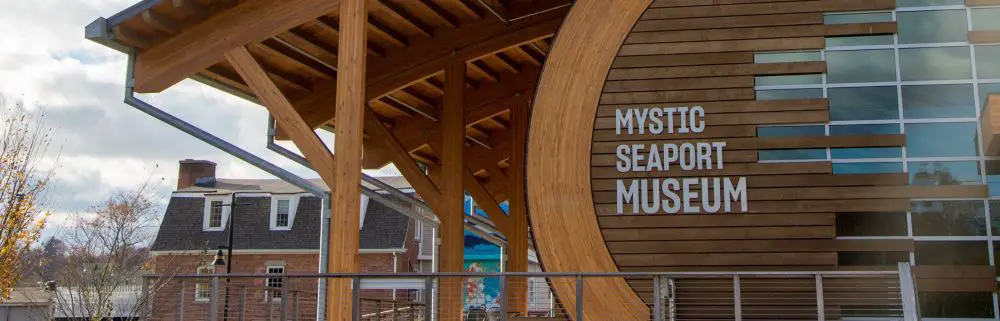
But for train visitors, be sure you have either UBER or great walking shoes, because nothing is close, and local transportation is either nil or simply invisible.
Mystic, not far from the New London, the home of the Coast Guard Academy, has a long history as a friendly hard working New England town best known for its shipbuilding excellence in the 18th century.
From the late 1700s through the next 135 years, more than 600 ships were built by the master crafters of Mystic. Typical of those work vessel is the Charles W. Morgan, the last of the great sailing ships. Built in New Bedford Massachusetts, the Charles W. Morgan is docked in Mystic and available for tours and education, fun and an opportunity to see up close the kind of lives whalers and their crews endured in order to supply the nation with oil for lighting, food, and other necessities of life.
Once ship building died out for wooden craft, replaced by steel, the Mystic shipbuilding property was purchased and became a maritime museum in 1939.
Today, besides the Charles W. Morgan, there are a series of buildings along a variety of walking paths and streets that offer education and entertainment for all ages, including some great children’s exhibits and outdoor playground, as well as gardens, a shipyard, a print shop, sailing center and Brant point Lighthouse replica.
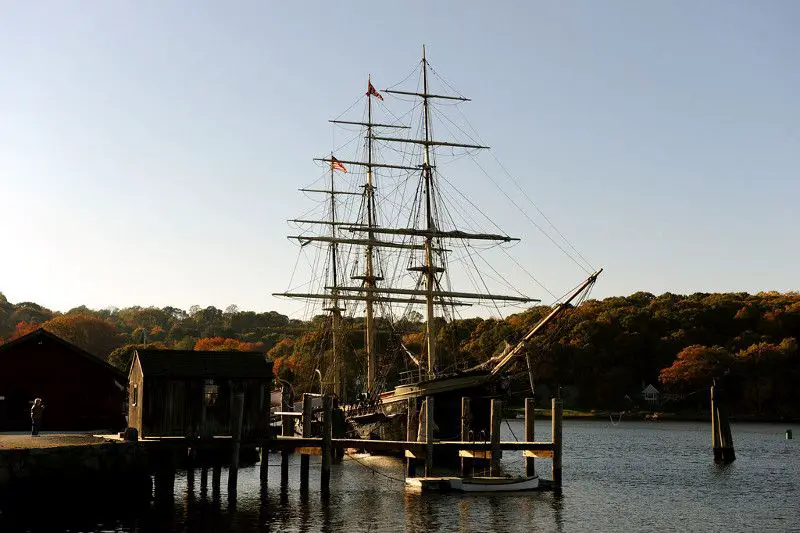
The seaport is also home to the Joseph Conrad, a Danish sailing ship built in 1882 to train merchant sailors. It was author Alan Villiers who saved the ship from demolition in 1934 and the Australian sailed it from Auckland in New Zealand to New York.
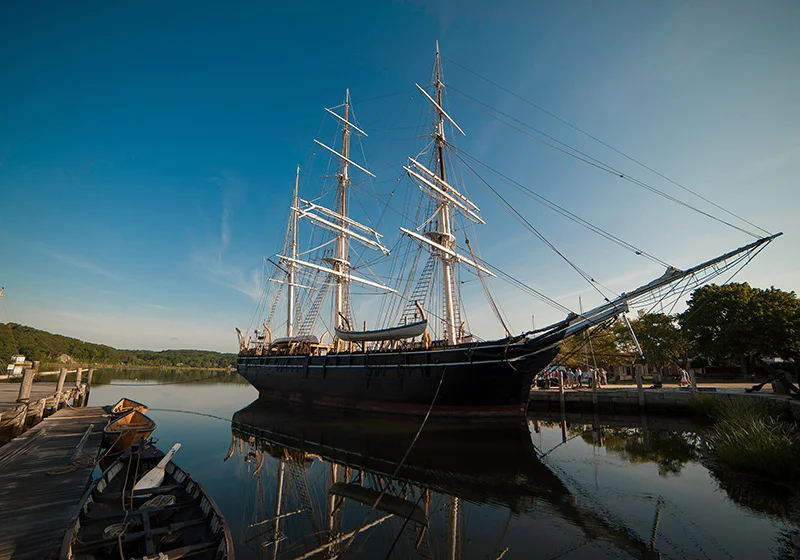
But it’s the Charles W. Morgan that commands the attention for historians and lovers of wooden boats or the history of whaling. The last of what at one time was more than 2,700 whale ships, the Morgan was launched in 1841, and was active in the industry during the 19th and early part of the 20th century.
Whaling itself can be traced back to 3000 BC, with the discovery of harpoons and spears, as well as other artifacts including bone and drawings.
In its heyday in the 18th and 19th centuries, whaling ships would be gone from home for three to five years, captains frequently bringing their wife with them.
Each of the ships carried a series of whale boats, the smaller boats lowered into the water by crew, who, upon sighting a whale would row out to surround him, harpoon him, then drive it closer to be brought on board ship for slaughter and preservation of bones, blubber and oil for lanterns, cooking, jewelry, scrimshaw, and dozens of other uses.
By the 20th century, ecologists and preservationists were bemoaning the capture of whales with the depletion of blue and sperm whales in particular. At Mystic, the last exhibition room, has varieties of photos, films and pieces of whale along with an apology to today’s viewing public for what seems to be cruel and inhuman treatment of a natural beauty.
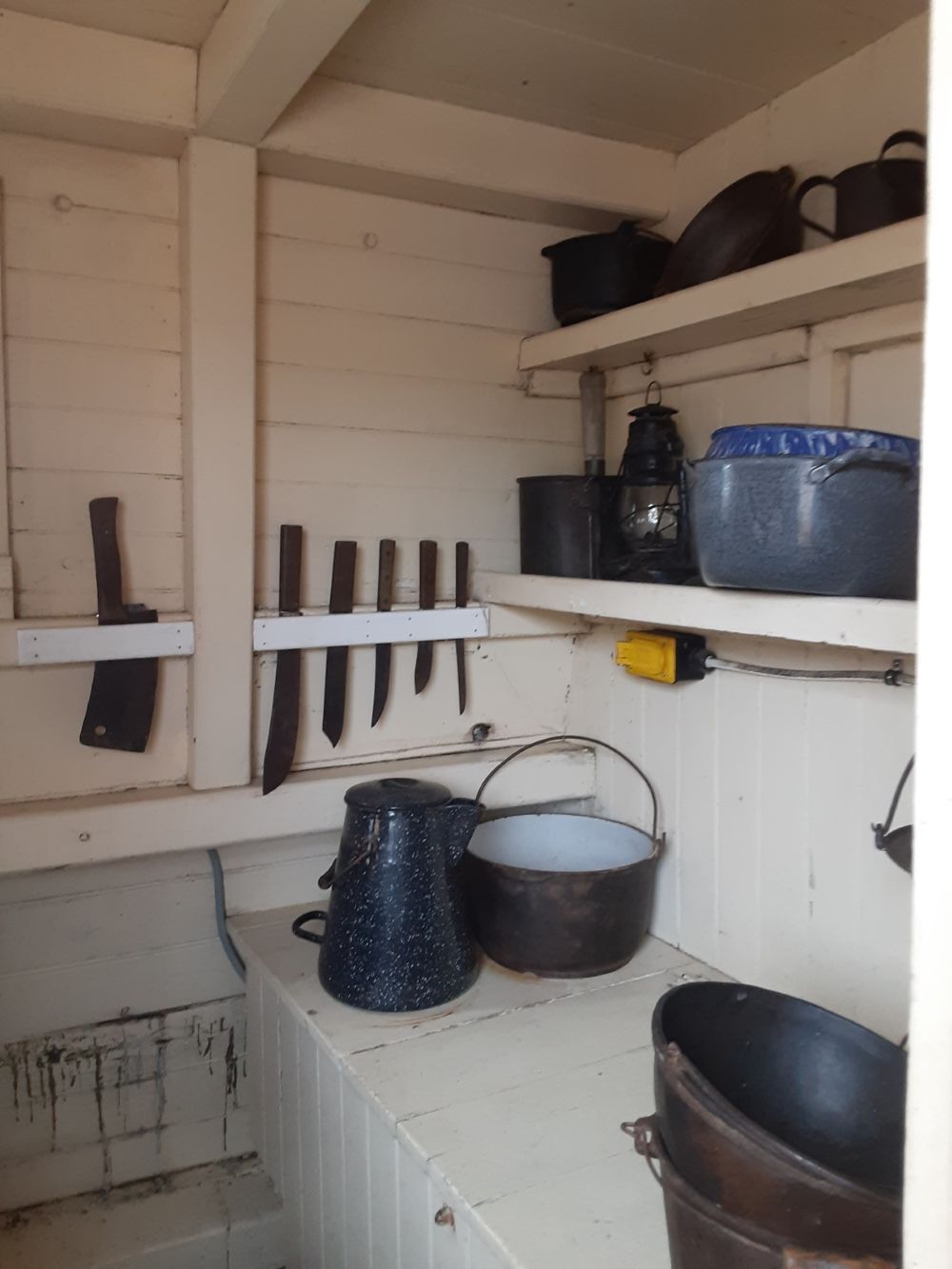
Going on deck of the Morgan, or below decks for those willing to access the dark and dreary sleeping quarters of the crew, on the Morgan, visitors can peer into the tiny kitchen where all food was prepared, mostly canned goods, fish, and dried and salt meats, or the bedroom of at least one ship’s captain, Clara Tinkham, the 20 year old bride who sailed with her husband in 1875. The bride had chronic seasickness and endured it for a year and a half before disembarking and taking a steamer back to New Bedford, Massachusetts.
It was years later she decided it was not seasickness, but rather the smell and constant presence of the chickens and pigs which walked all over the ship and were used for eggs and when, slaughtered, the pigs were used to provide fresh pork and bacon.
Another of the five brave wives who sailed with their husbands on the Charles W. Morgan over the years was Honor Matthews Earle, a former math teacher in New Zealand. She and Capt. Earle also brought their son abroad, and he also slept in a deck cabin on a hammock. Mrs. Earle volunteered to be a navigator for the ship, with her math expertise, and served as the ship’s assistance navigator.
Stories of whaling and the adventures of the men who went to sea were captured and popularized by novelist and poet Herman Melville who wrote the book in 1851. The story tells of the maniacal fight of Capt Ahab and his determination to kill Moby Dick the giant white whale who had bitten off his leg in an earlier trip aboard the Pequod.
It’s that book that brought the Melville Society, a community of academics who appreciate the works, life and influence or Melville to Mystic this week. The Society is the nation’s oldest active society dedicated to a single author and their visit to Mystic as part of an annual convention brought new life to Ismael, Captain Ahab and Pip, the ship-boy for visitors to Mystic’s Seaport Museum.
mystic
Tired of Facebook? You can also Find ViniVidiScripto on the Following Platforms …