Bayshore Pharmacy of Atlantic Highlands has expanded its Home and Bath Safety department to make a rehabilitation discharge process less overwhelming for a person returning home after hospitalization.
From bathroom safety products to dressing aids, the popular Pharmacy in the Foodtown Shopping Mall on Route 36 at First Avenue can assemble, deliver and install new home products, enabling the resident to focus more completely on the recovery process.
Coming home after a hospital discharge can be stressful, the pharmacy staff agree, in offering innovations to its already large bath safety department.
Providing copies of a discharge medication regimen to the pharmacist to review any changes will also ensure new or changed medications are at your home and ready for following doctor’s orders.
Most home safety and daily living aids including raised toilet seats, shower chairs, and showering accessories are readily available and can often be delivered before discharge to make homecoming less stressful.
Visit www.BayshorePharmacy.com to learn more about our product selection and to schedule an appointment for home safety installations.
Since its founding, and now in the second generation of family ownership, Bayshore Pharmacy has been proven to be a partner in health and a neighborhood pharmacy that can accommodate most related needs and supplies.
The Pharmacy, which has been in business for nearly 60 years, is open seven days a week and offers local daily delivery. Further information is available by calling (732) 291-2900, www.BayshorePharmacy.com or following Bayshore Pharmacy on Facebook, Instagram and Twitter!
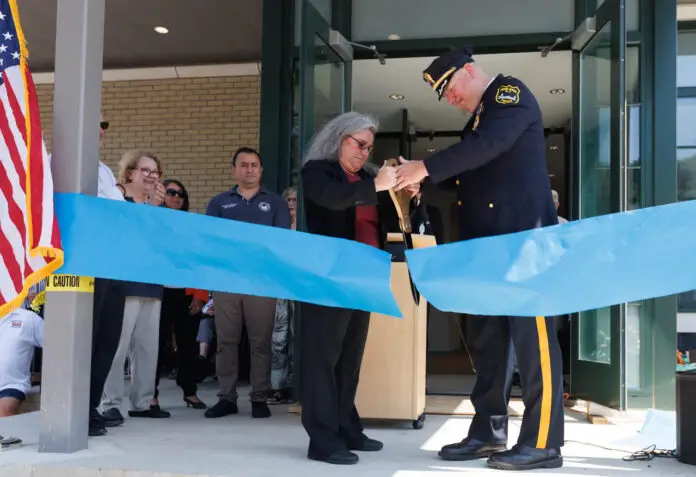
The Mayor & the Chief cutting the ribbon to the new borough hall Photo's Courtesy of Highlands Business Partnership & Shore Grafx
Mayor cuts Ribbon for New Borough Hall
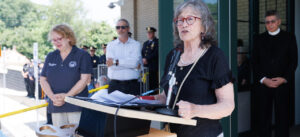
“We will always be stronger than the storm,” Mayor Carolyn Broullon reminded the people of Highlands as she cut the ribbon officially opening the new Highlands Borough Hall and dedicating it to the people of Highlands.
Photo’s Courtesy of Highlands Business Partnership & Shore Grafx
Mayor Broullon, joined by members of council and borough administrator Michael Muscillo led the ceremonies on the front steps of the building facing Highland Avenue and across Miller St. from Our Lady of Perpetual Help Church and quoted statistics highlighting how patient and perseverant Highlands residents have been since Hurricane Sandy wiped out the former borough hall on Bay Avenue.
Mayor Broullon reminded the crowd of some 100 people in the hot sun on a humid July day that it has been 3,904 days since Super Storm Sandy came to town and changed the lives of so many people in the Bayshore. She noted the former borough hall, which had been dedicated Oct. 8, 1961, and given 61 years of service to the people of Highlands, was one of the many structures damaged by the storm some have called the storm of the century.
“It has taken three mayors, 18 council members and many staff members over these ten years, eight months and nine days to get to here and now,” the mayor said, with the audience applauding the efforts of all. The completion of the move into the new facility will take place over the next few weeks.
Falling short of saying it could never happen again, Mayor Broullon listed all the features built into the new building, constructed by Kappa Construction Company, which ensure durability, energy efficiency, and protection against even a Category 5 hurricane. “These were paramount construction determinations in the planning process,” she said, along with the make the many more pieces of equipment that make surviving future storms possible. “The building is equipped with solar panels and LED lighting and will have a natural gas-powered backup generator when it is delivered in the fall.”
Monmouth County Commissioner Lillian Burry was the official representative of the Monmouth County Board of Commissioners at the event, congratulating the mayor for her leadership in seeing the long-awaited building coming to completion. Burry noted this is the first time all of the borough’s facilities, including the Police Department and municipal court, are under one roof and expressed happiness the dedicated borough employees who have completed all their municipal business in trailers since Sandy will now have a facility in which they can take pride.
Chief Burton escorting Monmouth County Commissioner Lillian Burry into the new Highlands Borough Hall. Photo’s Courtesy of Highlands Business Partnership & Shore Grafx
Mayor Broullon introduced Police Explorer Michael DelDuca, who led the Pledge of Allegiance to the flag. Both the state and national flags have been flying in front of Borough Hall on Route 36 since the poles were installed several months ago.
The Highlands Police Department and the Highlands Police Explorer Post lined the ramp leading to the main entrance throughout the ceremony.
In addition to Police Chief Robert Burton, who also spoke on the perseverance of the borough residents and their pride in the borough, former Police Chiefs James T. Davis and Joseph Blewett were also at the ceremony.
Burton accompanied the mayor in the ribbon cutting and the official opening of both the police department facilities and the borough’s municipal offices.
The Rev. Martin McGrail gave an invocation at the start of the ceremony, noting that though the new construction has been long in coming since the storm, “It is all in God’s time,” and residents have been perseverant, patient and blessed with what has come about since Hurricane Sandy.
The Reverend Marti McGrail-Photo’s Courtesy of Highlands Business Partnership & Shore Grafx
The Reverend Martin McGrail provided the Invocation followed by speakers starting with Police Chief Robert Burton, Council President Jo-Anne Olszewski and Councilman Donald Melnyk. The speeches were upbeat and praised those who had persevered over the years to see the Borough to this accomplishment.
While looking forward to what the new building means in the future of Highlands and noting how honored and grateful she felt personally for being able to celebrate the “first official day of Highlands new Municipal Building,” Councilwoman Joann Olszewski also paid tribute to the past and the power of Highlands through the centuries. The new building, she said, by “its stature, beauty, and strength pays homage to Highlands’ storied past.”
Councilwoman Joann Olszewski – Photo’s Courtesy of Highlands Business Partnership & Shore Grafx
Every era brings new people to the community, she said, people who learned to cope with the power of the seas and the hills. That, she said, is because “once here, no one wants to leave.”
“There is something uniquely special in Highlands, and it is not just the geography!” she said, pointing to the “awe-inspiring grit and strength coupled with the kindness and spirit of its residents…”
As an example, she noted that when 1500 structures in the borough were damaged or destroyed during Sandy, “Highlands’ courage, spirit, and generosity lifted everyone up. Residents and workforce moved to temporary quarters and valiantly pushed forward together to restore, rebuild and renew their lives, spirit and work. “Part of that, she said, includes the fact that for more than ten years, borough employees and the Police force, worked for 10-plus years in trailers.
Each day, as this building grew upward from its firm footing, it paid tribute to Highlands folk, past and present and future, she said.
Then, speaking for the building, Olszewski said it is constructed to say, “I am here, I will endure, and give space, light, honor and service to those who live here and those whose work in all capacities has brought Highlands to what it is today; a one-of-a-kind bounteous borough.”
Also expressing the pride and happiness of the municipal leaders at the opening of the facility, Councilman Donald Melnyk continued the mood of the day with an upbeat talk, thanks to the public and praise for those who persevered to see the borough reach this accomplishment.
All members of council present thanked those who attended, including Commissioner Burry and her husband, retired Coast Guard Capt. Donald Burry, Director of NJ LGS Rick Richardella, Atlantic Highlands Mayor Loretta Gluckstein and that borough’s Council President Lori Hohenleitner and Administrator Robert Ferragina, Henry Hudson Regional Superintendent Dr. Tara Beams and Henry Hudson Principal Kevin McCarthy. Council also expressed thanks to Congressman Frank Pallone for his congratulatory message will be on display in the new building Although not able to attend, the Borough would also like to thank Congressman Frank Pallone for sending his Aide with a lovely letter that will be displayed in the new building.
The Congressman was unable to attend but sent his Congressional aide to participate and bring the congratulatory message to the borough.
Following the ceremony and tours of the facility, a buffet of all varieties of specialties offered by Highlands restaurants was offered in the new Court Room. Water bottles commemorating the ribbon cutting ceremony were also given as souvenirs of the day.
In their first official notice of who they are and what they stand for, the Atlantic Highlands Republicans formally announced the trio they anticipate will win election in November to be the new Mayor and council members in the borough.
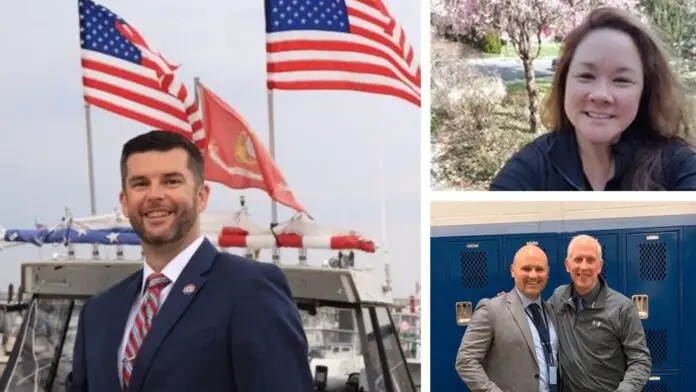
Jim Murphy, currently serving his second term on the borough council and a third generation Atlantic Highlands resident. Is seeking the mayoral candidate for the first time and is joined by Ellen O’Dwyer and Vinnie “Coach” Whitehead, seeking seats for the three-year terms on Council.
The official press release formally introducing the team includes background on each of the candidates that highlights their active participation in all phases of community efforts.
Murphy’s history of serving the community dates to his earlier years leading a high-school youth group for Our Lady of Perpetual Help St Agnes Parish. His life is richly steeped in service to the Atlantic Highlands Community in many capacities, including serving as Council President, Police Commissioner, and Chair of the Department of Public Works for most of his tenure on Council.
The mayoral candidate also served on the Planning Board, OEM, (Office of Emergency Management) and Open Space committees. Once elected Mayor, Murphy vows to lead, listen and embrace citizens, and most importantly include them in the due process of his mayoral role.
First and foremost, the press release continues, he represents the “voice of the community” for the Town Council. Murphy believes “Transparent leadership” is key to the successful future of Atlantic Highlands.
Ellen O’Dwyer is an active member of the Atlantic Highlands community. The council candidate earned her MBA in marketing from Seton Hall and an undergraduate degree from Rider University where she honed her skills and today remains a highly regarded and recognized leader in the field of Biological Sciences.
Following her formal education, Ellen served as Captain in the US Army Medical Service Corps. Today, she is passionate about Atlantic Highlands, its government, environment and future. Currently serving as Captain of the Atlantic Highlands Sustainable Green Team and in prior roles as a member of the Environmental and Shade Tree Commissions, O’Dwyer has led a number of successful Green initiatives for the town, including a Sustainable Jersey certification. The candidate is highly passionate and committed to the future of the borough, and knows her abilities as a successful businessperson, hands-on volunteer, community ambassador and environmental steward will further that commitment.
Once elected to Town Council, O’Dwyer’ s expertise and skill set will have a continued positive impact across the community.
Vinnie “Coach” Whitehead is most recognized for his beloved role within the Atlantic Highlands community as an educator and coach at Henry Hudson Regional High School for 44 years. Coach’s multi-generational relationships, proven mentoring, and leadership amongst adults, parents and children provide him with the knowledge, strength and skill set to navigate the role as a town council member.
A listener, a calming force, and a mentor who leads by example. Candidate Whitehead is committed to “building into other people’s lives, especially young people, the values needed to be productive citizens in society.
Through his enduring commitment to serve, once elected to council, Whitehead will bring with him his lifelong history of guidance, leadership, preparedness and faith.
“Our three Republican candidates are standing, strong in their commitment to unify ALL ATLANTIC HIGHLANDS CITIZENS, the GOP membership pointed out .
Our Atlantic Highlands Strong team has four core principles, the release pointed out: FAMILY, INFRASTRUCTURE, SAFETY, and EDUCATION, otherwise known as the F.I.S.E. Initiative TM.
“With so many proposed community altering decisions that are on the table and anticipated in our future, the F.I.S.E. Initiative TM. places these four values at the forefront of all the candidates’ decisions. In so doing, every issue, challenge and decision can be evaluated for its impact on the community, its people, commerce, and ecosystem.”
“Jim, Vinnie and Ellen agree that it is the RIGHT of our citizens to learn about and be notified of proposed changes, ordinances, and community legislation while in process, not after the decisions have been made, “the press release continues. “We are 100% aligned that it is a pivotal time in the future of our community. We believe our town is crying out for fresh and non-partisan leadership to lift up our community and listen to the voices of our citizens while navigating the future of Atlantic Highlands. We are excited to share more about our initiatives and pledge to the Atlantic Highlands community.
Beginning July 15, interested persons will be able to visit www.ahstrong.org and learn more about upcoming events, fundraisers, town halls, and opportunities to meet with the candidates. All are invited to reach out via email to Smkayata@gmail.com and learn more about how individuals and neighbors can partner with the Republican AH Strong team by volunteering, donating, or sharing thoughts and ideas. In that way, the press release concluded, “we can truly become AH Strong and unify our Atlantic Highlands citizens today. For information please contact: Susan Kayata at smkayata@gmail.com
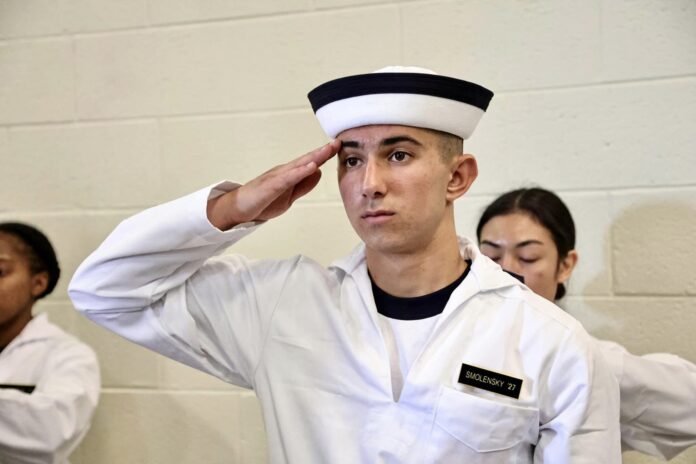
Tyler J. Smolensky, a 2023 graduate of the Marine Academy of Science and Technology (MAST) was inducted into the Naval Academy Class of 2027 June 29, marking the beginning of six challenging weeks of basic midshipman training during Plebe Summer.
Smolensky, son of Mr. and Mrs. Scott Smolensky of Middletown, is one of two MAST 2023 graduates who was inducted at the Naval Academy last week. The two MAST graduates were selected from among approximately 15,000 applicants submitted for the approximate 1,200 candidates selected.
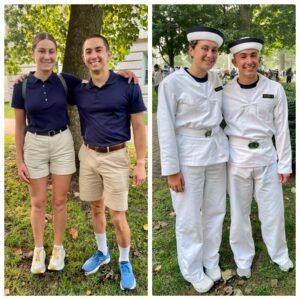
Also inducted was Alexis Walker, who, like Smolensky was also a member of the National Honor Society at MAST. She is also a member of the Spanish Honor Society.
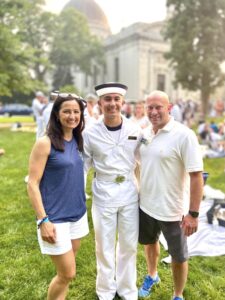
Smolensky and Walker
The six-week Plebe Summer is a requirement for each student at the Academy. During this period, plebes have no access to television, movies, the internet, or music and are restricted to access to cell phones, permitted only three calls during the six weeks of Plebe Summer.
The pressure and rigor of Plebe Summer is carefully designed to help plebes prepare for their first academic year at the Naval Academy and the four years of challenge that awaits them. The new midshipmen assimilate basic skills in seamanship, navigation, damage control, sailing, and handling yard patrol craft as well as learn infantry drill and how to shoot 9 mm pistols and M-16 rifles.
Other daily training sessions involve moral, mental, physical, and professional development and team-building skills. Activities include swimming, martial arts, basic rock climbing, and obstacle, endurance, and confidence courses designed to develop physical, mental, and team-building skills. Another forty hours are devoted to instruction in infantry drill and five formal parades.
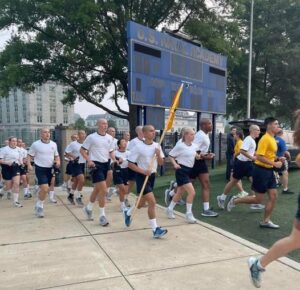
Smolensky Day1 (July 1) carrying the guidon for his company during the first Plebe Summer PEP (physical education program).
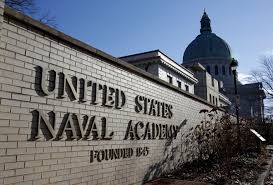
Founded in 1845, the U.S. Naval Academy is a four-year service academy that prepares midshipmen morally, mentally, and physically as professional officers in the naval service. More than 4,400 men and women representing every state in the U.S. and several foreign countries make up the student body, known as the Brigade of Midshipmen.
In 2022, U.S. News and World Reports rated the Naval Academy as the #1 public school, #4 undergraduate engineering school, and #6 national liberal arts college. Midshipmen learn from military and civilian instructors and participate in intercollegiate varsity sports and extracurricular activities. They also study subjects such as leadership, ethics, small arms, drill, seamanship and navigation, tactics, naval engineering and weapons, and military law. Upon graduation, midshipmen earn a Bachelor of Science degree in a choice of 26 different subject majors and serve at least five years as commissioned officers in the Navy or Marine Corps.
For the Smolenskys, who were present for their son’s induction, it gave them “a spectacular feeling of patriotism but also a day marked by some trepidation.” The parents said they were helping their oldest son to report for processing and then seeing him take the Oath of Office to become a Midshipman. “Overall,” they said, “we are so proud of Tyler for his hard work, determination and selflessness to give of himself to a greater purpose of service in the Navy. We pray that his time at the Naval Academy and beyond are safe and successful.”
Tyler grew up in Middletown and attended River Plaza and Thompson Middle schools before attending high school at MAST. He completed for and was accepted into MAST with a strong interest in the STEM focused curriculum, as well as the campus at historic Fort Hancock on Gateway National Recreation Area and the small learning environment in the approximate 300 student 9-12 grade school.
Last month was not Tyler’s introduction to the Annapolis Academy. He visited the college when he was in 7th grade and developed an affinity for the school and an admiration for military training, ideas that were further enhanced when he attended MAST and was fully immersed in the NJROTC program required of all MAST students.
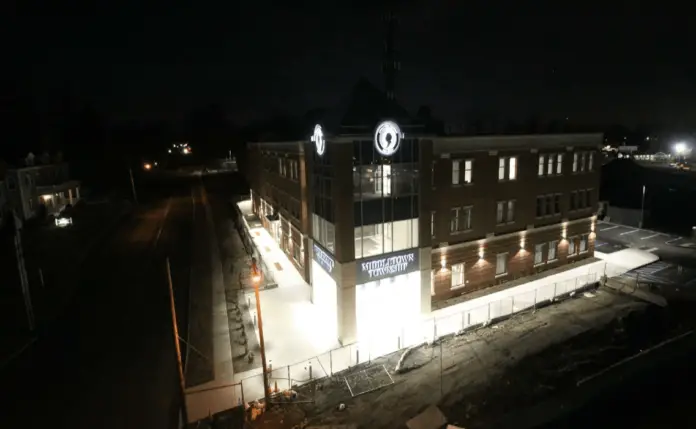
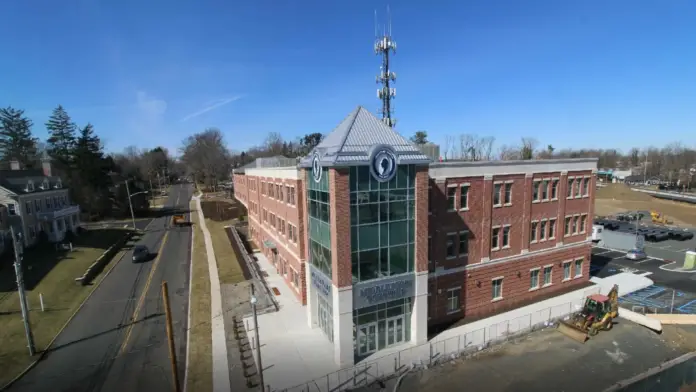
It was an old-fashioned, neighborhood party to welcome a new friend Wednesday evening when Middletown elected officials and hard working township employees cut the ribbon officially opening the new Town Hall and proudly showing hundreds of guests through everything from the court room to the family bath rooms, to say nothing of the state of the art construction and sophisticated equipment that will keep Middletown far ahead in the 21st century.
It all began with Monmouth County Surrogate Maureen Rausch leading the crowd in a pledge of allegiance. Maureen’s predecessor and former Middletown Mayor Rosemarie Peters, who set the bar for excellence and service in a county surrogate’s office, was there along with her husband and other friends and neighbors as all stood proudly to pledge the flag one of Middleton’s outstanding volunteer fire companies had hoisted on the truck for all to admire.
From there, an outstanding High School senior belted out the Star-Spangled banner with gusto and spirit with as much applause for her excellence as for the nation being honored. Then, with the commanding officers of Naval Weapon Station Earle standing by…the Leonardo portion of the Colts Neck base and thousands of Navy acreage all fall within the township… former mayors and former and current township committeemen gathered around while current Mayor Tony Perry officially cut the tape in front of the building. And Middletown Town Hall is officially open for business.
Then the fun began. Outside, in one of the huge parking lots that will ensure parking will be easy if stopping in to pay a tax bill or get information on veterans’ benefits, there were food trucks of every kind, tablecloth covered tables and pots of flowers as centerpieces for comfort and enjoyment, and many of the township’s various departments set up to give out information, answer questions, and show how happy they are to be in a facility that accommodates every bit of township business possible. There’s even a passport office.
There was also a billboard size sign proclaiming the new Town Hall and pleasant employees inviting everyone to sign it, explaining it will be on display in the new building. There were gifts of Middletown coins, pins, and very clever coasters (with a can and bottle opener concealed on the bottom side) as giveaways, along with tons of information, ice cream from the Creamery, and some pretty fantastic, iced coffee from Booskerdoo, the coffee and baking company up the road.
Booskerdoo even handed out cards so you can stop in at their business another time for even more free coffee. There were fun props to wear for photos in front of the new town Hall and so much else, all in fun, all in pride in Middletown township.
People of all ages were touring the building, upstairs and beyond, or simply hanging out in the main lobby and catching up with neighbors and friends.
Tucked away in a small corner beneath the stairs just inside the main door, …far too small to show off all the history of Middletown, were the indefatigable members of the Middletown Historical Society, from Ray Veth and Peter Van Nortwick to the ever proud and hard working Tom Valente inviting viewers to see historic papers, photographs and special memorabilia that tell the history of Middletown for centuries.
The Society has been collecting and displaying all their information since 1968 and always inviting new members to share in the past of Middletown while enjoying its present and looking towards its future. Representatives of the DAR, the daughters of the Revolution were present as a reminder of Middletown’s heroics and place in the war that won its first freedom.
Mayor Perry introduced so many notables there for the festive occasion and called for praise. quickly given with deep appreciation and thunderous applause…to township administrator Tony Mercantante for the role he played in the building of the 72,000 square foot facility, as well as the township employees, the police department and all the team members that helped it all happen through cooperative efforts and hard work. He looked forward to the nation’s celebration of its 250th anniversary in three years and noted Middletown, too, is ready for it in its history dating back longer than that.
“The future is to be decided here,” Perry told the crowd, and “everyone of the 68,000 residents can take pride in the township.” He cited the major disasters the town came together to overcome and beat from World War II through 9-11, Superstorm Sandy and Covid and reminded spectators that Middletown has stood the test of time and persevered in struggles. Showing the world what its residents are capable of. He urged visitors to the new building to “demand excellence always from your leaders.”
Want to see pictures of the construction phase? Click HERE
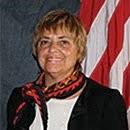
Make no mistake about it. Renee Swartz is a ground breaker, a pioneer, a leader, and a very smart lady who decides something needs to be done, then promptly goes about making sure it happens.
But even after a lifetime of donating time, talent and innovations to her causes, all of which focus on the importance of books in everyone’s lives, this indomitable lady is not taking a back seat to any of it…she is merely stepping down after 23 years as the Founding Chair of the New Jersey Center of the Book, the affiliate with the Library of Congress along with 49 other Centers representing each of the states, the Center she founded in New Jersey 23 years ago.
It is the occasion of this retirement that is the cause for the gala celebration planned for Wednesday, July 19 at the Molly Pitcher Inn. The celebration will honor Renee for her years of service to the NJ Center for the Book and is open to the public. Tickets are $95 and available by e-mail to Marianne.gaunt@comcast.net or at the door the day of the event.
For Renee, it all began because she raised her hand.
Looking back now at her many years of volunteerism, Renee, enthusiastic, loquacious, and loaded with fond memories and poignant reminiscences, can laugh and blame it on her parents, her years earning her degree at Barnard College, her children, and how they all tie in with her belief that books are vitally important to everyone.
The daughter of a highly respected physician in both Monmouth and Middlesex counties and a mom who was a teacher and emphasized the importance of learning, Renee also believes she inherited a natural love for learning and keeping herself informed. She readily admits that as a child growing up in Keyport, she literally read her way through the borough’s small library by the time she was in fourth or fifth grade.
Then she eagerly sought out other sources. She also believed diversification is necessary in reading, be it biographies, knowledge, science, nature, history or simply comedy and children’s stories. To this day, there is always a book beside Renee’s bed for a last-minute chapter before settling in for the night. Right now, the book is Horse by Pulitzer Prize winner Geraldine Brooks, a novel set in the 19th century at the time of the Civil War.
It is this Keyport native who went on to Barnard College, met her husband, Harry, now the late beloved physician of Monmouth County, and the couple settled in Middletown where the doctor had his office and Renee brought up their sons and daughter with the same love for reading she has.
There was the day Renee was asked to volunteer as a survey taker for the American Association of University Women, as a way of determining what educational resources would be offered to the growing population of Monmouth County.
So Renee Swartz raised her hand and agreed to serve.
Since then, her advocacy for libraries has been felt at all levels of government. At the national level, she was Chair of the NJ Delegation to the White House Conference on Library and Information Services task forces, serving as national treasurer and permanent representative.
She was on the NJ State Library Advisory Council, the American Library Association Advisory Board for the National Office of Information Technology Policy, and numerous other national, state, and county committees, task forces, and communications offices. She wrote and developed The People’s Bill of Rights, which was subsequently adopted by the New Jersey Library Association and was an amendment to the White House Conference in 1979 as the Preamble to the Second White House Conference.
So when the only county library at the time was a bookmobile, Renee knew she had to do something about that as well. When asked for volunteers to working on expanding the library, well, Renee Swartz once again raised her hand.
In 1966, she raised her hand when asked to join the Monmouth County Library Commission with a goal to make it bigger, better, stronger and more involved. She became the commission chair in 1976 and remained in that position for the next half century, accomplishing, or ensuring that would be accomplished, all that she dreamed a library should be.
Renee’s idea was never to have a library be a quiet place where children could research essays in school or pick out a book for a scout activity. A library has to be more than that, she insisted. Actually, she smiles in remembering, she would tell everyone involved that a library should not be just a library…it is a Community Center. That is why she initiated jazz festivals in the library in those early years; today, the sound and history of music and dance are popular regular attractions in the main county library and all of its branches in Monmouth County.
What’s more, she went on, not satisfied that a library should be just a community center…”it has to be the corner store for the mind.” That means, she explains, everything the mind needs should be as easy and readily available at the corner store.
That is how the Monmouth County evolved to the point today, it is truly a corner store with all its branches making it close to neighborhoods throughout the county offering everything from yoga and story times for kids, to concerts and interviews with authors.
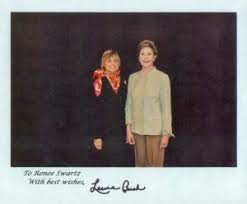
Then there is the Center for the Book. This is the organization created as a designated center affiliated with the Library of Congress to promote reading and literacy. In 2001, with First Lady Laura Bush as eager as Renee to ensure libraries would always abound, New Jersey was not one of the forty-three states with a Center for the Book. Ms. Bush saw that New Jersey’s Renee could change that, and she was right.
New Jersey became the 44th state to create a designated Center in affiliation with the Library of Congress, and Renee went on to chair it until this year. Content it has now achieved her original goal, and confident of the capable hands of her Board of Directors, the tireless lady has decided to put the chairmanship into other hands and relax a bit to enjoy other aspects of her life, which still includes those children and now grandchildren, as well as a quieter less active life still only a stone’s throw from her favorite library Eastern Branch on Route 35 in Shrewsbury.
Simply citing some of the accomplishments of New Jersey’s Center for the Book is describing Renee’s goals …
The nationwide reading-writing initiative for youth in fourth through 12th grades has had nine national winners from New Jersey’s Center; Red Bank’s Two River Theater has been designated a New Jersey Literary Landmark together with such other representatives of prominence in specific fields including the Rutgers Institute of Jazz Studies and the Grounds for Sculpture; authors and others who demonstrate exceptional dedication to literacy who have earned the state Center’s coveted Literary Lions Award, or the Route 1 Reads Initiative, the partnership of 16 affiliate Centers for the Book that promotes and commemorates important aspects of the state so motorists can learn even while traveling.
The New Jersey Center’s Poetry Indeed! Event at Rutgers gives student authors an event to present their poetry and illustrations, the popular New Jersey Center exhibit in the pavilion of States exhibit in the National Book Festival at the Library of Congress in Washington, the lecturers, the awards to outstanding librarians, the grant initiatives that are rewarded, the art exhibitions even the Food for Thought program in Monmouth County where the Center teamed up with the county library system to promote the importance of nutrition literacy for better health.
New Jersey Center events made science fun for kids attending programs at the Liberty Science Center and the Clothespin Doll Project brought out ingenuity, color, and excitement to youngsters invited to participate in depicting all the immigrant backgrounds of America’s residents by decorating clothespins in native dress.
All this has been made available through Renee’s efforts, through the New Jersey Center’s hard work, and through that idea of Renee’s that the library should indeed be the corner store for the mind.
That Renee Shwartz has been successful in all she sets out to accomplish is well proven. It did not take the honors she received by President and Mrs. Bush. Nor did not take her being named by the President to the Institute of the Museums and Library Board. a federal agency of the executive branch which administers funds to 122,000 libraries and 17,500 museums across the nation. Nor even more recently, did it take the naming of the children’s Library at her beloved Eastern Branch in her honor.
All are honors she has received and cherished, all are blended with the many other accolades she has garnered over the years of pursuing her goal to make libraries and books a part of everyone’s life.
But indeed, they, too, are among her collection of signs and symbols. Renee Swartz may never have earned a degree in library science to be a certified librarian. But she knows how to create a library that answers people every day of their lives.
So often it is the little things, or the seemingly insignificant things, that bring about the greatest happiness. But too many of us don’t stop to appreciate them or even think how nice people are, so it’s always fun to give examples of both big and little things that make it such a great pleasure to live in the Bayshore in Monmouth County.
Teamwork is brings happiness
Last week’s boat on First Avenue incident in Atlantic Highlands is one of the big things that makes living here so great. It was literally no more than two minutes from the time the boat trailer driver stopped that both police and volunteers, borough workers and the fire and first aid, were right there to help.
They knew exactly what to do, whether it was to grab the tape to rope off streets, divert traffic before it got near the closed area, or check with the businesses to be sure everything was OK inside. It was amazing to see how everyone seemed to know precisely what to do and nobody got in each other’s way doing it. Teamwork, working together, accomplishing a common goal, helping neighbors, friends and strangers. That’s what it was all about. Both Highlands and Keansburg offered their support as well, and Monmouth County offered whatever the borough needed.
Sodon’s Electric Brings Happiness
Not quite as significant to a town full of people but certainly something very impressive for a homeowner who wasn’t sure how some of the emergency equipment in her home worked, was Sodon’s Electric. They received a call that the homeowner, who lives alone, did not know how to turn on a generator in the event of flooding and possible damage in her basement. Listening to all the stories last week about how bad storms were going to be and how much flooding there was going to be, she was naturally worried.
Sodon’s Man on the Job not only went to the house, inspected the equipment, but also showed the residents how to operate the equipment and made suggestions to keep it all in proper working order so she wouldn’t have to worry again. Happy to do it, they said, and she was very grateful.
Koeppel Plumbing Brings Happiness
Then there is Koeppel Plumbing, a family business that goes back four generations. If it isn’t the oldest still operating business in the borough, it’s certainly one of the oldest. And it’s easy to see why. Mr. Koeppel does more than outstanding plumbing, he’s got fascinating stories to tell about his great grandfather who started the business and all the fine people he meets on a regular basis while doing his job to help others.
Care One at Middletown Brings Happiness
Then there are all those folks at Care One of Middletown who work together, resident and employee alike, to help organizations that help others. Middletown Helps Its Own, a great organization for ever, is the recent beneficiary of activities at the Care Center that keeps them part of the community. “We are part of the community,” the affable administrator Jimmie King said, “so of course we get involved.” It’s not out of the ordinary for the ‘family at Care One” as they are often referred to, to do good things for others. The residents get a thrill out of being involved and helping.
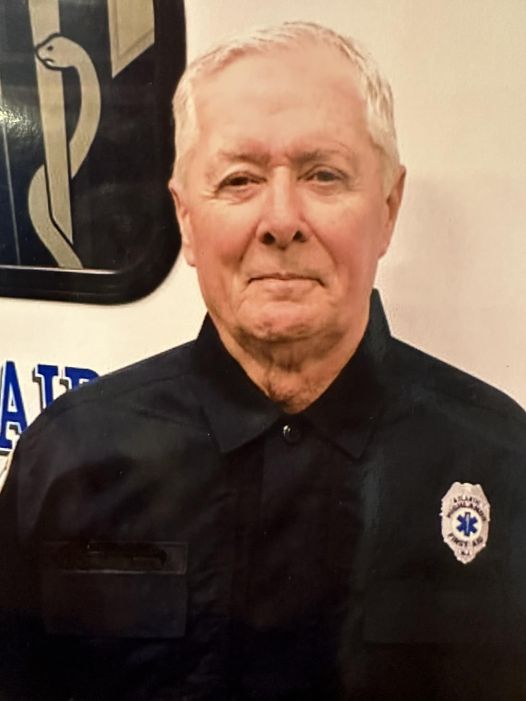
Funeral services for the late Walter Curry, who died Friday, June 30th at home, will be held Friday morning at Posten’s Funeral Home at 10 a.m.
Visitation for Mr. Curry will be held Thursday at Posten’s Funeral Home on E. Lincoln Avenue, Atlantic Highlands from 2 to 5 p.m. and from 7 to 9 p.m.
Walt, former councilman, active firefighter and first aid volunteer for decades, was a retired teacher from the Middletown school system.
Remembered and honored several times in recent months for the role he has played in assisting in so many ways both the residents and image of Atlantic Highlands, Walter was honored last December by the Mayor and Council and the Fire Department on the occasion of his 80th birthday and the 60th anniversary of his years on the fire department. During those years, Walt served as fire chief three times, in 1981, 1994 and 19954. He also served 58 years on the first aid squad.
Curry was a member of the borough council for five years beginning in 1975, then served on the Harbor Commission from 1987 through 2015.
Local residents all have special memories of Walt, his family and the impact he has had on the Bayshore. During last year’s ceremonies, many firemen, municipal leaders and employees who have served for decades with Walter kept everyone laughing and recalling events from the past and the influence Curry has had on their lives. One of the humorous stories told about the popular gentlemen was the one former Mayor Fred Rast told about his childhood friend, and their early lives together.
The Curry and Rast back yards abutted each other when the Rast family lived on Washington Ave. and the Currys on E. Highland. The two boys were only a few months apart in age, Curry the older, and both remember the nights they camped together in the back yard, the family get togethers of both families whose parents taught each of their children the importance of giving back to the community, always pitching in, always doing their share.
The Rast and Curry families, as well as the Sheehans, go back for generations. Everett Curry was Fred Rast’s father’s shop teacher in Atlantic Highlands High school, before Everett went on to teach in the Middletown system.
One story in particular that Rast told is familiar to most parents whose sons know where the liquor cabinet is in each of their homes and the thrill of sneaking something past their parents.
Rast recalled nights the boys camped in the back yard, then, under the stars, crept into the Curry home to try a sip or two..or three..from one of the liquor bottles. So as not to be detected, they would replace what they drank with an equal amount of water. Like most boys, they continued growing up and moving on, always keeping in the backs of their minds the fun of sneaking something from their parents.
Curry’s father, Everett a former Mayor and equally highly respected gentleman of the borough, was honored at a dinner in his later years. That’s when the adult Rast and Curry boys learned their fathers were far smarter than they thought.
The senior Curry pointed out in his address at the event that he always thought that he could drink more alcohol as he got older…. until he realized it wasn’t so, it was simply that his son and Fred had watered down his house supply.
As for all their years of service to the community, octogenarian Walt said at his 80th birthday celebration at borough hall: “it’s how we grew up. It’s what everybody did.”
Walter Curry has done it well.
Mayor Loretta Gluckstein’s proclamation last December on the occasion of Walt’s 80th birthday noted “few areas of community life have not been touched by Curry’s hands, as friends and family acknowledge with gratitude.
” His dedication to public service and the warmth with which he exhibits it is an inspiration to all of us.”
It will be hard to find anyone more excited or prouder when Middletown Township celebrates the grand opening of its new Town Hall, tomorrow, Wednesday, July 5 than Mayor Tony Perry.
The gala event, which will include food, fun games, entertaining music, exciting giveaways, and more, marks the culmination of more than five years of planning, design and construction. The celebration, which begins at 6 p.m., concludes with fireworks at 9 p.m.
For Perry, it is the highlight of the five years he has already served on the governing body since first elected to the Township Committee in 2017, making him the longest serving mayor in more than 50 years. And this week’s dedication, he said, will always remain one of his proudest moments heading up the township in which he takes great pride.
Looking back at the town hall where he first served, and comparing it to the new facility, Perry sees it as something in which every resident can take pride, and every resident and employee will be far better served.
He is particularly proud of the state-of-the-art facilities for the township Police Department, recalling when the previous town hall was built the department was smaller, amenities were fewer, and no considerations were made for female officers since there were none. The new police department facility, he said, offers fitness facilities, separate bath facilities and more and improved space for a department that is second to none.
Perry is also pleased with the amount of shared services the township offers and provides for other municipalities, seeing it as tax savings for all; the new construction will enable the township to expand on shared services as well.
But Perry is most proud that Town Hall represents a superior work environment for its employees as well as a government site where the residents are welcome and will have greater access to information and records that they want.
“I want the residents to feel as proud of this building as I do,” the mayor said, “and more importantly, realize that this Town Hall is representative of the township as a whole, one building with all its amenities and offices under one roof, drawing the entire township together as the one large and wonderful township that it is.”
Perry also noted the building was not constructed for 2023 or 2025, but rather “this is a building that is state of the art today, tomorrow, and will be from here on in. I expect that this town hall will outlast me and so many of us here now.”
It has been an exciting five years as Mayor and part of the planning of the building, he said, and recognizing all the time and effort that has gone into the design that “reflects everything that is so great about Middletown.”
After the ribbon cutting ceremony, township employees will also be offering open house tours and residents will be given the chance to participate in a community mural.
Parking will be available in the large gravel lot and there will also be a free shuttle at the Middletown Arts Center (36 Church Street). The rain date is July 7.
Tomorrow, after stopping by at the Allen House in Shrewsbury at 9 a.m. and feel the inspiration hearing the words of the Declaration of Independence read aloud. Think back to when Thomas Jefferson holed himself up in his room in Philadelphia to concentrate on the words for the document that formed a nation.
Think of how the young and the old, from Jefferson to Delaware’s Caesar Rodney and Philadelphia’s own Benjamin Franklin, were inspired by John Adams’ fiery New England twang urging his fellow Congressional members to take action and shore up George Washington’s troops leading their own battle for freedom.
Think of New Jersey’s own five signers of the Declaration of Independence and realize how each of these men truly did put his life, his land and his personal honor on the line for this belief.
Then walk across the street, better yet, if your car is parked in the Shrewsbury Borough Hall parking lot, take advantage of the Shrewsbury Historical Society’s magnificent collection. Tomorrow, July 4, will be the last chance to see an exhibit of 45 chairs, perfect seating arrangements for infants, toddlers, busy housewives, hardworking farmers, and professionals, all captured in a display that shows not only American ingenuity but also the best of designs from other nations and centuries.
Each story has a history of its own, and the Shrewsbury Historical Society is filled with members who know those histories and are so willing to share them with everyone.
This particular exhibit was also on display, in part at the Monmouth County Library’s Eastern Branch, but even if you’ve seen it there, there are more chairs to see at the museum tomorrow before it closes.
Ask about becoming a member of the Society; ask about their next exhibit scheduled to open in the fall. Check out some of the other new items on display to celebrate the Fourth. Enjoy the delicacy of the miniature houses and ask for the history behind them.
The Museum will be open July 4 from 10 a.m. to 1 p.m. enough time to let you see how thriving and ambitious this Historical Society is and the contributions it makes on a regular basis to preserving the history of Shrewsbury and the surrounding area.