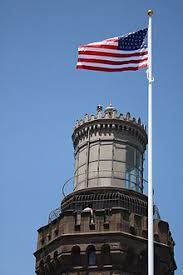
The Pledge is being recited at the Twin Lights on the anniversary of the birthday of the nation in honor of the fact the Twin Lights is the site where the nation’s official Pledge was first recited publicly on April 25, 1893 . The flag which was hoisted on the Liberty Pole described as the “national flagpole” that was twice as tall as the Twin Lights’ towers in the front of the historic building.
The Department of Environmental Protection will host a public recitation of the Pledge of Allegiance at the Twin Lights on Monday, the Fourth of July at 2 p.m.
Historian and state ranger Nick Wood will address the group following the ceremony and give a brief history of the significance of the allegiance pledge and why it is part of Twin Lights history.
The Pledge will be recited with the wording of the original pledge in 1893.
“I pledge allegiance to my Flag and (to) the Republic for which it stands, one nation indivisible, with liberty and justice for all.”
Members of the Twin Lights Historical Society will be present during the ceremony, and the museum and grounds are open for visitation.
While we are celebrating the Fourth of July as the birthday of the United States, it is also a time to reflect on the wisdom, intelligence and thirst for justice and knowledge of Thomas Jefferson, the writer of the Declaration of Independence.
It’s also time to reflect on John Adams, the obstinate, stubborn and determined member of the Second Continental Congress who directed that Jefferson write the Declaration.
Author Joseph Ellis referred to the two men as the Odd Couple of the Revolution.” And so they were.
While they could not have been more different in appearance, style, demeanor, political beliefs and national roots… Jefferson was a Southerner, Adams a New Englander, Adams a Federalist, Jefferson a Republican…they were close friends, then distant enemies, then at the ends of their lives, close friends once again.
The story of both of their deaths on the 50th anniversary of the signing of the Declaration, both thinking of each other or that day in the minutes before their deaths is well known.
But why they fought and disliked each other for years, and how they got to rekindle their friendship is not so well known. It is a lesson for all that even our beloved forefathers lost respect and affection for each other over politics.
Today, we can also learn from these same forefathers it is truly possible to disagree politically, but continue to cherish a friendship and personal happiness.
The friendship that began when the Southern gentleman and the feisty New Englander nine years his senior both served in the Second Continental Congress lasted through those years of forming the nation until Adams was elected the first vice-president, and Jefferson named the first Secretary of State.
Jefferson was a staunch believer in the new states each preserving their own rights, Adams, on the other hand, favored Washington’s idea of a strong central government with each state having very little power to do anything. Jefferson, realizing he could not carry out his duties under a President who rejected states rights, resigned as Secretary of State And so the feud between two friends began…over politics.
It got worse when Adams was elected President and Jefferson vice-president, at a time the two offices were not determined by a single vote.
Adams had won by a slim margin, so they could not have been happy years as two strong intelligent and passionate men each sought his own political belief to be correct.
It got worse in 1800 when Adams ran for his second term, and Jefferson won. The New Englander was so incensed and crushed by his loss, he and Abigail scooted out of Washington before Jefferson’s inauguration.
And so the friendship that had worked together to form a nation fell apart because of political differences.
For the next dozen years or so, the antipathy continued; Adams even writing letters gossiping about Jefferson, complaining about how he was running the country, making some pretty illicit remarks about Mr. Jefferson’s personal life.
Another old friend, Benjamin Rush, who was also one of the original signers of the Declaration we are celebrating Monday, lamented over the friendship that had been lost between his two friends. So he wrote both of them letters, telling each that the other wanted to renew the friendship. And he kept it up in subsequent letters.
It was Adams who conceded first and wrote a brief note to Jefferson at Monticello. Jefferson answered. Adams wrote again. Jefferson answered again. Over the next 12 years, the two shared 158 letters, most of which are preserved today. In one letter, Adams told his old friend “you and I ought not die before we explain ourselves to each other.”
And that is why, while Jefferson was dying the eve of July 4, his last words were, “Is it the Fourth?” When told no, he lived for several more hours, dying just before the sun rose on the Fourth of July, 50 years after the famed document was signed.
Hours later, at his home in Massachusetts John Adams’ last thoughts were both of the Declaration and his old friend as he said, ”Thomas Jefferson still survives.” He was wrong, but how could he know that Jefferson had died just hours before at his home in Virginia.
Two lives… Two enemies… One Nation… One Friendship.
No matter where you look, there are always things that can make you happy, even on the difficult days. And on good days, they make the sun shine even brighter, the breezes feel even more refreshing, and make you realize how very nice people really are.
Take today for instance. A couple of weeks ago, I had written to a dozen friends or so to suggest they purchase one or two dollar store gifts and drop them off at the Care One Care Center in Middletown.
Seems the residents play a lot of Bingo and other games during their afternoon activities, and the recreation department generally gives them money for their wins. But when a couple of my friends dropped off inexpensive scarves for lady residents, easy-to-do embroidery kits, crossword puzzle books and even packages of old-fashioned candies that caused quite a lot fun and conversation among residents, the joy was overwhelming at the care center among both staff and residents.
Then this week, two more friends sent very generous monetary donations with a request the activities manager stock up on whatever is needed. Several of these thoughtful gifts included notes saying they were happy to do something, recalling the excellent care staff gave to someone they knew, or someone in their family either recently or many years ago.
So, all of this caused happiness all around! The residents just love that people remember them and the staff is effluent in letting them know how many people who might not visit still think of them and want to be part of their lives.
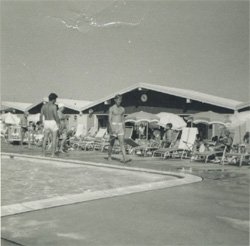
Then there’s another friend, John DeRobbio, who is spreading a lot of joy among all those leagues of old-timers who spent summers at Conners Hotel.
John had scooped up, after the historic hotel and pool were demolished to make room for Sea Streak and its parking lot, a whole bunch of ceramic tiles that had been around the pool.
Over time, John has fashioned these tiles into miniature crosses and made gifts to members of the Black family that made Conners such a wholesome, happy, wonderful place to spend summer days and nights.
Now all the recipients of those beautiful little crosses are feeling the smoothness of the tiles and remembering the saltwater splashing, sandy feet, hot-dog smearing and every other kind of liquid or material that cross over those tiles decades ago… A thoughtful gift from a thoughtful man who has more than a few Conners memories of his own.
And the wonderful Bernie Sweeney Way street name honoring a most generous man and his family in Atlantic Highlands made people happy for so many reasons.
But only few know about or probably even think about is how dedicated the members of the Atlantic Highlands council are. Almost all of them, the ones who were not there were out of town on business, were there for the ceremony and to greet Kathleen and Jay. All were in full support of the mayor’s idea to name the road after Bernie and all looked very happy about it at the ceremony.
But the Mayor herself deserves a few kudos, not only for the idea, but for the fact she was there for the dinner time celebration. Just an hour before, she had just come from the medical center where her mom had some minor eye surgery (as if any surgery to the eye or on an elderly person can be considered minor) and she was bringing her back home to adjust and recoup.
While this Mayor has also shown that Mom comes first, somehow she always still manages to ft in everything she has to do as the chief elected official of the town.
Maybe it’s time to look at the Oceanport Board of Education.
Is anyone interested in seeing if there are any stories behind their filing a petition with the state Commissioner of Education? That is the petition to try and thwart the six elected boards in three towns who want to provide a great education at a more logical financing manner. But these three towns want to ask the people in the towns whether it’s what they want.
And right there it seems like that’s the main difference between the three towns collectively..Sea Bright, Highlands, and Atlantic Highlands, and the Oceanport mayor and council and Board of Education.
The three towns want permission to let the people they represent have the final word on where education for their children is taught and how they’ll foot the bill for it.
Haven’t heard a thing from the Oceanport Mayor and Council, perhaps because education is the school board’s business. But don’t the rest of the elected officials care what happens in the education of their kids?
Don’t they ever see any need to ask questions or get information when it involves their towns’ people?
Maybe that’s the way things are done there. Because even the Board of Education hasn’t asked any questions, apparently hasn’t tried to talk to anyone in the other three towns, even so much as to pick up the phone and ask what’s going on or can you give us some information.
But they haven’t… Until recently.
No, Oceanport did not reach out to any of those towns, or their boards of education recently. Instead, they took the step to ignore any communication, compromise or understanding. Instead of communicating with neighbors, they went right to the state complaining about something they haven’t even talked to their neighbors about.
In short, Oceanport Board of Education spent money, apparently had an executive session and at least by majority decision, decided the smartest thing they should do is tell the Commissioner they have a pretty strong objection to letting the people in their neighboring towns exercise their rights to have a vote in their towns to hear what the people of their towns want.
Whew!
The Oceanport Board of Education seems more interested in taking away the right of others to vote than it has in what is best for both the student and the taxpayer. Ironically, that action is costing their own taxpayers money since they used their attorney to file the petition with the Commissioner.
It was enough to make me want to look deeper into some of the meetings, e-mails, actions, lack of actions and activities in the past few years to see whether this is Oceanport’s normal Plan of Action when something comes up that the board members don’t like.
And some of the things I found are amazing! There will be more information to come and more reasons to wonder how the Oceanport Board of Education conducts business.
In spite of JCP&L delaying the necessary electrical work to provide constant video coverage of the construction site, work is progressing on time at the site of the new borough Hall on Route 36, with concrete being poured this week in the first of several sections of retaining wall and exterior main wall of the front of the building.
Touring the site with Borough administrator Michael Muscillo, project manager Catlyn Munson and project supervisor Bill Gerapetritis of Kapp Construction, it was evident work is continuing on time as workers simultaneously completed duties in various sections of the site. This includes laying underground pipe for storm water flow, completing the first retaining walls on the Miller St. side of the property, and continuing to raise more frames to continue the wall both where it eventually will connect to the building as well as to continue to form the front portion of the building.
While workers were called from the site one day last week to complete another project, they worked all day Saturday to compensate for the missed day Gerapetritis explained. Nor has weather caused any serious problems to date, he said, noting that rain during the 28 days it takes to cure the concrete in the retaining wall, can act in creating an even stronger concrete.
The new facility, which will also include the police department, court officers, and temporary prison cells on the lower level, actually has the front door and primary entrance for visitors conducting municipal business on the Highland Avenue side of the building. The entrance faces the side of the Daino three story home on Miller Street as well as the back yards of residences on Highland Avenue. Other entrances, primarily for employee and police entrance and exit, will be located on the Valley Ave. And Miller St. sides of the building. Parking will be both in front of the building as well as along the rear of the building facing Navesink Avenue.
Muscillo, who has been making regular reports to the governing body on construction progress, lamented once again that the long-promised video of construction action he has been promising will be available on the borough website, is still in need of more electrical work before it can be activated. He expressed hope the electrical project for that purpose should be completed by next week. Similarly the trailer offices where the construction team meets and conducts business during the workday are also without any air conditioning until the power company completes its work.
Mayor Carolyn Broullon, who was also on site this week, noted while the main entrance of the building faces the Highland Avenue side and residential backyards, landscaping of the retaining wall at the borough property is included in the plans, and features tall perennial growth that will present an attractive view from borough hall as well as provide a layer of privacy and natural growth for the Highland Avenue residents.
Because of the proximity of the Miller St. house to the property line, Munson noted there is a vibration monitor installed in the residence to ensure any movement of the earth will be identified immediately before any possible damage could occur.
Gerapetritis, who is a former construction company owner, was hired by Kappa Construction earlier this month and showed and explained the drawings which laid out the dimensions and location of construction, as well as the entrances to the site. The state Department of Transportation has given approval to the borough for widening the present driveway on Route 36 to allow both ingress and egress from the highway as well as another entrance on Miller St. extending behind the building for parking there as well as on the Valley St. side.
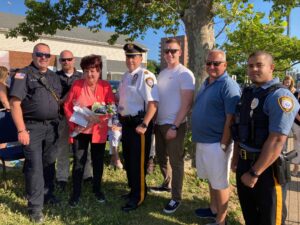
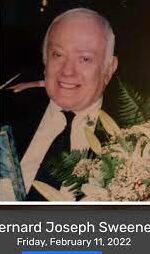
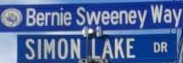
Naming Simon Lake Drive the new Bernie Sweeney Way was the borough’s birthday gift to the late owner of the Shore Casino at a festive ceremony Wednesday evening at the Municipal Yacht Harbor.
Dozens of local residents and friends turned out to see the public works department uncover the Bernie Sweeny Way sign on the late restaurateur’s birthday June 29, as well as to praise his widow, Kathleen, for all she has done for the borough and its residents.
Police Capt. Harry Murtha, a close friend of Sweeney, who died in February after a long illness, captivated the crowd with several “Sweeney” stories that conjured up good memories and lots of laughter among the crowd.
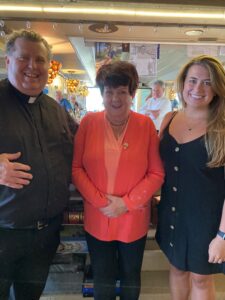
The Rev. Jarlath Quinn, pastor of Our Lady of Perpetual Help St Agnes Parish, where the Sweeneys are parishioners, also praised the borough leaders for following what Bernie did all his life, giving back to others. The priest noted Bernie would have been pleased that the borough sought to say thanks and to name the road for him so others will also always remember his many kindnesses to the borough.
It was Mayor Loretta Gluckstein who said shortly after Sweeney’s death that she thought the road to the Shore Casino should recognize how generous he has always been to all in need. The governing body unanimously agreed, and the borough introduced and pass the necessary ordinance to rename the road at its March and April meetings.
In introducing the program, and the governing body members in attendance. Gluckstein also said that “Bernie Sweeney is synonymous with Atlantic Highlands,” praising the philanthropic nature of the late Casino owner and his wife.
With Capt. Murtha, members of the police department in attendance at the event, presented Kathleen Sweeney with a bouquet of flowers in yet another gesture of how beloved the couple has always been to all who know them.
Also present for the ceremony were Harbor Manager Lou Fligor, members of the public works and fire departments, Sweeney’s friends, former Mayor Dick and Pat Stryker, who have known the Sweeneys more than half a century, and members of various departments and commissions as well as friends.
Following the ceremony , Shore Casino Manager Jay Strebb, Kathleen’s son, also spoke briefly, thanking the crowd for attending the ceremony and the mayor and council for the honor they paid, and invited all back to the Shore Casino for hot dogs in front of the entrance, explaining that not only was the original building on the site a hot dog stand, but it was also the late Sweeney’s favorite food. Guests were also invited into the Casino to enjoy more light refreshments as guests of the Sweeneys.
Parents in the Oceanport school district received a letter this week indicating the Board of Education is asking the state Commissioner of Education to invalidate the six resolutions approved by the three municipalities and three boards of education seeking to put a question of regionalization on their ballots in three separate municipalities.
In a move that has preceded any apparent attempts by the Oceanport school board to engage in in any communications with the three governing bodies and three boards of education, the unsigned letter, identifying the writer only as Oceanport Board of Education, said the Board had filed a petition the afternoon of June23 seeking an order to invalidate “the resolutions approved by the Borough of Sea Bright, the Borough of Highlands, the Borough of Atlantic Highlands, the Highlands Board of Education, the Atlantic Highlands Board of Education and the Henry Hudson Regional School District Board of Education.”
In a unified effort, each of these six official elected boards had all passed resolutions asking the Commissioner of Education to enable them to out the question on the ballot to create a K-12 regional school district to include Sea Bright, Highlands and Atlantic Highlands. Currently, Sea Bright children attend schools under the Oceanport Board, or the Shore Regional High School Board.
Each of the six bodies who passed the resolutions which have been forwarded to the Commissioner took the action after a new law was enacted in January which paved the way for smaller school districts to conduct studies and pursue actions to ensure academic excellence and economic advantages for taxpayers with a regional plan. Both the municipalities and the school boards sought professionals in the field to conduct studies and make recommendations on the economic and academic impact on both children and taxpayers. Both Henry Hudson Regional school district and Highlands and Atlantic Highlands held several workshops inviting the public to attend, learn about the recommendations, ask questions and make any recommendations. There was no one at any of these meetings or workshops who identified themselves as either professionals with, or members of either the Oceanport or Shore Regional boards of education.
In its letter, Oceanport Board of Education added “it is our opinion that the Borough of Sea Bright at this time is without legal authority to pursue the proposed regionalization and referendum in November of 2022 as a matter of law.” However, in the letter to the parents there was no indication whether the Oceanport Board of Education cited any law or precedence under current law it cited for its opinion.
The Oceanport Board of Education has not responded to a request for information.
Borough Administrator Robert Ferragina announced at last week’s meeting of the Mayor and Council that Bernie Sweeney Way along Simon Lake Drive will be officially signed and dedicated at a ceremony at 5:30 p.m. Wednesday, June 29.
The sign will be placed on the Simon Lake Drive sign at the end of First Avenue at at the harbor entrance near On the Deck Restaurant.
The governing body unanimously introduced the ordinance to honor the late Bernard Sweeny, owner with his wife, Kathleen, of the Shore Casino in the Harbor shortly after his death in February following an extended illness.
Mayor Loretta Gluckstein set the dedication date for June 29, which is Mr. Sweeney’s birthday.
Jay Strebb, general manager of the Casino owned by his mother, Kathleen announced that in honor of the occasion, the Shore Casino will be offering hot dogs in front of the Casino following the ceremony. “These were Bernie’s favorite food,” Strebb said, “ and at one time before he converted it to the grand Casino it is today, this building started out as a hot dog stand in the harbor, so it’s fitting we celebrate his birthday and this great occasion with hot dogs.” Light beverages will also be served, and Strebb said there will be other offerings within the Casino at the same time.
“I’m happy they are honoring Bernie with such a grand gesture,” said Kathleen Sweeney , his widow and owner of the Casino, “there is no doubt he loved the harbor and all the people he has met through this long alliance of more than 50 years. Jay and I feel so honored the Mayor and Council appreciate and love him so much that they have taken this step. We thank you all sincerely for friendship and the wonderful support Jay and I have had since Bernie’s death.”
If there is any one thing that stood out for me on a recent visit to the Twin Lights, it is there is always something new and exciting to learn at this museum high on the hill in Highlands.
Nick Wood, the state ranger and historian par excellence, and his team of three well trained volunteers, all give tours daily at the museum . It is well worth the $12 for an hour or so of sheer enjoyment, plenty of knowledge, and a new appreciation for lighthouse keepers, ship captains, the United States Life Saving Service and so much more.
The Museum does not charge anything for visiting and touring on your own, enjoying the magnificent view either from the front lawn or, with a small fee, from either or both of the towers. But the $12 tour also includes a trip up the towers along with an information and a fun-filled visit to the six galleries, two outbuildings, and of course a small gift shop that are all part of the Twin Lights.
Touring with Nick brings history alive. You can almost hear the recitation of the Pledge of Allegiance as you rub your hand over the foundation that once held that very large flag before which the first recitation of the pledge was said. In the Lifesaving station building, you learn the difference between the lifesaving station, the lifesaving service, and the Coast Guard. In the outbuilding housing the Fresnel lens, you learn so much more about its brilliance and how it came to be at the Twin Lights. That’s only the start.
The museum, both inside and out, is well designed with plenty of signs, photographs and videos that help explain all of the exhibits. But hearing Nick explain the little extras not captured in the written word, and to learn from the questions and his response to others in the tour group makes the trip ever so much better.
Nick tailors each of his tours to the will and whims of the group, be it two persons or a dozen or more. If there’s a huge interest in shipwrecks, he can expound on that. Or if it’s a technical group and wants to know more about the Marconi wireless message, or even the America’s Cup race, he can go into greater detail. I wouldn’t ask about ghosts or pirates ,though. Nick is a historian and likes to ensure every fascinating fact he gives has a strong foundation in research and documentation.
The historian has excelled in training his team of three other volunteers who give tours as well, each eager to share facts they themselves have learned during intensive training for the part time position.
Tours are $12 for adults, $2 for children, and are offered seven days a week between the museum’s open hours from 9 a.m. to 4 p.m. While there are usually tour guides available, it isn’t necessary to make a reservation; but if you want to ensure a specific day and time, I’d suggest calling 732-872-1814 and making a reservation.
If you are visiting and want to climb the towers and not opt for the tour, $5 enables you to climb one or both for those spectacular views, more history, and a chance to imagine how Fort Hancock looked when it was an active army base, how the merry-go-round turned at Sandlass’s Amusement park, and or how Highlands looked a century ago.
Any visit to the Twin Lights is a grand way to spend an afternoon regardless of weather. Even on rainy days, the galleries within the building are filled with so much information, so many fascinating exhibits, and so many stories about local people that make every Bayshore resident proud. The grounds are wonderful for picnics,
The museum and grounds are open seven days a week, the museum closes at 4 and the grounds at 4:30. Plan a visit of a hour or half a day, enjoy the outdoor seating and grounds, and learn about the important role lighthouses have played in the history of both New Jersey and the United States.
Jackie Caruso Larsen was too young herself to be a witness to anything about prohibition. But she still remembers the names and people she knew as a child who were part of that fascinating part of American history in Atlantic Highlands.
One of Jackie’s stories focuses on the boarders at her grandmother’s rooming house on the west side of the compound the family owned on Center Avenue. Jackie’s parents, Dominick Caruso and his wife, the former Mae McAllister, lived in the bungalow on the east side, their first home after getting married. This gave her mom a bird’s eyes of the comings and goings of her next door neighbors, Jackie said. And she continues the story.
“And come and go they did. From what I was told the men met for dinner in Grandma’s enormous kitchen, ate, made their plans for the evening, played cards and then headed for bed.
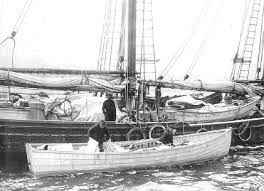
Sometime in the wee hours of the morning, dressed in boots and rain gear, they took off. It’s rumored that they went down to the bay, rowed out to a large boat and unloaded crates of Canadian whiskey.
Around daybreak they returned. This went on several nights a week. The year was probably 1929.
Then I’m told one night was different.
There was a lot of commotion in the early morning hours. Jack Rungayne, a Russian immigrant, had his leg smashed between two of the boats. The other boarders, Nick Perfetto, Joe Sceina, Tony the shoemaker and my uncle Lou carried the injured man to his bed. No doctor was summoned because of the secret nature of the injury, but the man managed to survive.
Soon after this, Mom and Dad moved to their own house on Avenue D. By then, Rum running was near its end. But I do remember hearing of other another related incident.
The man living across the street was involved in hijacking trucks. One day his victim surprised him with a gun and chased our neighbor all the way down Avenue D. They couldn’t quite make it to his house so he dashed into Mamie Mardorf’s house, ran up the stairs and hid under her bed. Apparently Mamie possessed great powers of persuasion and got the man to leave.
Years later, I remember sitting at my Grandma’s table with these very men, the boarders. They must have liked the food and lodging! Nick was always joking, Tony never spoke, Jack with his horrible limp frightened me and Joe, also a barber, played the trombone right in that very kitchen!
One such occasion was Uncle Joe’s return from World War II where he served in the Navy on a mine sweeper. There was a huge party and the whole neighborhood showed up. There was food, drink, dancing, singing, and of course, card playing.”



 The Rev. Jarlath Quinn, pastor of Our Lady of Perpetual Help St Agnes Parish, where the Sweeneys are parishioners, also praised the borough leaders for following what Bernie did all his life, giving back to others. The priest noted Bernie would have been pleased that the borough sought to say thanks and to name the road for him so others will also always remember his many kindnesses to the borough.