Atlantic Highlands Councilman James Murphy is not seeking re-election to borough council in November, with Ellen O’Dwyer Woods stepping in to run for one of the two seats on Council for the Republicans.
Former Councilman Brian Boms is seeking the second seat for the two three-year terms to be decided at the polls.
According to the records filed at deadline with the Monmouth County Board of Elections, Murphy is not listed as a candidate. He is apparently not seeking another term when his current term expires January 1, 2025.
The two Republicans will face incumbent Council President Brian Dougherty and newcomer Jose Pujals in November, with Democrats maintaining control regardless of the results. Currently, Murphy is the only Republican on the governing body.
Borough voters will have contests for the school board election for three of the four seats to be determined for the new Henry Hudson Regional Board which will take over from the interim board appointed this year. The nine-member board to be determined in November will be the first board elected for the new Prek-12 regional school district. Four of the new board seats will be Atlantic Highlands residents, the other five will be decided by Highlands residents.
There were only two candidates who filed for the two three-year terms on the regional board, so incumbent and current board president Cory Wingerter and Claire Kozic will most likely be elected to those full terms.
Noreen Higgins, Bonnie Knechtel and Justin Thomas have filled for the one two-year seat on the board, and Allison Jacobs, Chelsea Witkowski and Richard Colangelo have filed for the single one-year term. This means voters will have choices for the single one year and single two-year seats to be decided.
Voters will have the opportunity to give their opinion on whether they would approve a two-cent increase per $100 assessed valuation in their tax rate to provide funds for open space.
Unlike Highlands voters, however, Atlantic Highlands voters will not have the opportunity to give their opinion on whether Sea Bright should be included in the regional school district. Mayor Lori Hohenleitner had said that question would be ‘frivolous’ in indicating she did not approve it being placed on the ballot.
Residents of the Care One at Middletown Care Center have been entering the Monmouth County Arts and Crafts Fair for more than ten years and every year come home with several prizes.
This year was no different when the summer fair was held in Freehold, and residents worked both individually and in groups to garner award winning ribbons in several categories.
Two residents, Sandra and Jean also had entries in the Middlesex County Fair at the same time and came home with awards for second and fourth place.
All the residents at Care One celebrated the awards to their artists at an in-house fair activity complete with cotton candy and popcorn so all residents could enjoy a display of the artwork that gained County-wide attention.
Many of the artwork pieces remain on display at the care center, located on Route 36, Middletown, between Highlands and Atlantic Highlands
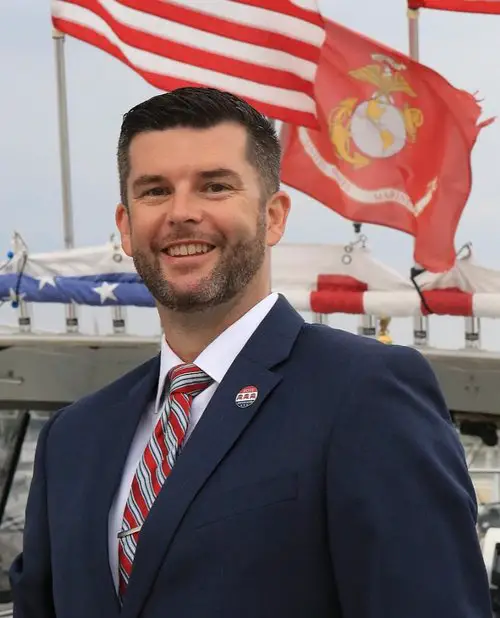
Middletown Mayor Tony Perry is doing one terrific job of reminding residents of the area how important Middletown and Monmouth County have always been in the history of the nation.
He’s also been pretty terrific in combining that history with all the modern events that are continuing to make this area so important in the United States.
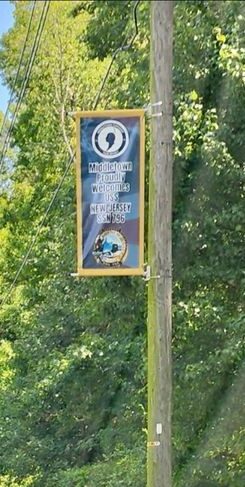
All those proud banners the township’s Public Works department is hanging along Route 36 are a reminder that the nation’s third naval vessel named for the Garden State will be commissioned right here at the Leonardo pier next month.
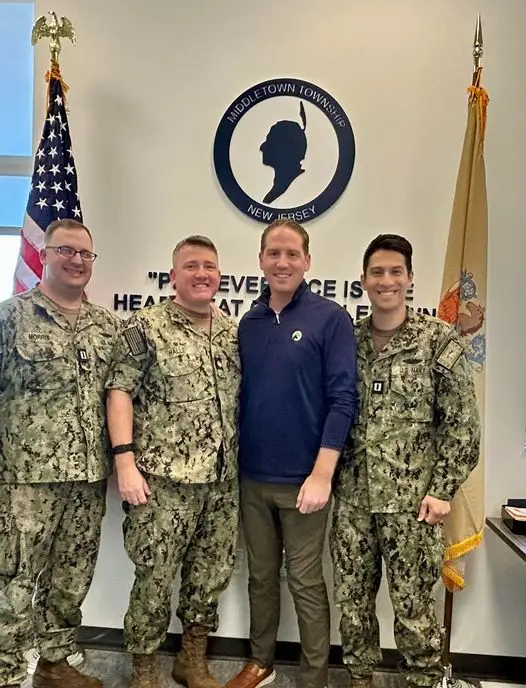
It’s also another sign to Captain Steve Halle, the commanding officer of the nation’s newest submarine, that the Navy is truly welcome in Middletown. Captain Halle was honored at a recent Township Committee meeting when he came to visit the pier.
Mayor Perry noted that the banners going along the highway for the New Jersey (SSN-796) will showcase the patriotism and pride this township has for the military and every veteran who has ever served in any of the wars or is still active duty today.
He showed that same pride and patriotism once again this month when the Daughters of the American Revolution were celebrating the 200th anniversary of Marquis de Lafayette’s visit to America 200 years ago.
Lafayette was a young Frenchman who certainly aided the USA in the Revolution and helped us form a new nation; his tour around the country really did begin right here in Middletown.
But the mayor shows pride in history even before we became the United States as well, as is evidenced by his talk at Stories around the Campfire and learning more about native Americans, recalling the Lenni Lenape were the earliest settlers in and around the Bayshore.
Nor is Captain Halle the only nationally known personality who just visited Middletown. Speaker of the House Mike Johnson was also the Mayor’s guest at a township meeting, and our own former State Senator Joe Kyrillos was right there with him.
Yet with all the pride and activity for the past, Mayor Perry keeps in mind all the folks who are keeping Middletown such a great township today.
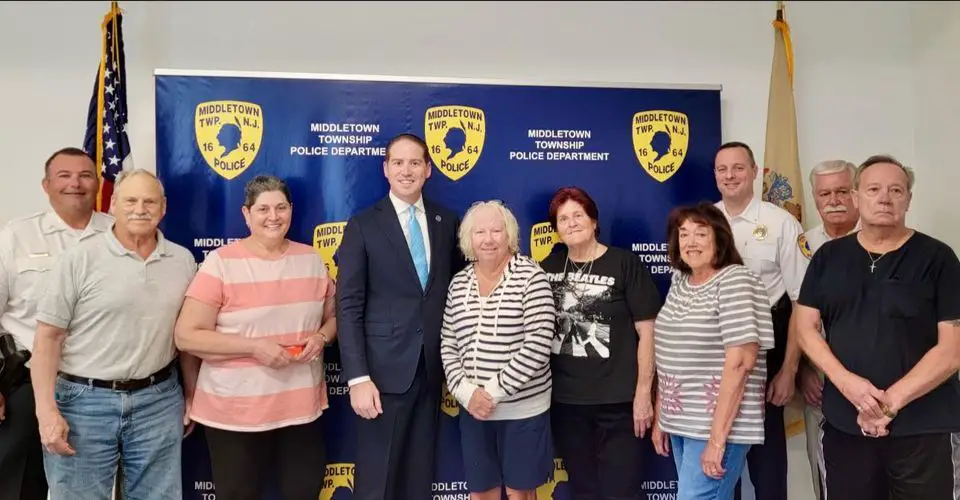
What a great idea to honor all those school crossing guards before they get out on those street corners every morning and afternoon during the school year to ensure safety for all our kids. Congratulations also to Cheryl Amodio Wilson whom he honored for being on the job for 30 years. Cheryl is a popular and beloved figure in the Navesink school area and loves all those kids as much as they love and appreciate her.
Mayor Tony Perry Mayor Tony Perry Mayor Tony Perry Mayor Tony Perry
The Knights of Columbus are inviting sponsors to sign up to celebrate the 4th annual Oktoberfest & comedy night set for Saturday, October 12, and offering the highly requested comedian, German Oktoberfest menu and music that has marked the event for the last three years.
Not only that, said an enthusiastic chairman of the event, Mike Napolitano, the prices will remain at the same $40 per person of the past, with a special discount for children 12 years of age and younger.
Tickets for the event, which always draws a full house crowd, are available online, and sponsors are invited to be recognized for supporting the fund raising event that enables the Knights of Columbus to continue its many philanthropic efforts in the Bayshore and in the Our Lady of Perpetual Hep St. Agnes parish.
The expanded menu for this year’s Oktoberfest will include Belford Brewing Company providing a special Oktoberfest Craft Beer Tasting of the Top 3 Oktoberfest brews, Black Forest Bratwurst Company providing their local artisan-made gourmet German provisions including knockwurst, bratwurst and smoked Pork Chops, and Bahrs Landing providing its highly popular Pea Soup as well as its German Potato Salad, both made with recipes that have been in the Bahrs family for the century the restaurant has been a part of Highlands.
Napolitano also said the Knights of Columbus will once again include a free ticket for a drawing on a flat screen tv with every admission ticket purchased.
Sponsorships, tickets, and reservations can be made now at
The Henry Hudson Regional Board of Education is holding a special meeting Wednesday, September 4 to get legal advice on pending litigation.
Although the original legal notice of the meeting indicated it was a meeting of the Boards of Education, and a roll call vote would be taken for each board, school administrator Janet Sherlock confirmed that these were typographical errors which have since been corrected.
She confirmed this is a meeting of the current board and its professionals and no one else will be present at the executive meeting. The new Board of Education will assume office in January after nine members are selected in the November election.
Matters to be discussed in closed session, with no action being taken that evening, include the litigation brought by Highlands Council president Jo-Anne Olszewski against the Highlands and Atlantic Highlands boards of education, as well as the Henry Hudson Regional Board. The council president’s action was taken before the two elementary school boards were dissolved and the Henry Hudson board expanded.
Also being discussed in executive session is a matter involving Dr. Secil Onat, assistant Commissioner of the New Jersey Board of Education Division of Finance and Henry Hudson, in a matter apparently brought by Henry Hudson. Since it is a matter of litigation, the administration could not address the matter.
The board’s third legal matter to be discussed with counsel is the amended petition filed with the state Commissioner by the boroughs of Sea Bright and Highlands.
The meeting will be held at 6 p.m. in the gym at Henry Hudson School and no action will be taken
On August 26 at approximately 3:06am, Middletown Township Police responded to Motorcycle Mall of Monmouth, located at 656 State Route 35 on a report of a burglary in progress. Upon arrival of the officers, two subjects were taken into custody as they were standing beside one of their vehicles. A third subject was apprehended after a short foot pursuit.
Police investigation revealed that the subjects were using two stolen work vans to facilitate their attempt to steal the motorcycles. Inside the vans, police observed five stolen motorcycles and one ATV that had been removed from the business with a total value of $56,000.
Arrested on scene was Joshua Hueston, 28, of Union City. He was charged with burglary, theft, criminal mischief, burglary tools, two counts of receiving stolen property, and conspiracy to commit burglary. Also arrested was Ronald Terry, 33,of Newark and charged with burglary, theft, criminal mischief, burglary tools, two counts of receiving stolen property, and conspiracy to commit burglary.
Luis Ruben Cuevas, 30, of Brooklyn, NY, was charged with burglary, theft, criminal mischief, burglary tools, two counts of receiving stolen property, and conspiracy to commit burglary, and obstruction. All three were processed and lodged in the Monmouth County Correctional Institution pending a retention hearing in the Monmouth County Superior Court.
Chief of Police R. Craig Weber stated, “I would like to commend the great police work and the professionalism of all the officers who responded to this crime in progress and assisted in the follow-up investigation.”
Anyone who may have witnessed or has information about the incident is asked to contact Detective First Class Keith Hirschbein at (732) 615-2120.
Any persons arrested or charged with offenses are presumed innocent until proven guilty in a court of law. Additionally, except in specific circumstances, arrest and complaint information and names of those charged may be released.
Saint Michael A prayer once popular at the end of every mass is being restored for all masses, at church liturgies in the Our Lady of Perpetual Help St Agnes parish.
In Sunday’s weekly bulletin distributed at all the masses in both Catholic Churches in Highlands and Atlantic Highlands, the pastor, Father Jarlath Quinn, gave a brief history of the Prayer to Saint Michael the Archangel and announced that he will reinstitute the practice of adding that prayer to the end of every mass beginning Sunday, September 1.
The Angel has been revealed and honored both by Jewish and Christian believers since the early 300s where the Old Testament refers to him in the Book of David; he is also described as one of the seven archangels in the book of Enoch. In Revelations in the New Testament, it is written Michael casts Satan out of heaven. He has been described as the Leader of the Army of God and is regarded as a guardian of the church. He was revered by military knights during the Middle Ages.
Father Quinn noted that the prayer which has been said in the Church for centuries was composed by Pope Leo XIII in 1886 at a time of disturbance in the church that involved the takeover of the Papal States by the Italian government. Pope Leo added the prayer to mass, and it was said regularly until 1965. At that point, a reform in the liturgy of the mass after the Second Vatican Council called for it to be excluded.
Father Quinn said that in October 2018, amid scandals and disunity in the Church, Pope Francis began reciting the prayer in the Vatican, invoking the powerful intercession of the Archangel.
The Pope further suggested that the prayer be once again included in church liturgies and many parishes have already followed Pope Francis’ example. In OLPH-St. Agnes, the prayer has been said frequently at many of the masses at the conclusion of the mass, and Father indicated Sunday it will now be a regular prayer at every mass.
The prayer to St. Michael the Archangel,
Saint Michael the Archangel, defend us in battle.
Be our protection against the wickedness and snares of the Devil.
May God rebuke him, we humbly pray, and do thou, O Prince of the heavenly hosts,
by the power of God, cast into hell Satan, and all the evil spirits who prowl about the world seeking the ruin of souls. Amen.
Saint Michael Saint Michael Saint Michael Saint Michael
Next time you’re at the Farmer’s Market, pick up a bunch of radishes. They’re cheap, you usually get about a dozen in a bunch, there are not a lot of recipes for them in cooking, and some can be fairly pungent.
But they’re fun! And colorful in salads. Since they are really about 95 per cent water, they aren’t filled with all the vitamins and minerals that are so great for eye and heart health. But they aren’t bad for you either, have practically no calories and, like all vegetables, no fat.
And if you’re not a gardener but want to grow your own veggies, it’s the perfect one with which to start. In fact, in the northeast, you could probably plant some seeds now and get a bunch before cooler weather sets in, they grow so fast. Which makes them perfect for youngsters who want to start their own gardens. It doesn’t take a lot of patience to wait to see the plants pop up from the earth.
Actually the radish is a flowering plant in the mustard family. It’s called a root vegetable because that’s what the colorful part is, the root, the only part of the plant most folks think is edible.
But even the green leafy plant is great washed well, chopped and placed in salads. There’s no waste in a radish!
In salads, radishes are the raw, crunchy vegetable with a pungent, spicy flavor, varying in intensity depending on its growing environment. They come in all sizes, flavors, color, and length of time it takes to grow and mature. That’s because of the various chemical compounds produced by the plants.
While it’s growing, the radish is helpful to most of its neighbors. Because of that pungency, there are few pests or illnesses that actually like to hang around them. So they’re often planted next to vegetables or fruits that are frequently attacked, their sharpness keeping the bad things away from their neighbors as well. Cucumbers and tomatoes love to have them as growing neighbors, as do lettuce and peas and even the herb chervil.
Radishes have been around a long time, but don’t have much history. Today, they are grown around the world, but there are few archeological records to let us know where they started out life or when. We do know both Greek and Roman writers talked about them in the first century. As far as North America, radishes probably came over here along with the first Europeans seeking new land. There have been stories by other ancients that they are a great medicine, or a poison, or even a vegetable cooked with ostrich meat. But they are more fables than proven facts.
What is true is that they’re easy to grow from seed, are annual, germinate in three or four days and mature in three to four weeks, They like full sun and sandy soils, and once harvested, they last several days in room temperature, or a couple of months refrigerated.
As far as their leaves go, try them in salads! They add a different kind of flavor that’s hard to identify but your taste buds know something special has been added. Add them to soups, or saute them and serve as a side dish, or simply use them as a garnish.
Justin Thomas, a native and resident of Atlantic Highlands for more than 30 years, is seeking a two-year term as an Atlantic Highlands resident on the Henry Hudson Board of Education in the November election. The candidate cited a number of reasons why he is seeking office to serve in the district where he received his elementary and high school education.
Single and the business analyst and business relationship manager for Wakefern Food Corporation in its Tech-Supply Chain division, Thomas has never run for any office in the past, but feels it is vital now.
The candidate has been involved with the Boy Scouts with Troop 22 in the borough, as well as the Jersey Shore Running Club. He held a number of leadership positions and was involved with a variety of clubs will attending Rutgers University where he earned several degrees.
A resident of Atlantic Highlands all his life, Thomas graduated from both Atlantic Highlands and Henry Hudsonschools before going to Rutgers University where he earned two bachelor’s degrees as well as a master’s degree.
As a lifelong resident and graduate of the local system, Thomas said he is running because “I would like to be involved with creating opportunities and advantages for the student body of our communities.” Through his own experience he is aware of the great experiences and opportunities that Henry Hudson provides to its students and the community.
He is also aware that since it is a small school district, the educational system lacks exposure to particular curriculum and programs. A small district also means fewer allocated resources, he believes. However, he is quick to add, citing his own educational background and degrees earned based on his education here, “Henry Hudson did prepare me to succeed in different avenues inside and outside of the classroom.”
Because of the advantages of a larger school district, Thomas believes Sea Bright should be included in the regional district for education. An increased student body population consolidating the municipalities means more taxpayer money towards Henry Hudson Schools from an additional source will allow the board and community to vote on enhancing education in the areas they see fit.
Looking towards the future, Thomas believes his education, experience and ideas can bring different values and perspectives to the Board that can accommodate the needs of all parties involved. As a native of the borough, he feels his familiarity with the school systems, communities, history, organizations, businesses, and in general, the entirety of the local area, will enable him to consider many aspects of education and its impact on the community, both in taking pride in its educational system as well as its impact on the local budget.
“As a lifelong learner I’m always continuing to educate myself with certifications, classes, training courses, and much more,” Thomas said, adding he is beginning a Mini MBA Course next month in “Digital Supply Chain Management”.
“The labor market is always continuing to shift and change. I’ve worked in Higher Education, Manual Labor Job Occupations, Information Technology, Sports, and for the boro of Atlantic Highlands,” he explained, when asked about his educational experience.
He is also looking forward as a board member to locating opportunities the board can use to provide students and the community with greater access to information and contributions towards what could be done more efficiently.
To be a successful Board of Education member, Thomas believes the elected personnel must serve as a liaison between the school system and the community. As a Business Relationship Manager whose daily responsibilities support the IT Tech Division and as an advocate for Wakefern’s business divisions throughout the supply chain for Wakefern, recognized as for one of the largest Food Retailers in the United States and the Northeast, he is not only eager but also capable and experienced in order to take on the position as a board of education member.
Directing attention to actions, duties and responsibilities of board members, Thomas believes the most critical responsibilities are developing an annual Budget to enable the education system to be highly effective, operate and establish school policies and regulations, and evaluate the superintendent. Other key roles and responsibilities are managing district policies, approving the school district’s budget, advocating for public education, clarifying district purpose and establishing goals, facilitating School Board Authority, evaluating Instruction and education, establishing goals and evaluating outcomes, managing community relations, providing support, mitigating risk and negligence, as well as reviewing school policies, school structures and appointing leadership. In short, the candidate believes he has an obligation as a board member to be a liaison, representative and advocate for the school system and community.
Atlantic Highlands voters have the opportunity to elect four members to the board, and of those, one is for a two year term on the board. That is the seat Thomas is seeking and will be opposed by two other Atlantic Highlands residents for the position, Noreen A. Higgins, and Bonnie Knechtel.
Native Son Native Son Native Son Native Son Native Son Native Son Native Son Native Son
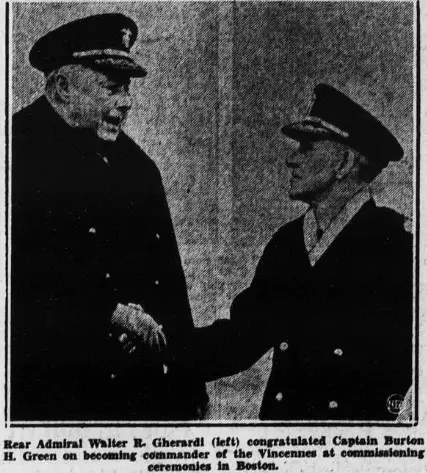
When Captain Burton H. Green came aboard Naval Ammunition Depot Earle in October 1943, he brought with him a distinguished reputation as a Naval leader in other areas before assuming the position as the first commanding officer of the newly constructed ammunition depot whose property spanned from Leonardo in Middletown to Colts Neck.
A graduate of the Class of 1905 from the Naval Academy at Annapolis, Green was a classmate of many other distinguished leaders, among them Admiral Chester Nimitz, the Navy’s leading authority on submarines during World War I.
Captain Green had been in and around the new depot before assuming command. He took up a temporary headquarters in Red Bank during the construction and watched the development of early planning.
Prior to coming to New Jersey, the Wisconsin-born naval officer served on the USS Tacoma, in Cuban waters during the 1907 uprising; served in China during the Manchu uprising that saw the overthrow of the Qing dynasty and created a republic, and commanded the USS Bainbridge, as well as the USS Decatur. He also had command of a division of destroyers, including the USS Tallahassee, the USS Milwaukee, the USS Lamson and the USS Toanoah. He was the Executive officer aboard the Battleship Michigan during World War I and was promoted to Captain in 1928.
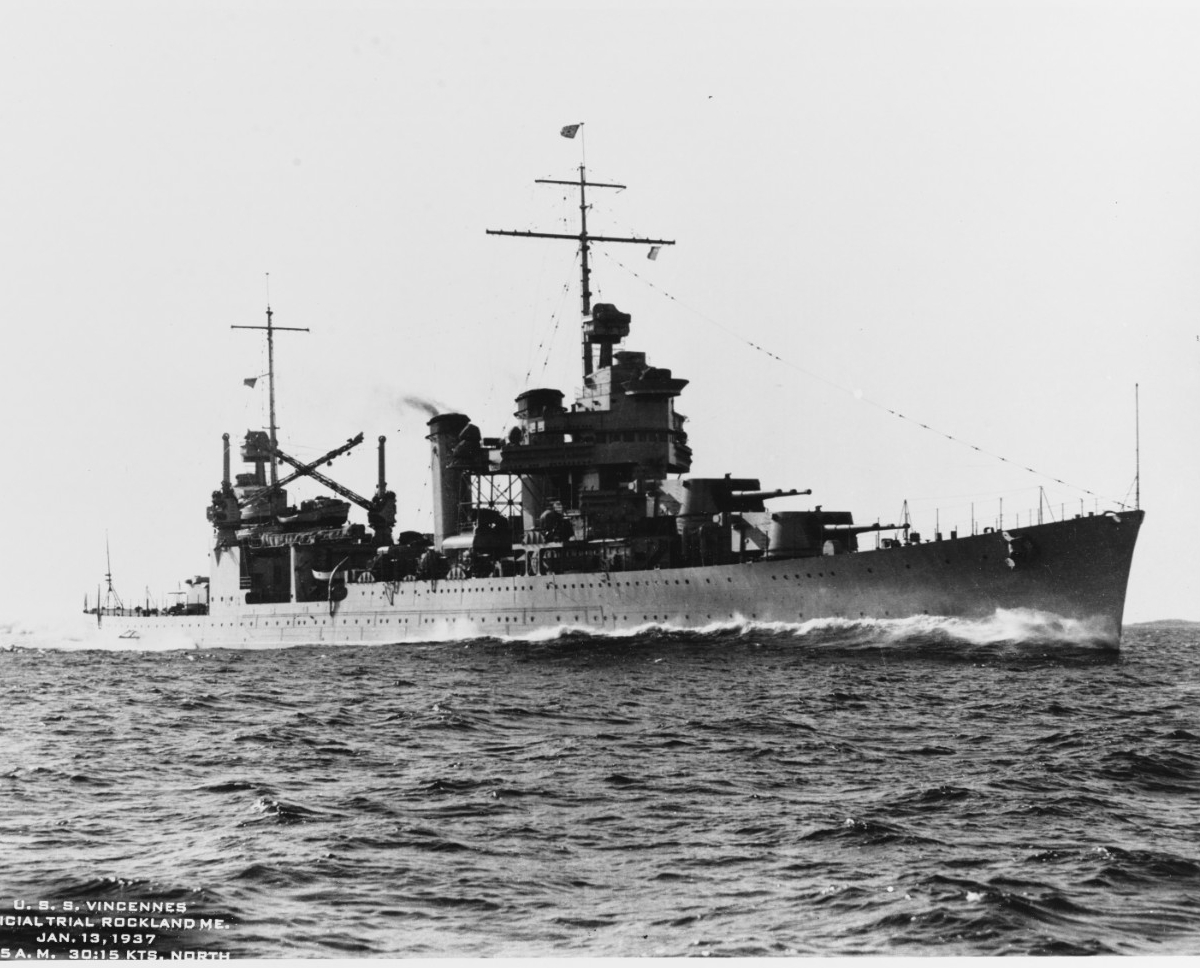
His last sea duty was as commanding officer of the USS Vincennes when the ship was commissioned in 1937.
Beginning land duty Captain Green was stationed in the Canal Zone where he was commanding office of Naval Ammunition Depot Balboa.
While the Captain retired in 1940 after 35 years in active-duty service, he was recalled the following year six months before Pearl Harbor brought the United States into World War II. He came to Monmouth County when plans for NAD Earle were underway, and he and his family lived in Rumson during the planning stages at Leonardo and Colts Neck.
In official reports filed about Captain Green, his contemporaries described him as a remarkable man continually on the job. “He considered his chief work to be getting the ammunition loaded, and with all his might and main, with insufficient funds, with inadequate tools, with far too few personnel, he struggled.” Sailors said his motto was “Our primary purpose is to furnish ammunition to the fleet; all else is secondary.” A motto that became the tradition of the depot.
Described as short, slim and wiry, Captain Green was a pipe smoker who was quiet and pleasant when his men were doing their jobs adequately, a vision of “most sudden and picturesque profanity at any who displayed ether ignorance, bard judgment or bad faith.”
By November of 1944, 403 Navy combat ships were serviced at NAD Earle in temporary storage, initial outfitting, or replenishing ammunition.
Captain Green is credited with leadership and vision that enabled him to see through the mud and muck, ice and sleet as well as disappointments and round-the-clock efforts to convert swamp and forest into an ammunition depot built during the world’s most awful war. Yet he claimed no credit for himself, hid his past accomplishments and continued to lead until he eventually relinquished his leadership of the nation’s newest and most formidable depot to Captain Hoover on March 15, 1945.
NAD Earle in Monmouth County, New Jersey, was doing its share in defending America during World War II.
Captain Burton H Green Captain Burton H Green Captain Burton H Green Captain Burton H Green Captain Burton H Green Captain Burton H Green