Among the most meaningful sites to visit in Harrisburg, the capital of Pennsylvania, is just outside the main streets of the city, Reservoir Park.
While the magnificent Capitol building and all the state offices in a majestic and stately complex that also includes a state museum are the highlights in the city itself, a short drive outside the downtown area is Reservoir Park, the oldest and largest park in the state capital and 85 acres of natural beauty at the highest point of the city.
Dating back to 1845, It contains an underground 30 million gallon reservoir and two six million gallon above ground reservoirs that feed freshwater, gravity style, to the city’s water system. When built, it was known as Prospect Hill, now Allison Hill and known as one of the best vantage sites to see the Capitol complex, Susquehanna Valley and even the Blue Ridge Mountains. The park is popular to locals for all its outdoor festivals and performances in season and is known as a main part of the Capital Area Greenbelt, the 20-mile greenway that surrounds a good portion of the city.
But for visitors, more important and memorable is at the very top of the Park where the National Civil War Museum is located.
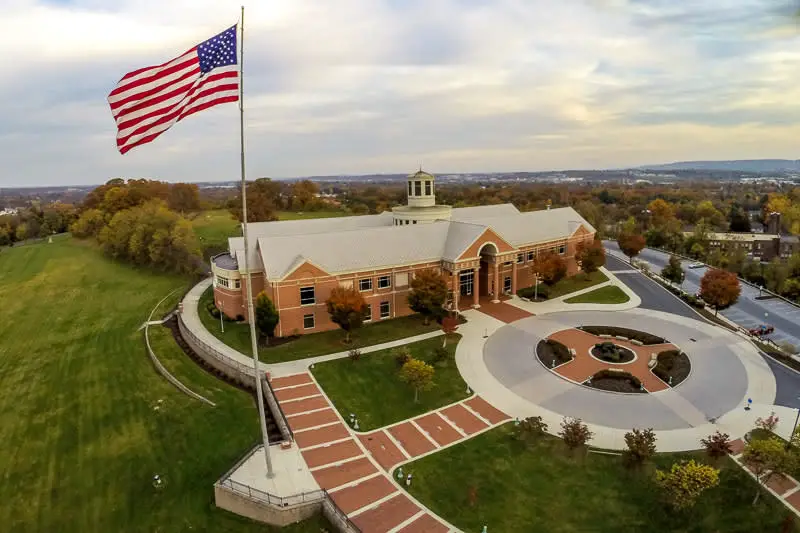
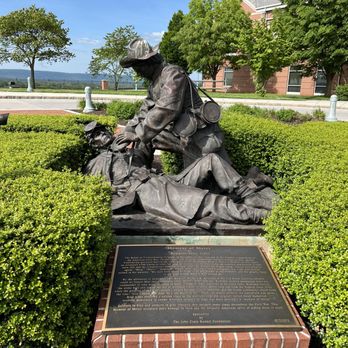
Just the statue in front of the multi-story building that tells the horrors and pain of the Civil War is a story in itself. It’s a story you can’t forget, yet we as 21st century people continue to fight wars in efforts to secure peace.
The Moment of Mercy is a sculpture by Terry Jones and depicts the outcome of the Civil War Battle of Fredericksburg, Virginia in December, 1862, three years before the war ended.
It was one of the bloodiest battles of the war, at least until that time, as 3000 Confederates fought from behind stone walls resisting Yankee assaults, and another 2,000 or so troops were up on the hill. After five hours of terrible combat, there were 6300 Union soldiers spread across the battlefield, either dead or wounded. Night came, along with a snowfall, battling soldiers refrained from killing during the night and temperatures dropped to close to zero degrees.
By the next morning, conditions were no better, and Yankee soldiers who had been crying out in agony, screaming for help from their wounds, or simply water to quench their fevered mouths continued, with no help in sight.
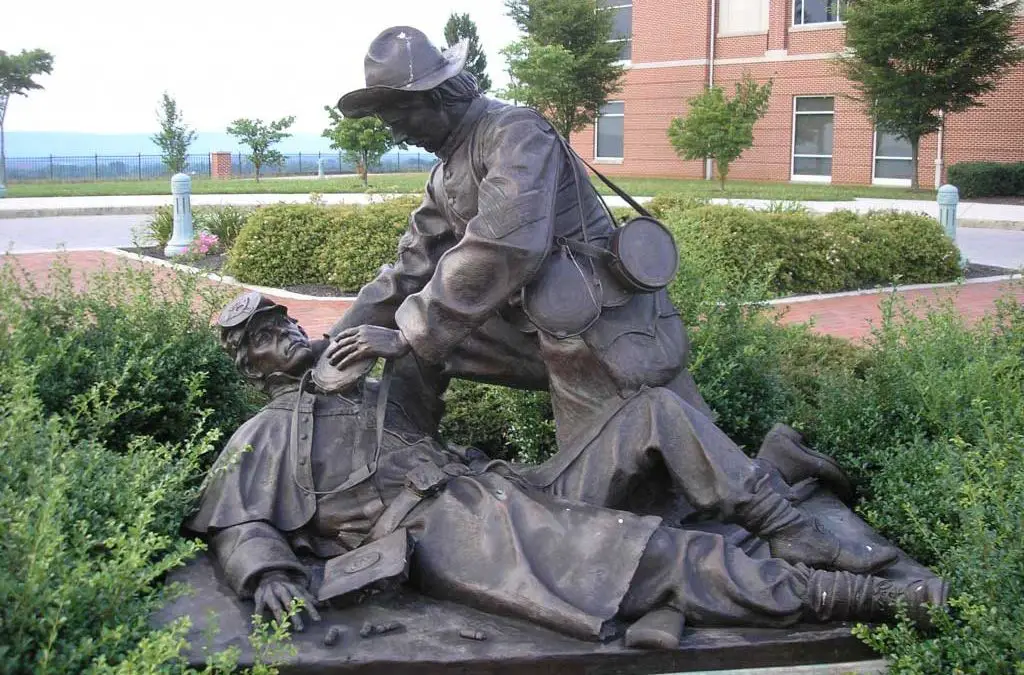
A 19-year old Confederate soldier, Sgt. Richard R., Kirkland from the 2nd South Carolina Infantry could stand it no more. By noon, he decided he had to do something to quell his own anguish and appealed to his commander to let him take water and supplies to the injured the troops had spent the previous day battling. His captain agreed, and Kirkland gathered as many canteens as he could carry, climbed over the stone wall that had been protecting the Confederates and headed for the fallen Yankees.
Seeing an enemy soldier coming into their midst, federal troops its began shooting at Kirkland. Until the Union commander recognized what was happening. He sent out the order to his Union forces: ““Don’t shoot that man, he’s too brave to die. “
For the next 90 minutes, the battlefield was quiet as Kirkland went from fallen solder to fallen soldier giving them all he could….sips of water, blankets when he could and a comforting hand. It was truly a Moment of Mercy.
Soldiers from both armies continued to do this throughout the war, at first fighting for what both they and their governments felt was right, then recognizing the anguish it involved as individuals, and doing what they themselves felt would bring comfort, even to the enemy.
Sgt. Kirkland, who had already seen battle at numerous other sites before Fredericksburg, went on to fight in the battles of Chancellorsville and Gettysburg and continued to distinguish himself for his courage. After being promoted to lieutenant, he and two other men took command of a charge during the Battle of Chickamauga, and in attempting to move his unit forward, was shot. His last words were, “I’m done for… save yourselves and please tell my Pa I died right.”
His body was returned home to Kershaw County, South Carolina, and he now lies in the Old Quaker Cemetery in Camden, the burial place of General Joseph Kershaw, General John Bordenave Villepigue, and two World War I Medal of Honor recipients,John Canty Villepigue,and Richmond Hobson Hilton. The Sons of Confederate Veterans posthumously awarded Kirkland the Confederate Medal of Honor, which was created in 1977.
The sculptor of the statue in front of the Civil War Museum, Terry Jones, has been a sculptor since the mid-1960s, studied at the Hussian School of Art in Philadelphia and the Ecole des Beaux Arts in Paris, France. He sculpted more than 600 bas-relief coins and medals for various private mints and was one of few American artists to be invited to show at the International Exhibit of Medallic Art in Florence, Italy. In 1984 the American Numismatic Association named him Medallic Sculptor of the year. He also sculpted the Vince Lombardi Super Bowl coin-toss commemorative and portraits of Gov. Tom Ridge and Lt. Gov. Mark Schweiker for the 1999 PA Inaugural Medal.
You can also Find ViniVidiScripto on the Following Platforms …
Reservoir Reservoir Reservoir Reservoir Reservoir