A History of the American Lighthouse
By Eric Jay Dolin
Liveright Publishing Co. 2016
By all means, go to the library and read this history of the American lighthouse while waiting for Dolin’s newest book, The Wreck of the Mentor, scheduled to be released June 2. It will give you an idea on how this author can present history so factually, accurate, and easily understandable in a style that is both fascinating and difficult to put down.
Dolin is a master of Research and equally masterful in presentation. His Brilliant Beacons does indeed tell the story of American lighthouses from colonial times through the invention of the Fresnel lens and the struggles it took to have it replace inferior lighting, as well as the impact on lighthouses and on the Civil War itself. But he does not tell these stories without laying the foundation for lighthouses along the river and ocean waterways a couple of thousands of years ago in Greece, when a statue of Zeus with fires burning on high alerted seamen to the reefs in the area of Alexandria.
There are chapters devoted to the long history of the Revolution and how both sides used attacks on lighthouses to gain control of lands either by providing light to avoid underwater dangers or dousing lights to prevent the enemy from seeing those dangers. Similarly, during the Civil War, Dolin explains in great detail how both the North and the South sought control of the Southern lighthouses with specific details primarily about the Cape Hatteras light, seen as covering the most dangerous piece of coast in the nation at the time.
Fascinating, however, are the chapters of the Fresnel lens, and the struggles brothers George and Edmund Blount had in trying to convince the United States Lighthouse authorities of how much more efficient and economical were the works of Leonor Fresnel over the inferior brightness or distance seen by American varieties. That, coupled with the inferiority of the government’s shabby control and lack of inspections of lighthouses had the United States lagging far behind Europe when it came to sea safety and protection of lands and seamen by the sea.
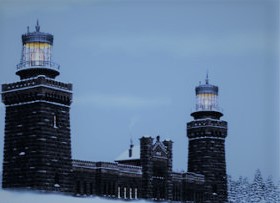
For readers in the Bayshore, the stories on the Sandy Hook Light as well as the Twin Lights are captivating. The Highlands twin towers were the site the Fresnel Lens where installed for the first time in America in the original twin towers on the hill in the 1840s. They became a part of history 20 years later again as the second lights were installed in the second Twin Lights built in 1862 . Dolin explains how the Twin Lights gained its place in history not only for being the test site for the first Fresnel lens in the country but also for being the first lighthouse powered by electricity.
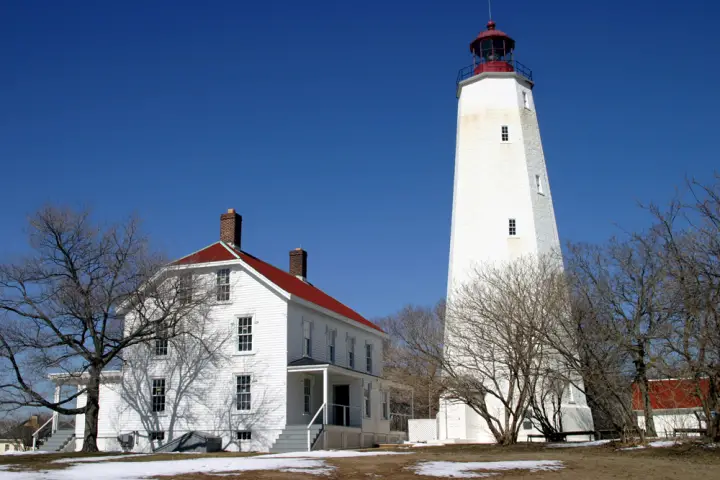
There are chapters on the heroes of lighthouses, and there have been many, as well as women who have been keepers, including Kate Walker who manned the lights at Sandy Hook with her husband before taking over for him when he died at Robbins Reed lighthouse in New York.
Each chapter is riveting; each chapter is deep in research and bright in presentation. It is a piece of American history that should be part of everyone’s knowledge. Seeing it from Dolin’s writing simply makes it awesome.
Beacons Beacons Beacons Beacons Beacons Beacons



There are chapters on the heroes of lighthouses, and there have been many, as well as women who have been keepers, including Kate Walker who manned the lights at Sandy Hook with her husband before taking over for him when he died at Robbins Reed lighthouse in New York. Each chapter is riveting; each chapter is deep in research and bright in presentation. It is a piece of American history that should be part of everyone’s knowledge. Seeing it from Dolin’s writing simply makes it awesome.There are chapters on the heroes of lighthouses, and there have been many, as well as women who have been keepers, including Kate Walker who manned the lights at Sandy Hook with her husband before taking over for him when he died at Robbins Reed lighthouse in New York. Each chapter is riveting; each chapter is deep in research and bright in presentation. It is a piece of American history that should be part of everyone’s knowledge. Seeing it from Dolin’s writing simply makes it awesome.

