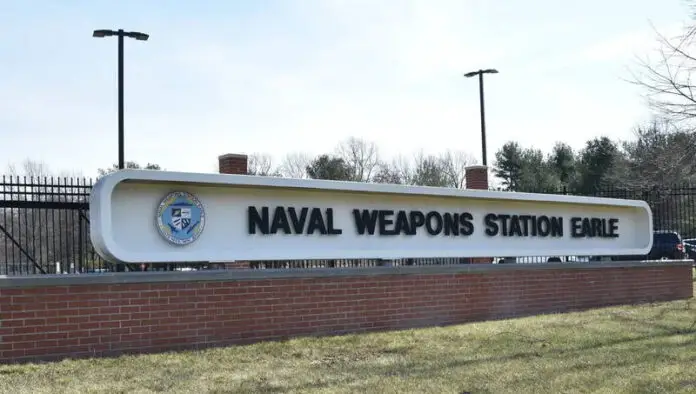
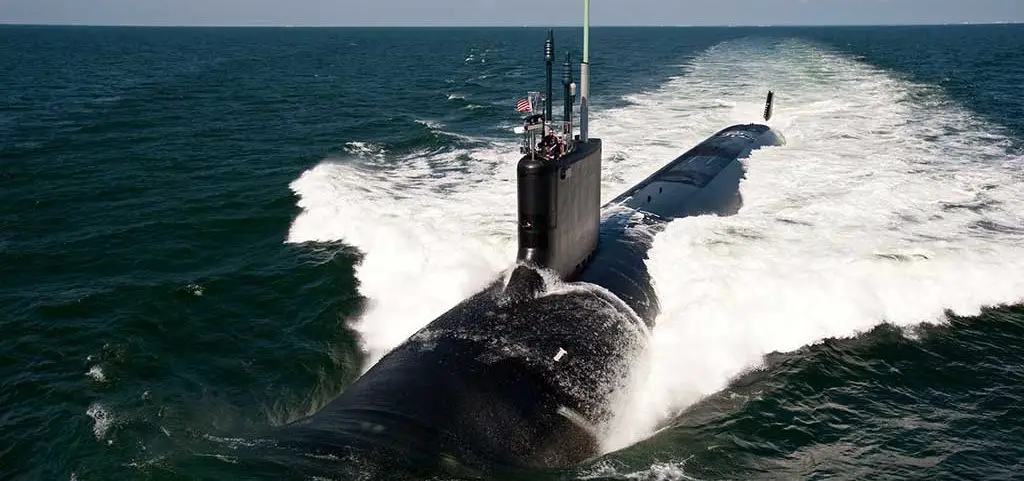
The newest United States Naval vessel named after the state of New Jersey will be commissioned at the Leonardo pier of NWS Earle in Leonardo, it was just announced by the Commissioning Committee.
The commissioning of the Submarine, New Jersey will be held April 26, 2024, at the pier.
Announcement on how and where to secure tickets for the event will be announced shortly.
I got this easy to make recipe for homemade Iced Coffee from … of all places …
Pravagen, the little capsule pill that if you take it daily allegedly helps your memory, also puts out some great recipes for brain health. While most of those recipes are equally recommended for better eye health and helping fight aging macular degeneration, there are still some others that are excellent to try. And good health for the brain goes along with great eyesight for best enjoying life.
In these sweltering hot days, why not try Iced Coffee with some cinnamon and spice from nutmeg and orange? Think cool.
Double or triple the recipe to save time and keep in refrigerator. Or make ice cubes from coffee in advance for added strength.
1 cup cold brew or cooled coffee
1/2 teaspoon freshly grated nutmeg
1 teaspoon ground cinnamon
1/4 teaspoon orange zest
1/8 teaspoon ground clove
1 tablespoon agave syrup
tablespoons half and half
ice cubes
Add coffee, nutmeg, cinnamon, orange zest, clove, syrup, and half and half to a blender or cocktail shaker
Add ice cubes to the blender or shaker
Blend or mix until the outside of the blender or shaker becomes frosty
Add ice cubes to glass if desired
Pour iced coffee over ice in glass
Top with grated nutmeg for extra flavor
Making cold brew ice cubes ahead of time to use instead of regular ice cubes helps reduce dilution
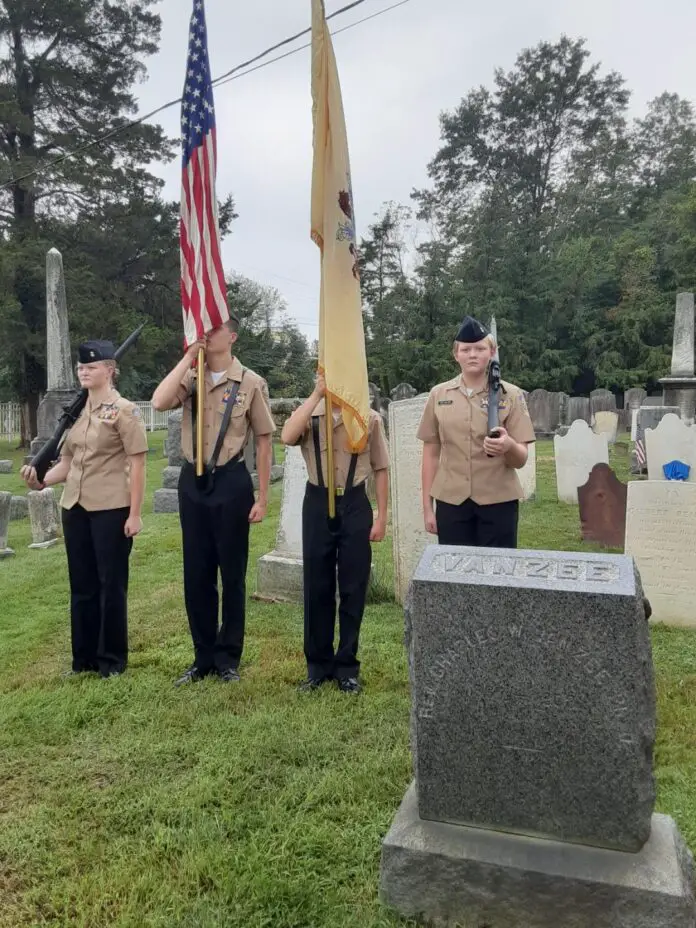
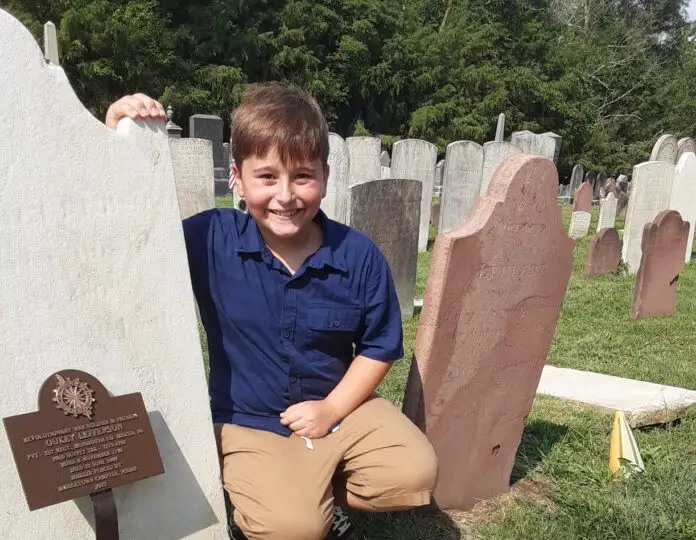
Grave markers for John Covenhoven, the Reverend Benjamin Dubois , Private Oukey Lefferson, Private Peter Van Dorn and Garret Van Der Ver were uncovered by DAR members and descendants of the nation’s first war heroes in a ceremony which began with a color guard from the NJROTC unit at Colts Neck High School presenting colors, and a pledge of allegiance at the graveyard by the close to 100 persons in attendance at the ceremony.
Prior to the ceremony, violinists Summer Liu and Evelyn Lee presented an hour long medley of military and patriotic songs for the gathering crowd in front of the church on Newman Springs Road.
Mayor Jon Hornik welcomed the crowd and urged them to remember and promote the importance of American history and the role Monmouth County and this area in particular played during the revolution. The DAR has recognized that at least 17 patriots from the Revolutionary war era are buried at Old Brick Reformed Church’s burial ground and markers indicate the burial sites of each.
Covenhoven was a colonel in the war, and a descendant of Dutch ancestors who came to New Netherland in 1625. The name is in the earliest records of the church as far back as 1709. Colonel Covenhoven also represented Monmouth County in the colony’s Provincial Congress before the war, and served on committees to draft the state’s first Constitution. He also was on the committee that designed the Great Seal of the State on the state flag. As a soldier, he was taken prisoner and signed an oath to the King in order to gain freedom, later signing an oath to the United States rejecting his former oath. He was elected to the State Assembly in 1781 and 1782.
The Reverend Benjamin Dubois, a minister at the Church during the War was known as the “Fighting Preacher” because he frequently shouldered is gun and knapsack and took his turn on patrol in addition to being ta pastor, the first born in the colonies and the firsts to preach in the English language. He sold produce to the Continental Army and signed aa 1781 petition to encourage free trade.
Private Lefferson serve in Capt. Benjamin Van Cleaf’s company in the 1st Monmouth Militia regiment under Col. Asher Holmes and was a tailor by trade. He signed the Articles of Retaliation after the war, served as a juror, was an elder in the church and eventually a deacon in the Old Brick Reformed Church.
Private Van Dorn served in multiple tours of duty in New Jersey troops other a variety of captains and colonels, and was at the Battle of Germantown, a major engagement during the war.
Mr. Van Der Veer provided his second son, Henrick, as a substituted for his service in the war, and paid the supply tax that funded the war. He and his wife Jane Voorhees had five sons and three daughters. Their oldest son, Tunis, married Francy DuBois and their youngest son David, married Catherine Dubois, both the children of the Reverend Dubois.
Also participating in the ceremony, which moved throughout the burial ground as DAR members and family members uncovered the new markers at each grave, were Chapter Regent Michele Donnelly, State DAR representative Jan Rohn, Monmouth County Historical Commission members Peter Van Nortwick and Maureen O’Connor Leach, as well as members of several local historical societies.
The Colts Neck Color Guard was comprised of NJROTC Lt. Virginia Van Mater, PO second Class Colin Gulka, Seaman recruit Charles Cappen and Petty Officer Morgan Van Mater.
Funding for the program and the markers was made possible in part by an operating support grant from the state Historical Commission through grand funds administered by the Monmouth County Historical Commission.
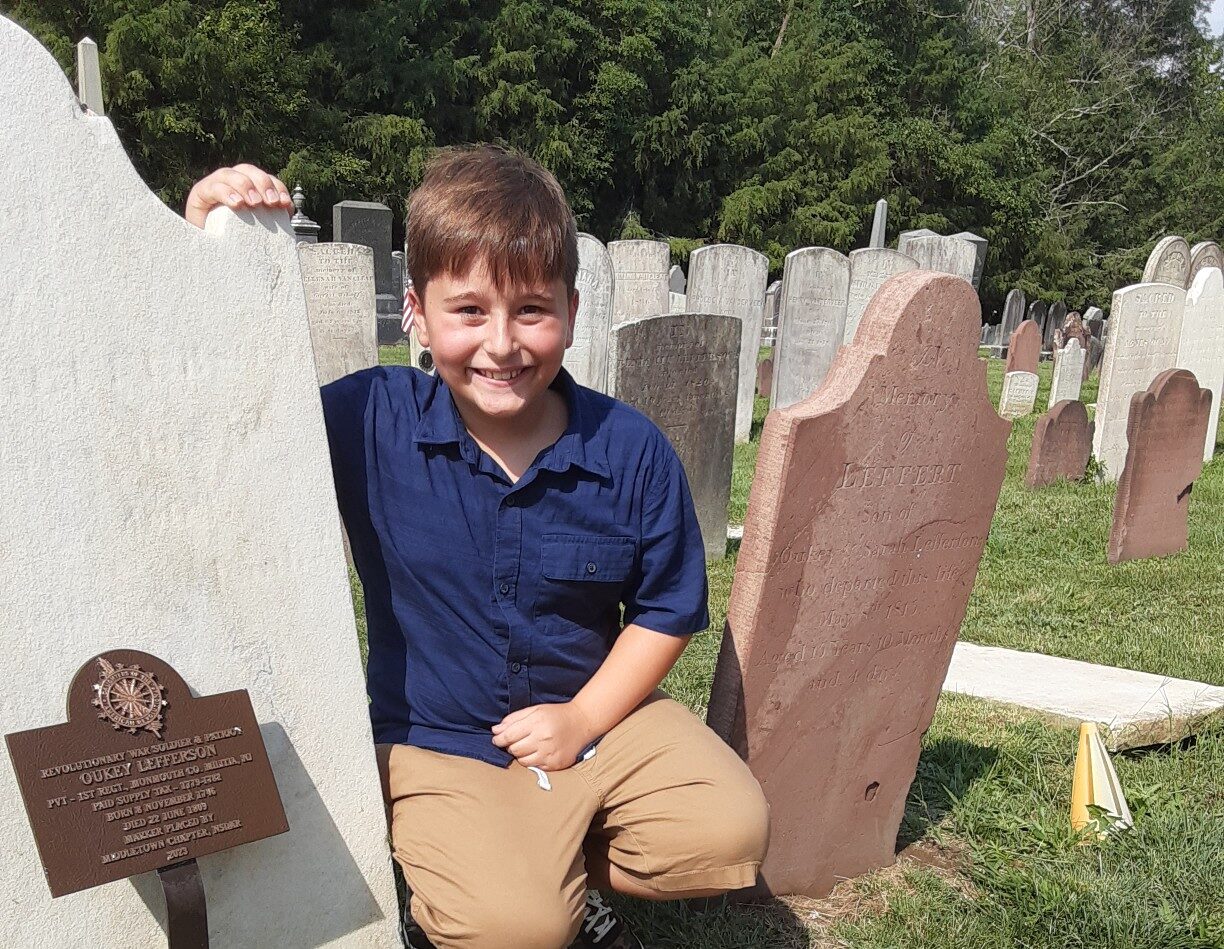
“I bet I’ll be the only one in the whole school who can say he’s done this!” a proud and happy Maxwell Altman said Saturday, after uncovering a new grave marker for Revolutionary War hero Pvt. Oakey Lefferson.
Altman, who came with his family from Berkeley Heights, is a ninth generation relative of the Private who served in the 1st Regiment of the Monmouth Militia under Co. Asher Holmes. As such, Lefferson, who was a tailor before the Revolution, guarded the shores of Middletown.
Both Lefferson and his wife Sarah Schenck are buried in the Old Brick Reformed Church in Marlboro, and his grave marker was one of the five dedicated yesterday by the Middletown Chapter of the Daughters of the American Revolution. The DAR is replacing all, markers where needed on the 17 known patriots buried at Old Brick Reformed Church.
Altman, a fourth-grade student said seeing the musical “Hamilton” gave him a love for Revolutionary War history and the founding of the United States as a nation. Since then he has been learning a lot more about that era, knows all the music from Hamilton and is eagerly looking forward to seeing 1776, a popular play on Broadway many years ago as well as a film.
Our Lady of Perpetual Help- St Agnes Parish will have an additional mass at 7 p.m. Monday, September 11 in commemoration of the September 11 destruction of the World Trade Center in New York.
The mass will honor all those who lost their lives in the attack on the United States as well as all the volunteers and emergency men and women who responded to the emergency both here as well as in New York.
The 9-11 attack had a tremendous impact on this area, both because the number of local residents who were killed at the World Trade Center and the number of local personnel who assisted with the thousands of survivors who were brought out of New York by Sea Streak, fishing boats and other volunteers for safety. Once in Atlantic Highlands, hundreds of volunteers assisted with necessities for those brought to the harbor, including providing and assisting with transportation for those impacted to get to their own homes.
The 7 pm. evening mass is in addition to the daily mass offered Monday mornings at 7 a.m. at St. Agnes.
Years and decades ago, there was always the feeling among Highlands kids that Atlantic Highlands kids didn’t think the Highlands kids were quite as good as they were. They certainly didn’t like having to share a school.
The Highlands kids who took the bus to Mater Dei and Red Bank Catholic High school were used to Atlantic Highlands kids getting on and saying “Oh, those Highlands kids have all the seats!” or “Oh, do we have to sit with those Highlands kids?”
When Henry Hudson was first proposed, and the Kavookjian family was so generous with such a spectacular piece of land for the new school’s construction, numerous newspaper articles reported on how Atlantic Highlands taxpayers did not want the school built in Highlands, did not want the kids to have to be bussed to school up the hill in Highlands.
Understandable, since there had never been a high school in Highlands, and parents had the choice of sending their high schoolers to Atlantic Highlands or Leonardo High.
Older Highlands residents shrugged their shoulders saying that’s the way it’s always been. After all, they pointed out, one town was known as the luxurious summer retreat for wealthy New York businessmen who built their “cottages” on the hill; the other was made up of hard working clammers and lobstermen who lived in their small, often unpainted and patched houses on the water, got used to the tides coming and going through their lower floors, and helped each other out when clamming was bad or times were tough.
In later years, the Sea Bright kids would come over to Highlands, joining the brave in jumping off the bridge, playing baseball or tossing footballs at Kavookjian Field, and simply doing what kids to…have fun, like each other, feud, and become pals again.
All three towns have changed in recent years, with many of the older residents forced out of their homes by higher taxes, attracted to lucrative and enticing purchase offers, and new construction inviting couples rather than large families to come and live in the beauty that is the Bayshore.
Most have forgotten or do not know about the earlier years, people from the towns are friendly to each other, and it seems to many that all are adopting, both the new people moving into historic old towns and the old residents grudgingly accepting and lamenting over the good old days and how their towns have changed.
Peace, happiness, friendliness and acceptance have grown to be the norm.
But it appears the school regionalization question is bringing up that difference between the two boroughs once again.
Some Atlantic Highlands school board members, both some of those in office now as well as many who formerly served on school boards, seem to be starting up a disparity again. The irony of it is they themselves have created some disparity.
For instance: Records show there is a difference in school rankings between Atlantic Highlands and Highlands, with Highlands elementary school kids coming out lower than their neighbors.
But did any of these former board members, from either town, do anything about it during their terms in office?
They talked about it, as do current members.
But where was any action?
Instead, this year, they renewed the contract for the Superintendent of Schools for the three schools who let it happen.
It appears that now, comfortable with a renewal of her contract, the superintendent is doing something about the disparity, but already there is wonder if she’s going about it the right way.
Finally, after two years here, presumably equipped with all the facts, she is focusing a little bit on Highlands. For a while there, she was taking away from the neighboring school…remember when there was not a full year of science for kids in Atlantic Highlands? That’s back now, and it seems there is more math this year for some grades.
But that’s at the cost of art classes. They’ve been cut to once a week instead of two.
What happened to the Challenge programs of a few years back?
What happened to all the great resources for Special Education classes and what happened to five different teachers at the higher grade levels to enable youngsters to acclimate to move on to high school?
What happened to a teacher dedicated strictly to teaching science?
There are those in Atlantic Highlands who now feel the curriculum is being changed, not to keep their children at a higher level, but rather to bring the Highlands school youngsters more in line with their new educational practices. There are many who say that simply isn’t fair to children in either school and does not meet their educational needs.
If that’s what is happening now, what will be different with the same schools under the same superintendent just with a different official name?
It would appear the superintendent would be doing a better job for her $180,000 plus a year if she concentrated on the job she was hired to do….oversee education in three schools. Instead she has been leading the charge on how taxpayers’ dollars should be spent. At first agreed Sea Bright is a great idea to be included, then changed her mind when her home town of Oceanport objected . Now she is leading the charge to forge ahead without Sea Bright, spend more money, and regionalize the three schools she is already overseeing.
The question has been asked, but never answered….is it because her home town of Oceanport is challenging the right of Sea Bright to leave that district under the new law created for just that purpose.? Have any of these board members ever asked their attorneys to render an opinion on whether leading the crowd to exclude Sea Bright could have a very personal effect on her own taxes in Oceanport. Those taxes would indeed be dramatically affected without Sea Bright’s millions continuing to pour in there.
The “Tri-Boards” of Education have set Tuesday night at 7 p.m. for a Fair in which persons whom they identify as their experts will give residents the opportunity to review the information that the Boards have presented in the past or during a meeting concerning the question of regionalization for K-12 education.
All information is available on the tri-district’s website.
It is not clear who the experts are, or whether any member of any of the three boards of education will be present to explain why they are conducting the fair and their own reasons for calling for a special election six weeks before the regular election in November.
Nor have board members spoken about why it is necessary to regionalize these three schools and then have yet another election if regionalization is approved September. 26 in order to bring Sea Bright into the regional plan.
The fair on Tuesday night will consist of tables with the unidentified experts from the district, the legal team and financial consultants. People will be invited to walk around and ask their individual questions.
The proposal for the fair differs from a town hall in that it is not an open event to enable persons to ask questions that all can hear and get responses from the experts that all can hear.
Conceivably, many persons could be asking each of the experts the same question, resulting in the experts repeating the same information numerous times, thereby cutting into time that could be used if all could hear the answers to each question out loud.
It is clear, according to business administrator Janet Sherlock., “Participants will not hear the questions that others ask.”
Ms. Sherlock noted, in response to a request for information on the Fair, that the boards have held multiple meetings since May of 2022 and the feasibility study and presentation are available online. People can attend BOE meetings to have questions asked and answered publicly, she said.
The administrator noted that questions that are asked that have not already been included in the FAQ will be added to the FAQ and posted and distributed on the districts’ websites and social media.
This is not a Board of Education meeting but rather a Fair in which people can walk around the gym and direct specific questions to each of the professionals paid by the boards to be present at the Fair.
“I love this country!” “Freedom!” “More opportunity for my kids.”
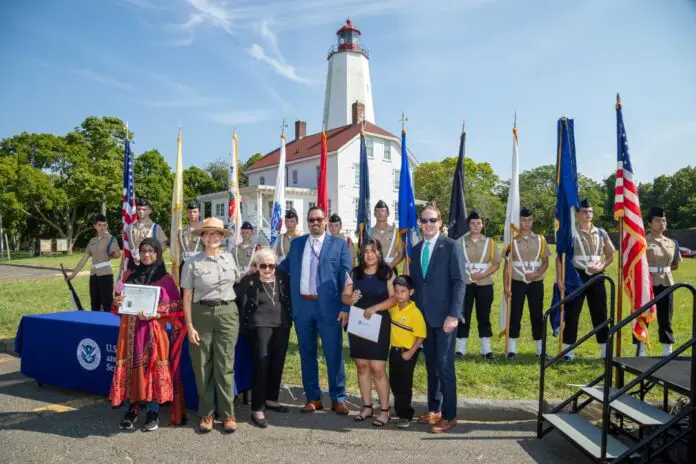
These were the reasons given time after time among the 40 new citizens before they took their oath as Americans at the outdoor ceremony in front of the historic Sandy Hook Lighthouse this week.
Conducted by the US Citizenship and Immigration Services Newark Office Deputy District Director Paul Correia served as master of ceremonies with the Honor Guard from MAST, the Marine Academy of Science and Technology presenting colors and staying throughout the ceremony which included both the National Anthem and the Pledge of Allegiance.
Keith Dorr, field office director from the Immigration Services office at Mount Laurel administered the oath in which each of the new citizens vowed to renounce and abjure all allegiance and fidelity to any foreign sovereignty where he or she has been a subject or citizen in the past. The new citizens also vowed to support and defend the Constitution and laws of the United States, bear arms when required, as well as noncombatant service in the armed forces when required, and perform work of national importance under civilian direction when required by law.
Monmouth County Commissioner Lillian G. Burry welcomed the new citizens to the nation and to Monmouth County, tracing her own pride in being a first generation American because of her hardworking parents who came from Italy. Middletown Mayor Tony Perry also congratulated the new citizens, all of whom live in Monmouth County. Perry drew applause when he greeted the citizens as “My Fellow Americans” then asked, “How does that feel?”
Mount Laurel Immigration Office Superintendent Vincent Stokes led the Pledge of Allegiance for the new citizens and the more than 100 family members and guests in attendance.
Jennifer T. Nersesian, Superintendent of the Gateway National Recreation Area at Sandy Hook, was keynote speaker for the program and reminded both guests and honorees of the diversity offered by the National Parks system which enables all to explore, visit, diversify and appreciate the beauty of the nation and the importance of preservation and history. She reminded the new citizens that their taking their oath at the historic site, near the oldest still operating lighthouse in the country “as of today, this is your park, and you are part of its history.” Nersesian also spoke of her grandparents who came from Armenia to be citizens and her husband, a citizen who came from Costa Rica.
Members of the DAR, the Daughters of the American Revolution Middletown Chapter, gave gifts of flags, bookmarks, patriotic pinwheels the story behind the Pledge of Allegiance as well as booklets of the Constitution and the Declaration of Independence to each of the new Americans.
But the pride, the tears, the emotion and the smiles of the new citizens from 22 different countries told the story of why they gave up allegiance to their own country, why they studied, learned and took tests to be qualified to be sworn as American citizens, and why they are taking that step now. For Prahart Patel, who came from India seven years ago and is a resident of Freehold, his reasons besides love of America and the freedom it offers includes the fact “my whole family is here.” Employed by a medical agency, Pagel said that “democracy has a different meaning here than in other countries,” and he added from now on, he simply “wants to be a good citizen.”
Camila Panella came from Brazil 13 years ago, lives in Middletown, and said she is a citizen because “I want to belong to the greatest nation in the world, Married and the parent of two children, Panella is a HR resource manager and said she loves the country so much and is so happy that both her children are already American citizens because of being born here.
Yenny Esbenal of Keyport came from the Dominican Republic, lives in Keyport and is a citizen because the nation offers more opportunity for each of her four children. She is a decorator with a bakery and noted she still has great ride in her own native land as well.
Sylvestre Innocent came from Haiti five years ago and notes one of his reasons is seeing the changes in his own country where there has been great violence, his mother died, and he wants to be an American. He added with pride that his brother is already an American citizen as well and is serving in the US Army. Innocent lives in Neptune.
Ernestine DaSilva, who lives in Long Branch and did not let a couple of accidents keep her from the ceremony, sat proudly among friends and family in her wheelchair, her injured leg aloft, to take the oath. DaSilva said she came from Portugal 37 years ago and thinks “it’s about time!” she made it official how much she loves the United States. “My two daughters are here, my BFF is here, my grandchildren are here, it’s great for me to be here as well.” One of her daughters was born in the United States, the other, born in Portugal is a citizen.
The new citizens came from Australia, Bangladesh, Brazil, Canada, Columbia, Dominican Republic, Ecuador, Germany, Ghana, Haiti, India, Italy, Jamaca, Pakistan, Philippines, Poland, Portugal, Russia, South Korea, Ukraine, the United Kingdom and Uruguay.
None of the new citizens wanted to comment on their feelings for those seeking entry into the country through the Southern border illegally. One new citizen simply said, “they should not break the law to come here.”
Former Atlantic Highlands Board of Education member Elisabeth Eittreim sent out letters asking for donations to underwrite costs of promoting the special School election set for September 26, and asking for volunteers to walk door to door to distribute door-hangers urging people to vote.
In a letter addressed to Atlantic Highlands and Highlands community members and signed by Eittreim, who served two terms on the Atlantic Highlands Board, the letter indicates the September 26 election” is a FIRST STEP toward allowing other districts (like Sea Bright) can join the district.” The letter lists the writer’s opinion saying why a first step is necessary but does not indicate what other districts besides Sea Bright she is anticipating requesting admission to the school district.
After 50 years of having three school boards, three separate districts and one superintendent in the two towns, Ettreim does not say why she never recommended any action while she served on the board or why now time is of the essence.
Ettreim is calling for volunteers to distribute door hangers on Saturday as well as donations to pay for materials to get out the word about the election. Checks should be sent to Friends of Regionalization, 123A East Highland Avenue, Atlantic Highlands, NJ 07716 but does not identify any of the members of the group, or if the group is a not-for-profit entity.
The address is Ettreim ’s residence.
A Paypal account and a regionalization page have also been set up for funds.
The letter urges visiting the website and the Facebook page, as well as attending an Information Fair on Sept. 12 at 7 p.m. at Henry Hudson Regional School to walk around tables and learn from experts, though they are not identified, about the impacts of regionalization on education, legal and financial areas.
Harborside Restaurant owner Michael Rosa and their architect reviewed and discussed a concept for another 22 apartments on First Ave which would require approximately three times as many parking spaces then they could provide onsite for the planned mixed use.
Stressing it is a concept review before making a formal presentation to the planning board, architect Jeffrey Gale of Gale and Laughlin, Hazlet, said the review of the Harborside expansion was to include the distribution of parking spaces between the property and the municipal parking lot within 300 feet of the business.
Planning Board Engineer Douglas Rohmeyer strongly recommended Gale seek a traffic survey to accurately determine whether the Harborside property is within 300 feet of the municipal lot, something he appeared to doubt at the meeting.
Under borough regulations, property owners within 300 feet of the municipal parking lot on West Avenue can claim parking spaces there to meet their requirements with no cost. Parking in the lot further than 300 feet would require $25,000 paid to the borough for each parking spot claimed.
Under the plans presented last night, the Wine Bar above Harborside restaurant would be eliminated, as would the parking lot currently in use. In its stead, parking would be provided at the lowest level of a new three-story building to extend over the parking lot and include the three stories of the current restaurant. The restaurant would be commercial use on the first level, with 22 one- and two-bedroom apartment or condominium units on the second and third floors.
Gale said the owners would provide 22 parking places and the remaining numbers would be allocated to the municipal lot. The new building would not include amenities like exercise rooms or spas, Gale said, but would have balconies and porch areas enclosed within the building area.
The property is in the historic business zone and mixed use is an approved use for the zone. The property has a 151-foot frontage on First Avenue.
All 22 parking spaces under the building would be compliant with the borough regulations, as opposed to ‘compact’ spaces which are not allowed under borough codes. The new building would include 19 two-bedroom and 3 one-bedroom units if plans remain the same when the project is formally presented to the board.
After more than an hour presentation, the planning board approved the variance request for the Torres property at 148 Bayside Dr. to change the shape of the lower deck of their house and add two dormers at the top with no difference in the height level of the house. Planning board member David Kupinski opposed the approval
An application submitted by Sandy Hook Scooter for a variance for 25 W. Highland Avenue was dismissed at the owner’s request.
Planners unanimously approved set back variances for Ruane-Dewis property at 6 Bonnie Brae Path for an addition to three present residence in height but leaving building coverage land site unchanged.