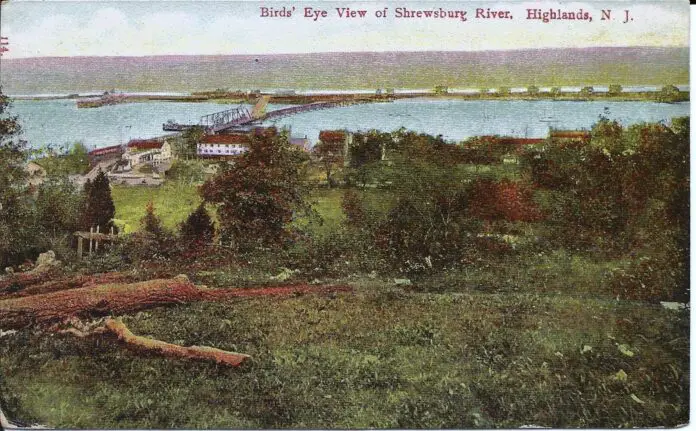
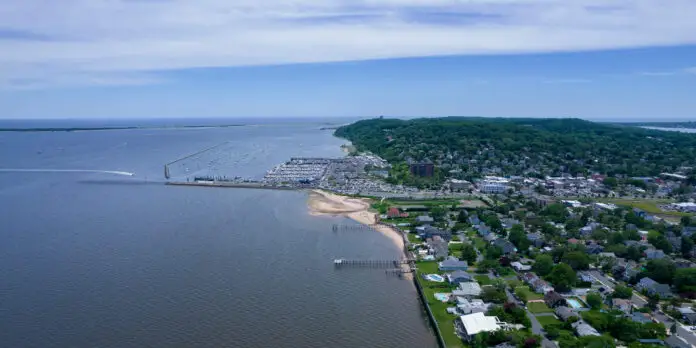
A bird’s eye view of the Shrewsbury river at the turn of the 20th century. One of many photos of earlier times in and around Sandlass Beach that are part of the collection of Susan Sandlass Gardiner, a member of the Twin Lights Historical Society. There is more about Henry Sandlass and the beach club at the start of the Sandy Hook Peninsula at the Twin Lights Museum in Highlands.
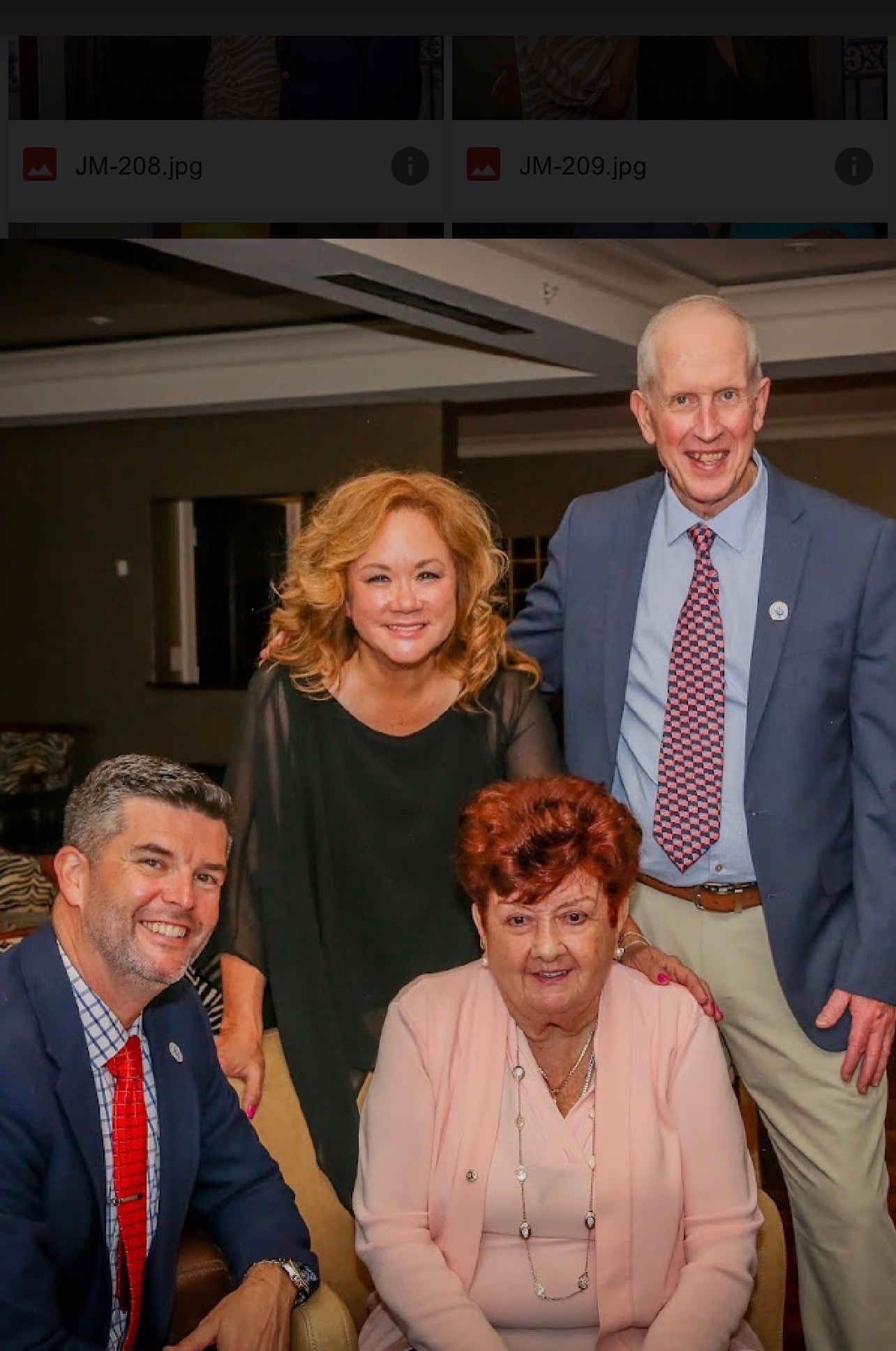
Kathleen Sweeny, owner of the Shore Casino with the AH Strong Team
The GOP candidates for Atlantic Highlands Mayor and Council seats in November officially kicked off their campaign Tuesday night with a festive gathering of more than 50 residents of all ages enjoying cocktails, music and camaraderie at The Wine Room on First Ave.
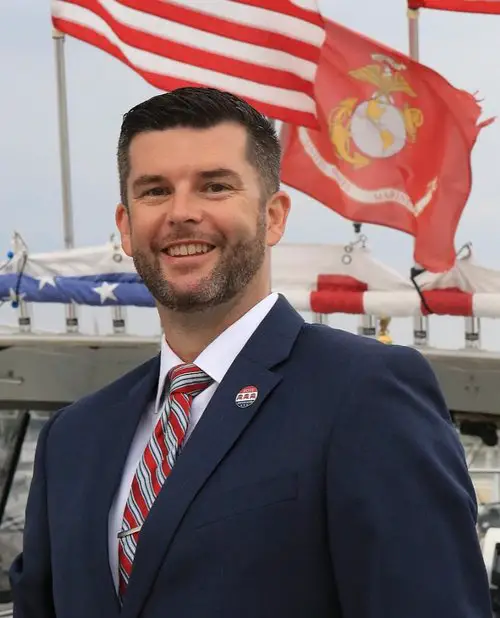
Councilman James Murphy, seeking office as Mayor, together with council candidates Ellen O’Dwyer and Vincent Whitehead laid out their ideas for the next three years if elected in November, replacing Mayor Loretta Gluckstein, who is not seeking another term, and Democrats Jon Crowley and Lori Hohenleitner.
The candidates also have the support and congratulations of State Senator Declan O’Scanlon and Assemblyman Gerry Sharfenberger, both of whom praised the GOP choices at the evening event.
Murphy, in introducing his running mates, acknowledged he feels “this is the very best team” for the borough with their accent on working together and listening to the people in making their choices and decisions on municipal matters.
O’Dwyer pointed out the candidates are “an action team,” more than a talking team, and after listening to the people, will work together to accomplish programs, activities and
government responsive to the residents. O’Dwyer also spoke on the importance of maintaining the natural beauty of the borough which includes both hills and beaches and has been an official Tree City for many years.
Whitehead said the GOP candidates work with a lot of TLC….transparency, love for the community, and care for each other as residents. Whitehead, who is seeking election for the first time after teaching for 44 years at Henry Hudson Regional School, said the TLC approach always worked to the benefit of the students when he was coaching at the high school, and as a proven method for decades there, he knows TLC will be highly effective in the community.
This week’s event was the first gathering to introduce the team that feels it can work together effectively to keep the small town feeling and natural beauty that so many people have moved here to enjoy while at the same time taking the necessary steps to make it happen efficiently and effectively.
The candidates are also visiting neighbors in their homes and invite anyone with questions to contact them for in depth discussions on their plans and vision for, as Sen. O’Scanlon said, “the storybook family” atmosphere of a small community.
The Planning Board hearing on the Kalian Consgruction Company application has been cancelledfor tonight at 7 p.m.
B22-12: Zlata-Clancy, will be heard at the 7 p.m. planning board meeting tonight. Only the Kalian application has been postponed.
The Planning Board confirmed that the applicant has requested and been granted a postponement of tonight’s continuation of the hearing for the application for the proposed First Avenue apartment complex at E. Garfield and First Avenues.
The next hearing on the application is scheduled for the next planning board meeting on Sept. 7.at 7 p.m.
Continue to check the borough’s ahnj.com page for any updates on the application date.
He’s been here just one month and already Father Gene, the Rev.Eugene Vavrick, has won the hearts of the parish.
Father Gene came to Our Lady of Perpetual Help St. Agnes parish at the request of Bishop David O’Connell, Bishop of the Catholic Diocese of Trenton. He was selected to serve as parochial vicar to the pastor, the Rev. Jarlath Quinn.
For several years, Father Quinn has been the sole resident priest at the parish that encompasses two churches, St. Agnes in Atlantic Highlands and Our Lady of Perpetual Help in Highlands. Parishioners come from both towns, others from Sea Bright and many from Middletown.
Father Quinn has had several priests assisting him with Sunday masses over the years but has borne the daily work of a priest and pastor of the parish by himself.
With Father Vavrick now in residence along with Father Quinn, many aspects of church work can be shared, giving both priests more time to carry out both the spiritual and temporal duties in the parish.
While Father Gene may be new as pastoral assistant, but he is certainly familiar with the area. He grew up in the Bayshore.
A priest for 30 years, having been ordained in May, 1993, Father Gene graduated from St. Ann’s Grammar School in Keansburg and Holmdel High School. He lived in both Hazlet and Holmdel during his growing up years.
He went to King’s College in Wilkes-Barre, Pa, graduating with degrees in government and business administration. Not enough for him to succeed in two majors, he then went on to the University of Notre Dame to begin graduate studies in theology.
He returned to Monmouth County in 1981 and taught religious studies at St. John Vianney High School. At the same time, he also became Director of the Christian Service program there and was active in the retreat program for students.
Father Gene still recalls that working with the Rev. William Bausch, the award winning author and former pastor. The two priests had a program where the students conducted their own version of a Church Ecumenical Council….he refers to that good naturedly as “our own Vatican III
Father assigned each of the students to be a Bishop, others as Cardinals, and one was elected Pope!
“We had some very interesting discussions and debates,” he says today, smiling, “The results of the Council were controversial then, and even more troublesome nowadays.”
After teaching at St. John Vianney, Father Gene returned to Notre Dame to take on more theology studies, completing his master’s degree in Liturgical Theology in 1988, then his Master of Divinity in 1989.
Quickly and proudly admitting he is a fan of Notre Dame football, Father was active with Campus Ministry and served on the staff of Residence Life, being the Assistant Rector of Holy Cross Hall. Even through today, he maintains warm relationships with many Notre
Dame Alumni, and still serves as Chaplain to the Notre Dame Club of the Jersey Shore.
Armed with experience, practical and theological knowledge, Father Gene was then ordained a priest in the Trenton diocese and served in several different parishes through the next many years, including St. Mary’s in New Monmouth. He also served at St. Mary of the Lake, Lakewood,Sacred Heart, Mount Holly, and St. Martha, Point Pleasant.
In 2004, Bishop Smith asked him to pastor the parish of St. Anselm in Tinton Falls, a position he held there for more than 20 years. Father Gene was also at Villa Vianney in Lawrenceville before the Bishop asked him to serve once again in the Bayshore.
Working as pastor of St. Anselm’s also brought numerous opportunities to serve the people, Father Gene said, and expressed his happiness that he “had the chance to walk with the people of St. Anselm for almost 20 years. I certainly learned a lot from that
wonderful, progressive community.”
It’s because of all those experiences in the past, the priest says, that he now comes to OLPH-St Agnes “with lots of gratitude for what has been,” adding “I look forward to sharing ministry with the people of this unique parish community. I pray that we can all grow into
becoming ever-faithful disciples of Jesus.”
Whether it’s his quick smile, gentle conversations, or booming baritone when singing in church, Father Gene has already been warmly welcomed by parishioners, offering masses, like Fr. Jarlath, in both churches during the week and on Sundays.
“The New Jersey DEP has inspected the site multiple times “since receiving the July 26 report on the possible increased contamination to soil and water surrounding the McConnell tract, Councilman James Murphy said this week. He indicated the agency has deemed it safe to continue construction.
Murphy, a councilman running for the mayoral seat in the November election, was joined by fellow candidates Ellen O’Dwyer and Vinnie Whitehead in urging the borough to take immediate action responding to the claims of increased soil and water contamination surrounding the Denholtz construction site on the waterfront property off Ave D and Center Avenue.
The councilman said he has spoken with concerned residents as well as Administrator Rob Ferragina regarding the environmental issues and knows that in addition to the NJ DEP inspections, the Monmouth County Health Department also toured the site, and both deemed it safe for redevelopment operations to continue.
However, the press release from AH Strong said, “With recent reports from Atlantic Highlands residents of odor, visible soil and water contamination, there are concerns that the stability of the site has changed.’ However, the release pointed out, the two agencies have declared it safe to proceed.
This site originally was deemed an active soil remediation site with measurable ground water contamination. It is currently in year 5 of a 50-year monitoring plan in agreement with the DEP which will continue to monitor the site.
The AH Strong team is calling for the documentation of the NJ DEP and Monmouth County Health Departments investigations and findings to be publicly published.
“Concerned citizens should be apprised of these test results as they compare to earlier monitoring reports,” the AH Strong team said, urging the municipality to “be diligent in its oversight of this redevelopment project to prevent and mitigate such threats” along with assurance it will take appropriate and immediate corrective action should any occur.
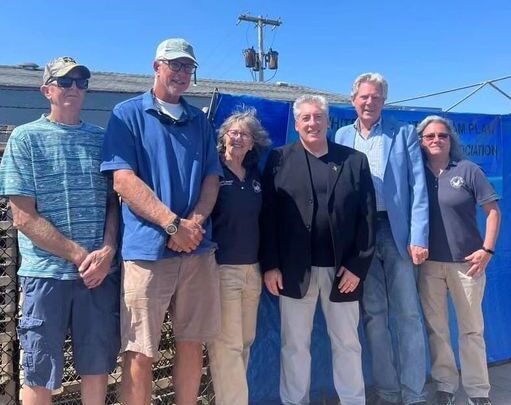
“This was just introduced, but we will see it all the way through,” a joyous Congressman Frank Pallone told Highlands clammers and borough officials Tuesday morning when came to the borough and announced a bill he sponsored promoting more attention to seafood and the health benefits of seafood introduced with bipartisan support.
Highlands Mayor Carolyn Broullon and Councilwoman Joann Olszewski were among those available for the morning meeting with the Congressman, who also introduced Michael Deluca from the Seafood Research Lab and explained how the bill also requires the Secretary of Agriculture to report to Congress on how much funding is spent on aquaculture as opposed to agriculture and its impact on seafood purchases, grants and other purposes.
Mayor Broullon praised the new bill, thanking Pallone for bringing attention to the seafood industry and the clamming industry in particular, and pointing out it brings better parody to the aquaculture industry as a whole. She said the act, known as the SEAS ACT, is a great opportunity for the seafood industry to have parity with land farmers.
In thanking the Congressman for sponsoring the legislation, she said “The commitment to Reporting, Education, Regional Centers, Research, Grants and Crop Insurance will be a welcome boost to our local economy here at the James T. White Clam Depuration Plant and across the region.”
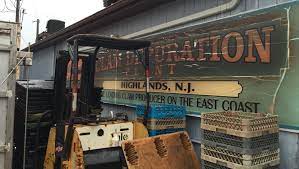
The James T. White Depuration Plant, Highlands NJ
Keith Craffey, president of the Highlands Clammers Association, also praised Pallone and thanked him for the legislation which will afford more protection and assistance for the seafood industry and its workers.
Pallone, even though he anticipates great support on the bipartisan bill, promised the crowd at the James T. White Depuration plant beach on Cedar St. that “we will be fighting” for its passage until it is passed into law.
The SEAS ACT, which has been referred to committee, would require the Secretary of Agriculture to report to Congress spending by the Department of Agriculture related to seafood purchases and grants, and for other purposes no later than one year after enactment and annually thereafter through fiscal year 2026.
The report must also include the total amount of expenditures on seafood and other aquaculture purchase for promotion of the industry, outreach supporting seafood and aquaculture and the value of such expenditures; the number of grants for the seafood and aquaculture industries, and other comparisons to paying attention to those who make their living on the water as opposed to on the land.
Pallone told the crowd in Highlands “I just eat seafood because it tastes so good,” but said the bill also includes a mandate for more education on the physical and health benefits of eating seafood, the number of vitamins and mineral are in varieties of seafood,, and the importance of keeping seafood an important part of every diet.
The bill also calls for evaluating the potential environmental benefits of the aquaculture industry with respect to climate control, conservation of natural resources as well as impact on pollution, disease and waste compared to agriculture.
Concerning education, the bill includes a mandate for the federal government to develop and implement a requirement for employees of the Farm Service Agency to offer training for all existing and new employees on eligibility for aquaculture-related Federal grants and programs as well as the support of the Department of Agriculture to provide this for seafood producers and aquaculture, all within two years, Pallone pointed out.
Included in the bill is also the mandate, that the Department of Agriculture plays a vital role in the United States agriculture system; and reiterates the eligibility of aquaculture and seafood products and producers for programs administered by the Secretary.
The bill calls for webinars every two years for conferences providing for education of officers and employees of the Department of Agriculture and other in the field of aquaculture in the United States.
“This Skate Park is dedicated to the Children of Highlands “said Mayor Carolyn Broullon as she and Councilman Donald Melnyk cut the ribbon before a crowd of more than 75 people to open the new Skate Park built primarily with Green Acres and other state funding.
Melnik, who heads the borough’s recreation and Open Space committees, also dedicated the park as a means for the borough to “invest in the future of Highlands” by providing open spaces for young people to get outside, recreate together, enjoy the outdoors and healthy exercise, make new friends and preserve memories. The councilman noted that providing healthy activities for the young “is a down payment for their future.”
The councilman, to the applause of the crowd, also emphasized “we’re not done!” with Broullon shaking her head in assent. “We have Frank Hall park, Overlook Park,.” Melnyk continued, while praising both the recreation department and the Department of Public Works for all they have done to complete the Skate Park along the block long stream of activities of active people of all ages.
The Skate Park was constructed by Spohn Ranch, Inc, with Colliers Engineering & Design, Inc. It stretches towards the Robert Wilson Community Center and the Snug Harbor Beach, a stretch that already includes tennis courts, a basketball and pickleball court, a gymnastics area for children and a relaxation area with tables, chairs and a mini-library available to all.
Broullon explained part of the funding is from “leftover from Green Acres funds and other money the borough received in the past but never used.
In the outdoor ceremony that began with a Pledge of Allegiance led by Ptl. Robert Alvator, Rev. Martin McGrail also praised the thought and dedication that went into the park’s planning and construction and shows the vision of the governing body in investing in the young. “We are all so grateful for all the hands that went into making this possible,” he said, and added the park itself “shows the needs we have.”
The minister noted that if anything good came out of the Covid experience, it was that “we are all in this together,” and we need to enjoy the outdoors, enjoy being together, and need to recreate.
Following the brief ceremony and ribbon cutting, scores of energetic residents, skateboards in hand, climbed the stairs, went beyond the fenced area and tried out the rolls, twists, turns, slides and jumps of an intricate and challenging skate park. Cyclone fencing and locks surrounding the park ensure safety during nighttime or off hours.
“I do not appreciate or agree with your take on the topics related to our Superintendent and regionalization. Please use facts and not put your personal opinions out there.”
That’s the comment VeniVidiScripto received in response to an article on the blog referring to the Henry Hudson superintendent, regionalization and the decisions the people of Highlands, Atlantic Highlands and Sea Bright have to make.
All well and good. As a proponent of everything Thomas Jefferson stood, fought for, and defended, I respect and appreciate everyone’s right to opine on anything in the blog. The option, of course, if things offend, upset, anger or scare a reader, is simply not to read it.
Normally VeniVidiScripto would not respond to a comment like this. Everyone has the right to an opinion in the United States. And to express it. Thank you, First Amendment.
But this comment is especially sad and disturbing. Because it begins with
“As a BOE member…….
So, a Board member who just approved putting the regionalization of two towns, not three, on a special ballot that will cost the taxpayers a few thousand dollars thinks it is proper to tell me to NOT PUT my personal opinions out there?
A Board member who authorized, read, and at some time agreed with the opinion of the expert taxpayers that Sea Bright should be included in any regionalization plan thinks it is proper to tell me to NOT PUT my personal opinions out there?
A board member who thinks she has the right, which she does, to “put out there” her opinion thinks that I should not put my personal opinion out there?
Is that what happens to people once they get positions of power, control or duty? Why is it the opinion of a Board of Education member that a citizen does not have the right to express her opinion? Why is it that a board of education member feels she can “put out” there that the writer has not used facts, but doesn’t feel she should identify what facts should have been used?
It is a sad commentary on the individual when “as a board member” one feels that gives her the right to silence or order or tell everyone else they do not have the right to have an opinion.
A board member is elected, sometimes appointed, by the people to represent the people.
A board member, like any elected official, needs to listen to the people in order to represent them.
A board member needs to hear from the people their opinions, their ideas, yes, even their suggestions, whether she likes them or not.
Maybe if the opinion of this board member is similar to that of other board members, it explains the problem the taxpayers and parents who want their kids to have the best education possible are having with this whole idea of regionalization.
It certainly makes it appear that board members are not listening to the people, not listening to the expert they retained; they appear to be listening only to the superintendent, their paid employee who has a personal interest in how the situation is resolved.
The board members appear to NOT want input from the people. Heck, they don’t even want the input from the expert they retained. So why on earth should a taxpayer feel her opinion should be heard?
Why should it come as a surprise when a board member writes “as a BOE board member,”….. as if she has more rights now that she is a board member, than an ordinary citizen?
Perhaps it isn’t entirely the fault of the board member.
Traditionally, and ironically, the largest part of the tax dollar is spent on education. Yet so many times it is so difficult to get candidates to run for the board of education.
Traditionally, and ironically in view of the huge amount of tax dollars poured into education, very few people attend meetings, and fewer yet even understand everything that goes on at meetings.
Traditionally, and ironically, voters do not turn out for special elections. Even school board elections receive fewer voters than other municipal elections.
Many boards have members who are parents of children in the school system they are selected to oversee. Those board members do not always vote the way they feel; they fear retaliation in some way against their child in the school.
Perhaps it is time to call for a state law to prohibit board members who have students in the district from serving. Perhaps it is time to call for a state law to prohibit members of teachers unions from serving on boards of education since they may feel a closer need to represent the union to which they belong rather than the people who put them in office.
These are only opinions. Mine. And thank you, Mr. Jefferson, thank you First Amendment, for preserving my right to express them. Publicly. And often.
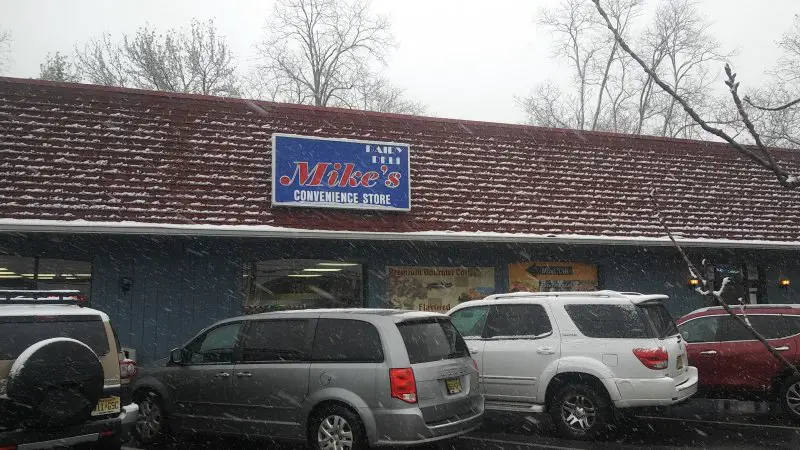
It’s show time again Thursday night in Atlantic Highlands when the Planning Board continues hearing the Kalian application to build that second apartment complex on First Avenue where Mike’s Deli is now. Stay Informed
The meeting starts at 7 p.m. and every resident, regardless of where he lives in town, should be present either in person or on zoom and become informed with all the details of what is being offered and what the planning board will do about it. Stay Informed
The borough has strict building regulations for a purpose. When the Master Plan for the borough was designed, and the laws made for what can go where and how it should look, it was for a reason. It is to keep the appearance of the town the way people who live here want it.
Builders who want to deviate from that plan must show a reason why it is necessary to do something “a little bit different” and still be able to build it. That’s what a variance is.
Only the planning board can grant a variance, that is, sufficient reason to go against the law that keeps buildings in Atlantic Highlands in the style the overall plan calls for.
Every town has a planning board, every town grants variances, some for very small reasons like building a porch on a house that is a foot closer to the property line than it should be. Then others request more variances, to either build too much on too small a piece of property, offer rooms, or parking spaces, or building heights, or other reasons.
So this is where the Planning Board needs the help of the residents. These are big decisions to make, deciding whether a builder is presenting something good enough, important enough, beneficial enough for the town to go against the Master Plan.
If they can prove some things are good and will benefit the town, and not cause any problems, then the planners may grant a variance, a deviation from the law. It’s up to residents to be informed, know exactly what the plans are, think of how it will impact them, their view of the town, their safety, their health or any other reason.
By attending the planning board meeting, residents can see the exhibits, hear the ideas, see how it impacts themselves, and be informed. They can give their own opinion, they can say whether they think going against the rule is worth the change it will create. Stay Informed
So, Thursday night, the hearing continues for what at this point would be the second tallest building in the borough, about a block from the entrance to the borough. Right next to what is probably the third tallest building in the borough. Stay Informed
The builders are willing to make changes, so they don’t need so many variances. They’re willing to hear the suggestions of the engineer and the planning board; in fact, they will probably have some different ideas Thursday night from what they presented last week. That’s because some wise members of the planning board and the borough’s very sharp Engineer Rohmeyer, asked lots of questions, made lots of suggestions and are working with the builder so he can perhaps make adjustments that are more in keeping with the law.
It’s an important meeting to attend. It probably won’t even be the last meeting of this particular project. But once approvals are given, and variances are granted, it isn’t easy to come back and say this is not a good thing for this town. Stay Informed
Be informed. Learn what’s going up on a small piece of property for the size of the building. When you get the chance, give your opinion. Let the Planning Board members know your concerns. Find out for yourself how many variances are too many? How many ways should a builder be able to go against the law and still keep Atlantic Highlands looking like the people of Atlantic Highlands want it to look like.
Stay informed. That’s the only way good things happen.
The second Planning Board hearing for 160 First Avenue is THURSDAY, August 3 at 7pm in Borough Hall.
At the Planning Board hearing, information on the proposed building, which would be the second tallest building in the Borough, was presented by two of the professionals retained by Kalian Corporation to build the complex.
Based on what the developer heard from the Board at the previous Planning Board hearing and the public’s concerns, in addition to more testimony and more experts testifying, it is probably the developer will offer changes to the design to come more in keeping with concerns raised at that meeting.
Numerous variances will be required for the building in the present proposal and it appears that no fewer than 44 variances are currently required.
The construction is planned for a property with 117-foot frontage on First Ave and a depth of 170 feet adjacent to a residential area.
Visit the Borough website at www.AHNJ.Com for the Planning Board Zoom attendance at the meeting, or attend in person at Borough Hall, 100 First Ave.