Seeing so many Christmas decorations already up, even seeing a couple of trees in family living rooms, I figured I really ought to put my Christmas Legends of the Bayshore book up for sale for gift giving to youngsters or oldsters who like to read legends and fables in and around the Bayshore.
I wrote the book last year, in part compiling some stories I had written each year for my own children. My custom during their growing up years, well, way into their 20s, was to write a legend then create a tree ornament that depicts the character in the legend. I wrote the book so other parents could be creative with ideas for ornaments that would match any of the stories.
While some of the stories could happen anywhere, in the ocean, like The Starfish and he Christmas Tree, or in any home, like “The Ornament not Selected,” there are many that focus on local people… fun legends about local legends like former Mayor Helen Marchetti, Highlands Mr. First Aid, Harry Duncan, or even the Atlantic Highlands Yacht Club team. There’s even one about the men and women who go to mass at St. Agnes every morning, “The Peanut Lady,” and another that takes place in Hartshorne Woods.
The book, in larger print suitable for younger children to read, are $15, and available at Bayshore Pharmacy, Bahrs Restaurant, or this blog.
Every once in a while, it’s just fun to bring a little make believe into your life
OPRA, the New Jersey state Right to Know Law, was designed by the state legislature to ensure the public gets all the facts they have the right to know from official documents, records and reports of every elected body in the school districts, municipalities, counties and state.
It’s a great step and a mighty effort to give the people their rights. But it still isn’t enough when public entities, or their attorneys or other professionals, really go out of their way to hide things.
In dealing with information from four different municipalities in the past year, there have been so many instances of these bodies withholding, hiding, or making it very difficult to get the facts. I have found filthy and sneaky means of keeping the people from knowing the truth, the whole truth, and nothing about the truth, about so many things. So far, of the four towns where I have attempted to learn information I am entitled to learn, Highlands, Atlantic Highlands, Oceanport and Sea Bright, Sea Bright is the only one where I have not found any attempts to keep me from knowing what’s going on. But then, I haven’t tried to get any information from any Sea Bright elected body yet.
In Atlantic Highlands, where the borough clerk is highly professional and efficient, there is never any problem in getting what you ask for. In some instances, the answer comes within the hour, with further information that an OPRA wasn’t even necessary to get it.
It was either the governing body, or its attorney, who made the decision to name that ordinance Redevelopment Plan but never saying it was the Mother Theresa School property. They did this at the introduction of the ordinance and the innocuous name would not have awakened anyone to the fact it was all about the property the people have been saying for three years they want for senior citizen housing.
It was only because local resident Mark Fisher keeps his eye on everything governmental and is so astute at keeping the people aware of what the powers that be should actually be keeping the people informed about, that it was made visible to the average citizen. What’s worse, neither the owners of the property, nor their attorney in negotiations with the borough for sale of that property were advised before it happened that there was a plan afoot to change the use of that property even before the sale is completed. The attorney was ZOOM present at the meeting and said it is the first he’s heard of it. Just like everybody else.
Until Mark Fisher got the governing body to make it clear. WOW.
In Highlands, the approach is just as seemingly underhanded but in a different way. In trying to get some information on how the new borough hall cost has risen by millions since it was first introduced, wrong information was forwarded under an OPRA request. A second request brought some information, but not all of it as requested. Still the clerk closed the OPRA as if it were a fait accompli. It was not. So there was yet another attempt to get information I’m entitled to receive. How did that go? Still did not get it, instead, I got an insulting written message from the clerk saying attend a Council Meeting. Knowing full well that due to a disability, I can not
WOW!
And how can I forget that ‘e-mail friendship’ that was attempted to be formed by a lawyer in the firm that’s being paid by the Oceanport Board of Education to protect all their thoughts and deeds? That was back a year ago or so, when Highlands, Atlantic Highland and Sea Bright were talking about the regionalization plans for the school districts.
The Oceanport school board attorney wasn’t openly involved yet, nor did she tell me that she was an attorney and her name had not come out at all in the regionalization discussions. Of course, I could have searched for it, but why would I? This was simply discussions between municipal bodies on the studies they had paid for to see whether regionalization was a good idea. Heck, Oceanport had not even asked a single question about any of it.
Yet I, a senior citizen who just likes to write and has spent a lifetime trying hard to keeping the public informed, received a chummy e-mail from an attorney in that law firm, asking for some information, saying she saw me at meetings, read my blog, and wanted to chat about something. But she never once mentioned she works for the lady who is representing Oceanport and opposing anything the other towns were proposing.
An attorney who wanted information about a deal that involved an elected board her company represented. But with all her legal background, she never thought it was important enough to share that information before asking questions of a private citizen rather than the governing bodies.
WOW!
So in the end, what does it all say? Does it give you a warm cozy feeling that you can trust your elected officials? Does it look like the people who have the right to know get that right easily? Does it look like we need more Mark Fishers attending more meetings and asking more questions?
More importantly, does it make you wonder why so many elected officials really want to keep things under cover? Does it make you wonder whether there might be some chicanery going on in some places?
Does it make you want to get involved and ask more questions?
I was less than eight years old when in our regular talks around the dinner table with my brothers, sister and parents every night,my father had told us that God did not give Israel many natural resources, none, in fact, that I know of. Then my father taught us that it was probably because this little piece of land had so much to teach, so much history we as Christians should know, and so much to offer. He said it is the people, not the gifts in the earth, who would do so much themselves rather than relying on natural resources to make the world a better place.
I was in grammar school when I learned the Christian importance of Israel, and learned the joy surrounding its becoming a nation on its own when it took over a piece of land occupied by Palestine and David Ben Gurian announced its independence and proclaimed Israel an independent state. It remains the only nation on earth where its indigenous people returned to their own land after thousands of years of forced exile.
I learned throughout my high school years how brilliant the people of Israel are, and how they combined brilliance with hard work and innovation, becoming the inventors and creators of so many things that make our everyday life so much better and easier. I admired the fact, that although they are the 100th smallest of all the nations in the world, they also have had more Nobel Peace Prize recipients, some 22 per cent of all those ever presented, a staggering percentage considering the small population and youth of it as a recognized nation.
I was the mother of a Marine whose ship pulled into Israel when he learned, and shared with me, how wonderful the people were, how even the women had to serve in the military and how people live in kibbutz’ to make each other’s lives better and help each other on a daily basis, all doing their share. He was the first I knew who visited there and I was happy to hear his stories of how they loved our military and America.
I learned through reading over the years the statistics on how Israeli people have made their nation the country that brought in more trees into the 21st century than any other nation, all of whom are still talking about preserving the environment. And that’s in spite of it being a desert. I learned it is in the process of building the world’s largest desalination plant and right now using more treated salt water for a variety of uses than any other country in the world. I learned that 90 per cent of its homes heat their water by solar power.
When it comes to science, Israel can’t be beat. They’re second in the world in space science, and its people hold more patents than are held in Russia, India and China combined.
Nobel prize winners for literature are as varied as the humorous Melissa Bank or the essayist Isaac Singer, or David Stromberg and so many more.
And it’s the only country in the world that revived its own unspoken language after thousands of years.
But it’s all its advances in medicine for which I love Israel the most. They’ve made great strides against diabetes…look at Oramed, insulin that can be taken orally, and Orcin to fight blindness, or ReWalk Robotics, the exoskeleton that helps the lame to walk. Israelis knows how to create medicine and make healthy bodies.
It’s more than five years since I had the faith in a Freehold radiologist NJ and an Israeli innovation to enter a trial for cryoablation, a simple, easy, painless way to kill a cancerous tumor in my breast. It was a procedure that took less than half an hour, let me keep a lunch appointment a couple of hours later, and took a band-aid to cover the tiny scar where the needle was inserted with the magic stuff that literally froze the tumor to death without even leaving the needle or injecting anything into my tissue.
I had the opportunity to visit Israel a few weeks after the procedure and was overwhelmed when I met with the men…and women, so many of them, who participated in the innovation and brought it to reality. I was humbled by their appreciation of me for entering the trial; I will never forget their warmth, charm and graciousness when they welcomed me to their part of the country .
Israel. A country smaller than New Jersey, a people who have spent their history in battling enemies that surround them, a bright and refreshing haven in the middle of a desert.
There are 26 official Muslim nations in the world, there are 18 official Christian nations in the world. But there is only one Jewish state in the world. Israel.
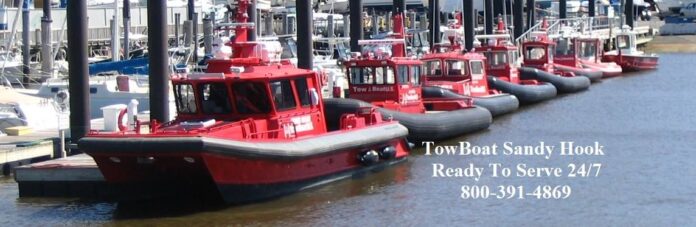
Finally the Atlantic Highlands Harbor Commission has made some headway in correcting some of the wrongs that leasee Capt. Harold Smith and his TowBoat/US has had to endure for the past two years.
Since the new $1.5 million dollar was built 22 months ago at the Harbor, and been leased to both the NJ State Police and TowBOAT/US, Capt. Smith has complained about the improper, unsafe, or inadequate construction problems that were apparently overlooked when Kappa Construction built the facility and walked away from the job as complete.
Since then, Smith has pleaded with the Harbor Commission, then when nothing was done, appealed to the governing body as the borough is building owner. He asked that he be released from his lease that he has been paying without any discounts for the incomplete or incorrect work and continued to ask that it be corrected. Council referred the matter back to the Harbor Commission saying it was their facility, and the Commission has been working with an attorney since then.
Last month, the Commission made some corrections and promised more, and Smith reported this week they have kept their promise. Borough council, however, had not yet taken any action on releasing Smith from his lease.
The businessman reported this week that the shut off valves for the gas have now been properly put in and his PTAC unit installed. He’s now waiting for a heavy rainfall to see if it’s been successful. He also indicated nobody has shared the results of the water test they conducted nor released any results of the survey they did.
But things are looking up, Smith said, as he continues operating the business he has had at the harbor for more than a decade.
Kappa Construction, meantime, is keeping on schedule at its $10-plus million dollar construction of the Highlands Borough Hall on Route 36 in Highlands. Most of the exterior initial siding and roof construction is in place and expected to be completed before colder weather sets in so work can continue inside during the winter months. A portion of the parking area on the west side of the building has been paved, and Kappa employees, after Police Chief Rob Burton reminded the firm parking on the state highway is illegal, are now parking within the property fencing and keeping both the highway lane and the sidewalk open for motorists and pedestrians.
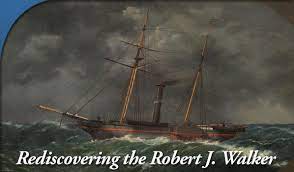
Dan Lieb will be the guest speaker of the Middletown Township Historical Society discussing the USCS Robert J. Walker, a steamship that made headlines in 1860 off the New Jersey coast.
Lieb will present his program on the historic ship Tuesday Nov. 22, at 7 p.m. at the Middletown Township public Library. There is no admission fee and an invitation is open to all to attend; there will be no ZOOM presentation of the program.
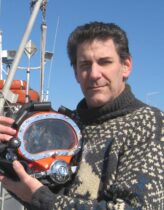
Dan Lieb
Lieb, a found member and current president of the New Jersey Historical Divers Association, will tell the story of the steamboat which was used for surveying. It sunk in 1860, a tragedy which marked the largest loss of government employees whose lives were lost at sea outside of times of war. His presentation will cover the discovery of the site of the coast, and further information on how the expedition was formed and records made at the site. Live will also speak on diver training and divers’ impact on historic preservation.
An employee at Divers Two, Lieb inspects, services and fills scuba tanks, repairs and alters wet and dry suits, sells and rents scuba gear, and runs foreign, regional and local travel for the firm. Certified as a PADI SCUBA Diver at age 17, he has completed more than 2,000 scuba dives from Canada to the Caribbean and holds PADI AOW and Rescue Diver certifications.
In addition to the presidency of the divers association, Lieb is a technical illustrator with 36 years of experience, and has worked on nearly 30 archaeological expeditions recording shipwrecks.
He has identified 14 shipwrecks off New Jersey and lectures extensively on shipwreck history. His mapping expedition for NOAA in 2014 recorded the remains of the Coast Survey Robert J. Walker. In in addition to writing several books on New Jersey wreck diving, Lieb has appeared on the History Channel’s “Deep Sea Detectives” featuring the sunken locomotives off Long Branch. He is also the director and curator of the New Jersey Shipwreck Museum at InfoAge in Wall, and a member of the Explorers Club.
The Historical Divers Association is a not-for-profit historical organization dedicated to the preservation of New Jersey shipwreck and maritime history.
For more information about the Middletown Township Historical Society, please visit MiddletownNJHistory.org.
The library is located on Tindall Road. near Route 35.
While each of the Atlantic Highlands council members gives extraordinary reports at council meetings of all that’s been going on within their respective committees each month, it’s Councilman James Murphy’s reports that are most in depth and in detail, actually keeping the public informed of all that is going on in the departments which he oversees.
As an example, at the other night’s meeting of the governing body, Council members Lori Hohenleitner and Brian Dougherty had nothing to report, Councilman Brian Boms said he had nothing to report, but did mention the planning board had cancelled its scheduled meeting last week because a lack of completed applications, and a about the upcoming fund raiser. Jon Crowley reported briefly, though enthusiastically, about the EM radio site soon to be a realty, Steve Boracchia give a brief report on the Harbor Commission and the impact of the high gas prices there, but nonetheless the harbor should fare better this year than last.
But Councilman Murphy had a page full of details on the first aid, recreation committee and the Public Works Department, keeping the public well informed of how busy all were this month as well as reporting on the success of events including the Halloween house decorating contest and parade. He said he was leaving updates on the police and fire departments to the other council members to report.
So Murphy reported and it was nice for the public to know the first aid responded to 20 calls during October, and another 12 already in November. It’s important for people to know the squad has answered 234 calls this year, a fact that might stimulate more interest in someone becoming a squad volunteer or perhaps contributing funds to help them. He urged residents to “give a smile and a handshake” to Tim Farkas, Mike Berth, Ann Schoeller, Amanda Stolte, John Wilson and Chief Lance Hubeny for being the call leaders for the month.
He reported on the success of the community CPR training class and cited the annual food drive and the Santa Runs which will run from Dec. 5 through Dec.8, directing residents to the squad’s Facebook page for information and how to make donations. He put out the e-mail address, info@ahfirstaid.org for anyone who wants membership information.
Murphy addressed the recreation activities by summing up the success of the Halloween events, as well as reminding parents recreation basketball signups are open until Dec. 4, giving prices, and once again, urging residents to visit www.ahnj.com and check out all information and registration for recreational activities. He announced the annual tree lighting ceremony Dec. 3 and deferred to Mayor Loretta Gluckstein for the most recent update on activities planned for the event.
When it came to the Public Works Department, Murphy reiterated their busy schedule, announced leaf pick-up, organized by zone, is on schedule, and there will be no more brush pick-up for the year, but announcing when the yard is open for drop-offs. He cautioned everyone to be aware of the heavy rain event predicted for this week. He reminded residents that DPW Director Jimmy Phillips is always ready, willing and capable in answering any questions concerning the department, its schedules, and the work it does.
A lengthy, thorough report. A lot to absorb in a single meeting but all information the public has a right to know. Perhaps council members should consider putting their monthly reports on the borough page so residents can read what they want, absorb what they need to, and have the opportunity to be kept informed about events, people and places going on in town.
It has charm, it has beauty, it has comfort, and it’s right in the heart of town! The Court Square Inn is Holly Springs’ answer to a most elegant and hospitable B&B at a price that’s easy to accept. It’s an award winning charming home away from home in northern Mississippi, a few miles away from the Tennessee state line.
While Holly Springs has charm, history, and plenty of other reasons to visit as well, the Court Square Inn is also only a short drive from University of Mississippi and all those grand Ole Miss sports games; it’s also not far from Tupelo for the folks who want to know where Elvis grew up. It’s only about 35 miles outside of another great town, Memphis, Tennessee, though with more economical prices.
For historians, a walk through their very historic Hill Crest cemetery is enough to give you in depth backgrounds on the Yellow Fever epidemic and the heroines of that time, as well as the 7 Confederate War Generals who are buried there, more than any other burial ground in the United States. In town, you can see where General Grant stored his ammunition during that most terrible of all wars, visit where Ida B. Wells grew up and why she is honored on a US postage stamp and stop in at Rust College. Rust is one of the historically Black Colleges that was built a few years after the Civil War, and Ms Wells father was one of those who made it happen.
But forget all that when you’re settled into the beauty and charm of the Court Square Inn and meet its friendly and southern genteel owners, Tim and Lisa Libby. The Inn is small enough that you get to meet everyone else who’s there…there are really only three units, two which are two bedroom and plenty big enough to host those after-event parties right at home, and one lovely one bedroom suite.
Traveling with one of my favorite grandsons..I have seven favorites…we reserved the two bedroom suite in the middle of the second story B&B. Right smack in the middle of town, from the porch outside, we could see the County Court House across the way, the historic hardware store, in business since 1837, and other shops, as well as the rows of American flags that dot the streets. Buildings In the area also display the new state flag for Mississippi, the one that did away with the Confederate flag and put in “In God we Trust”.
But back to the Inn and its special charms.
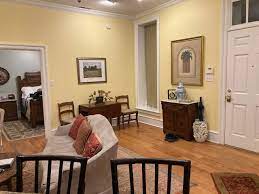
Our individual bedrooms, each complete with four posters, bedside tables filled with interesting books and local information and private bathrooms, were separated by the huge living room with fireplace, lots of couches and chairs, and a sit-at counter separating that portion of the spacious interior from the fully equipped kitchen. When I say fully equipped, that includes service for eight in dishware, more glasses than you can think of serving drinks in, pots and pans to cook whatever you want to bring into the large refrigerator and freezer, a dishwasher, and hey, even a washer and dryer in case you need to do a bit of laundry during your stay!
Since it’s a B&B, breakfast is also provided, and here again, it’s with the Southern charm and practicality that makes life just a little bit better. No need to get up and dressed to head out to a dining room here. Rather, Lisa has amply stocked the kitchen counters with plenty of delicious fresh pastry, cereals and fruit, and in the refrigerator, plenty of milk and two kinds of fruit juices.
The Inn was built just around the end of the Civil War and is Italianate style in structure. The rooms are on the second floor above the Apothecary, which was at one time the local pharmacy, but thanks to Tim and Lisa, has now been renovated into a spacious and beautiful catering facility for everything from business meetings to wedding receptions and celebrations.
Because it’s so popular and an award winner as one of Mississippi’s top B&Bs, reservations are a good bet, especially on football weekends, or major local events, such as the Hummingbird Migration in September. But you’ll always be greeted by a soft Southern voice, an intense desire and effort to meet your every need, and the opportunity to see just how charming and personable the South really is.
I have a great daughter-in-law. Not only does she keep my son supremely happy…or at least thinking he’s happy all the time…but she is so talented and hard working. She’s creative and has invented new meanings for the word recycle. That’s because it never ceases to amaze me how she can take a piece of trash, or something she has found in somebody else’s trash and make it into something new, useful, and beautiful … a work of art. She and Jim are working on renovating their third house where their hard work and her ingenuity and creativity have changed it from an eyesore or underused building in the town to a true tax ratable and award winning masterpiece people come to see and enjoy.
And I know where she gets all her creative talent, too. It’s called Cindy Fraser.
Cindy is Stacey’s mom and is a charming attractive and friendly lady who also lives in Mississippi and has transformed her own home into something like a museum with all the unique touches and talents she has poured into it.
Her hobby is painting and her favorite is folk art. So when she gave me one of her outstanding pieces as a gift when I was in Mississippi earlier this month, I was overwhelmed.
There are some tricks to Cindy’s artistry. In her folksy scenes, like the one she gave me, there are always lots of people, and they’re rarely alone. There are practically always happy kids in her paintings, the way she thinks all kids should be. The kids are always doing something, be it jumping, running, skating, skipping, or working.
And there are always adults around as well, usually couples or people together. Cindy is a people person and it shows in her artwork.
Her paintings have lots of light, be it from snow or sun, from streetlamps or interior. Kind of her own expression that light is so superior to drab and darkness.
And there are always animals, but not just any animals, animals that you wouldn’t expect to see doing things you wouldn’t expect to see them doing. And that’s the fun of it all.
You also have to look closely at Cindy’s busy picture scenes, because one of her other tricks is to put in some quirky action or animal that you have to look closely to find…then laugh because it makes you feel good to see it. In this photo, there are at least three different kinds of animals doing things or being places you wouldn’t expect.
So look closely at this painting, my newest cherished possession from a warm-hearted artist and friend. Take a couple of minutes to find the unusual, laugh at the silly and admire the artwork. It just makes you relax and feel good.
PLANNING BOARD NOTICE OF MEETING CANCELLATION-Notice is hereby given that the Special Meeting of the Atlantic Highlands Planning Board to be held on November 14, 2022 at 7:00pm at the Borough Hall of Atlantic Highlands, 100 First Avenue, Atlantic Highlands, NJ 07716 has been cancelled. Any matters scheduled will be carried to the Regular Meeting on December 1, 2022 at 7:00pm at the Borough Hall of Atlantic Highlands, 100 First Ave, Atlantic Highlands, NJ 07716.
The good news is this is the notice that was posted on the borough’s webpage, AHNJ shortly after 8 a.m. this morning.
There will be no planning board meeting tonight to review or even talk about that Redevelopment Plan the borough council introduced at Thursday’s meeting., the one that is proposing a major change to the Mother Theresa school property totally unknown to the public but was not identified as such in the Council meeting agenda.
The bad news is the public is still kept unaware of the reason for it.
The planning board meeting scheduled for tonight was so important Thursday night during the Council meeting that the chairman of the board could not even be called during the meeting to see if he would adjourn the meeting.
So now we know the Mother Theresa Redevelopment Plan that was going to be before the planners tonight is on the agenda for the regular planning board meeting on Dec. 1 at 7 p.m. at Borough Hall and presumably on ZOOM.
But there is still so much the public does not know.
That planning board meeting scheduled for tonight and now cancelled was so important that even when the attorney on ZOOM, representing the owners of the Mother Theresa property to be discussed as this all important meeting, could not even get a yes to his request that the meeting be cancelled, adjourned or postponed.
It was this attorney for the Mother Theresa school property owners who, in conjunction with the borough administrator, said he would contact the planning board’s attorney to get it resolved by this morning.
Read that again carefully.
It was not the borough who offered to get it adjourned; it was the attorney for the property owners saying he had never heard of this idea for the Mother Teresa Redevelopment Plan who said he knew the other attorneys and made suggestions, along with the administrator, of how it could be handled. Council had said they couldn’t simply call the planning board chairman right then and have it done. Of course, that begs another question
Who called that planning board meeting in the first place? It could not have been the planning board. They did not have a meeting in which they voted on the meeting. Does someone else besides the Chairman call meetings without anyone else knowing about them? Surely the secretary who advertised the meeting didn’t call it without being told.
Really. Isn’t it about time to stop all the secrecy and let the public know the whole story about what’s going on?
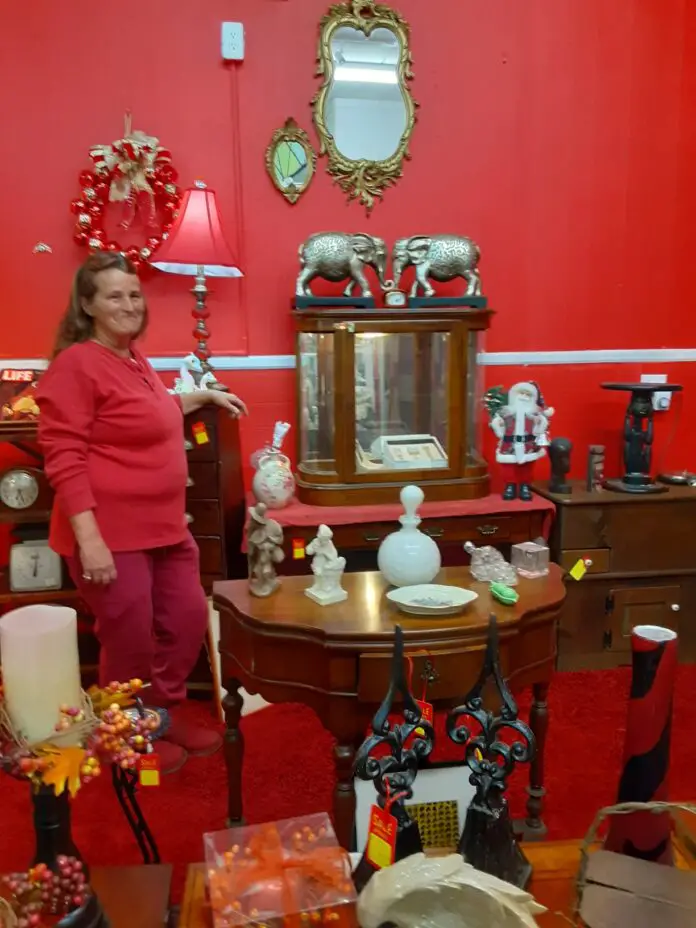
Ronnie Adams is an unusual, kind and generous woman. For more than 20 years, she has been holding garage sales, yard sales and doing fund raisers, all to raise funds so Calvary Chapel on Route 36 in Atlantic Highlands can continue its good work of providing whatever is needed for the less fortunate in the community.
And now Ronnie has opened yet another another shop in the amazing Renaissance boutique on First Avenue that is open seven days a week with an almost rock solid guarantee of having something for everyone.
The new shop in the group of neat and individual shops inside the red door offers a combination of old, new, antique, and quirky items for sale, ranging in price from fifty cents to $300, all to benefit all the community causes the Church sponsors and includes for their donations.
There is one more item in the shop, a signed soapstone sculpture of a mother and child that goes for considerably higher, but for now is simply a talking piece in the display. The $300 item is a fascinating antique wooden dough table, complete with the top board for rolling out dough, the storage drawer for allowing the dough to rise, and a couple of smaller drawers for tools of the trade.
But in between that 50 cents, for little ornaments, and the dough table, there are shelves and tables of cards, books, newspapers, statues, holiday items, and religious items for a variety of religions, from menorah to crosses. “Every religion is important,” said Ronnie ,”so we are happy to have items for each to respect and have.”
There are the unusual as well. Including the ottoman fit for a living room or bedroom, complete with storage space within and a hidden mirror in the cover. There are kitchen appliances from antique potato mashers and wooden rolling pins to graters and sieves and dishes and pots to use with all of them. There are horseshoes for good luck, and elephants of all sizes for bookends or décor. The new ideas include jewelry and candles, and with the Christmas season just beginning, there is an accent on Santa and mangers as well.
“We all have to give back,” the philosophical Ms. Adams says, “and we all have to help one another and do for one another. Running this shop for Calvary Chapel and all it does, its wonderful pastor, and the joy it spreads, is just one small thing I can do to practice what the Bible preaches we should be about.”
Renaissance is open seven days a week from 11 a. to 5 p.m. The Calvary Chapel booth is just one of the more than dozen shops where dreams and memories can be found and purchased at bargain prices