It was the Sun Oil Company vessel, the Sunoco, that went on fire and exploded in Sandy Hook Bay not far off Naval Ammunition Depot (NAD) Earle in the early morning hours of Jan. 1, 1945. The massive fire, which could be seen throughout the Bayshore area, lunched immediate safety precautions and actions by the commanding officer, dockmaster and Sailors and Coast Guards personnel aboard the ammunition depot.
Owned by the Sun Oil Company, commonly known as Sunoco and leased to Atlantic Refining Co, the vessel was enroute from Perth Amboy to Philadelphia when the incident occurred.
Although the precise cause of the fire, which started amidships, was never determined, there was considerable speculation the vessel struck submerged materials, speculation primarily since the decks of the vessel were clean and the hatches were intact rather than blown open.
Considered small by tanker standards, the Sunoco was 246 foot in length and could be compared to a barge. It had loaded 15,000 barrels of benzoil at Barber Asphalt Co in Perth Amboy. Benzoil is used to create 100 octane gasoline, and the shipment was enroute to Atlantic Refining’s refining plant at Point Breeze, Philadelphia. Because of the gale force winds and rough seas during a severe January storm, there was the strong possibility the Sunoco had anchored in Sandy Hook Bay east of the Fort Hancock station, and was pulling up anchor when the explosion occurred.
Captain John J. Jenkins was the 57 year old captain of the Sunoco, a long time experienced merchant mariner who hailed from Wilmington , Delaware. Born in Virginia, he had lived in Delaware for 30 years and had been working for Sunoco for 15 years. He was one of the eight men reported missing when the first alarms went out for assistance.
Navy and Coast Guard boats from NAD Earle and New York responded to the emergency, as well as the Firefighter, a New York fire-boat under Chief John Horton. That boat reported running into burning oil along the waterways enroute from New York to the scene just off NAD Earle.
Navy and Coast Guard boats rescued six of the 16 member crew, bringing them to the Naval dispensary at Leonardo and the Coast Guard hospital at Fort Hancock. Of the 16 crew members, the final tally showed three died, seven were reported missing and not recovered, and Sailors and Coast Guardsmen rescued six.
Firefighters met all kinds of disastrous conditions as they attempted to rescue survivors, including both a dead body and a rescued merchant seaman found on a raft in the turbulent sea. Additionally they had difficulty hosing down the blaze since the frigid temperatures caused the nozzles on their hoses to freeze and create considerably heavier weight in handling the hoses.
With the captain among the missing, men either dead or in the water, the Sunoco was left without any control and began drifting towards the Navy piers at Earle. The swift turn of events came after initial reports that the vessel appeared to be stationery in the water and not presenting any threat. However, within a few minutes of that information, another call came to the Leonardo pier from Bos’n Gross whose smaller boat was heading to the Sunoco in the rescue efforts. He reported the Sunoco was on the move, was burning fiercely and was on a direct collision course with the three piers at NAD Earle.
The Dockmaster, Lieutenant Commander O’Pray, got in his car and headed out to the pier area
He could see the flaming boat was within the area ,if not already alongside one of the piers. This was a vessel, loaded with benzoil, abandoned by its crew and officers, a derelict not under control.
At the three piers at NAD Earle, there were four ships berthed, each carrying a heavy load. Together, it totaled 16,650 tons of ammunition. And a burning derelict vessel headed towards them.
Looking back at all the challenges a military installation face, both in war and peace time, it would seem that the Navy with its waterfront installations might many more in both its efforts to help people at sea as well as to protect its installation from both land and sea problems.
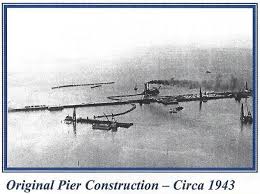
It is a tribute to the planning and orderliness of the US Navy that there are few serious accidents that have occurred at what is now Naval Weapons Station Earle. When built during World War II in 1943, the base was known as Earle Naval Ammunition Depot. Today, it is Naval Weapons Station Earle with its waterfront complex in Leonardo and its headquarters in Colts Neck.
The Navy installation spans more than 11,000 acres in Monmouth County, including more than 100 miles of rail tracks built to accommodate locomotives, flat cars, box cars and more between the Leonardo pier and the headquarters and other buildings and facilities in Colts Neck.
There are three piers on the Leonardo side, and in the beginning, in addition to Navy and Marine personnel, the Coast Guard also reported here during wartime, and were accommodated for housing at the Coast Guard base on Sandy Hook. With merchant vessels also carrying ammunition in addition to Navy ships, the Coast Guard’s work efforts intensified and by July of 1944, there were four Coast Guard officers and 60 enlisted men reporting for duty at NAD Earle.
It was the bravery, quick thinking and swift action of Navy and Coast Guard personnel and rugged equipment of the US Navy that averted an accident that had the potential of wiping out a large percentage of lives and homes in the Bayshore.
One sailor with his crew almost single handedly prevented that disaster because of his own bravery and their swift action.
It happened one cold night in January 1945.
Lieutenant Commander O’Pray was at home and in bed when he received a call from Chief Boatswain Alexander Gross. Gross reported to the dockmaster there was a vessel on fire just east of the pier area in the vicinity of Sandy Hook.
It was around 1 a.m. in the morning; there were extremely rough seas, and gale winds blowing throughout the area between 50 and 60 miles an hour.
O’Pray’s first orders were to get all the rail cars moved from the pier area. The cars were loaded with ammunition at this time eight months before the end of the war, and the commander made safety of personnel and land his first priority. Next, the dockmaster ordered that action be taken to get the ships berthed at the Pier away from the area, clear of any danger and ordered the largest yard boat to be in charge of that directive. Next, Lieutenant Commander O’Pray ordered that no fewer than three of the yard vessels head out to the stricken burning vessel and assist in every way possible in putting out the fire and rescuing personnel.
One of those three vessels sent out in the middle of a dark night, in the height of heavy seas and gale force winds, was YTB216, a tugboat.
Named the Cochise, and under the control of R.L. Tooker, was this the right move to make?
Did R.L. Tooker respond in the way he should? Stay turned for Part II of the story…
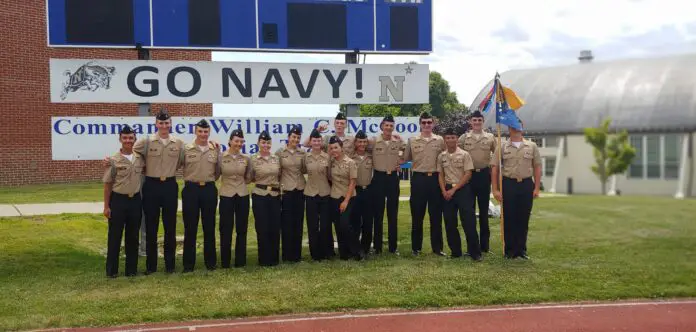
Fifteen rising junior and seniors from MAST successfully completed the NJROTC Area Four Leadership Academy/Sail Training earlier this month at Naval Station Newport in Rhode Island. The students were among the 108 cadets from the Northeast who participated in the intensive two-week program run by the NJROTC Area Four office and supported by the Naval Academy Preparatory School and the Officers Training Command at Newport. Normally held each summer, the program was suspended for the past two years due to the Covid pandemic.
The program is designed to develop and improve skills that will help cadets succeed in the future, whether they choose a military or civilian career path, and is a mix of static and dynamic training. Cadets who were selected to participate had to complete a comprehensive application, submit an essay about what they hoped to get out of the course, pass a physical fitness screening test, and had to demonstrate the potential for leadership.
Cadets who successfully complete the course are awarded the coveted silver aiguillette worn on their NJROTC uniforms.
During the two weeks in Newport, cadets participated in classroom, outdoor labs, and sailing sessions, and followed a specific Plan of the Day, starting with physical fitness training at 5:00 AM, and continuing with a block schedule of academics, drill training, and sailing. Cadets marched everywhere they went — to the barracks, the base dining facility, the classrooms, the pool, and the marina – and sang military cadences to stay in step and keep motivated. With the exception of boxed lunches at the marina, all meals were eaten in the base galley, and cadets were not permitted to talk, walk around, or socialize during meals. Cadets wore dark blue US Navy running shorts and a colored tee shirt specific to their platoon daily, and always carried water bottles to prevent dehydration and heat-related illnesses. All were required to turn in any electronics at the beginning of the course, and were not permitted phone calls home, access to social media, television, or junk food, with the exception of an eight-hour tour of downtown Newport when they could use their phones and eat wherever they chose.
Throughout the two weeks, the cadets were evaluated and critiqued, both individually and as a platoon, on level of effort and participation, motivation, and how well they followed and led in the many different challenges. A cumulative score for each platoon was tabulated to determine first, second, and third in each event, and one platoon was selected, based on scores, as the Honor Platoon. Additionally, the top scorers from each platoon were awarded for academics, sailing, and physical fitness, and one cadet was selected from each platoon as the Most Motivated Cadet and one as the Honor Cadet. One Distinguished Cadet was selected out of the three platoons as the top graduate in the course. Cadet Brandon Weiss of Oceanport was scored highest on the PT test of all cadets in his platoon, and Cadets Hugh Smith of Morganville and John Zeveney of Red Bank, along with two cadets from high schools in north Jersey, won the orienteering competition.
Classroom curriculum consisted of 22 interactive classes on leadership skills and topics highlighting personal and unit goals, issuing orders, delegating authority, taking the initiative, making decisions, communicating and keeping an open mind, developing teamwork, providing effective feedback, rewarding accomplishments, time management, safety, recognizing and discouraging inappropriate behavior, overcoming bias, and maintaining integrity.
Sail training consisted of classroom instruction in physics, safety, seamanship, navigation, rules of the road, weather, and sailing nomenclature and terminology, followed by hands-on training on Rhodes 19 sailboats modified for teaching purposes. This training culminated in teams of four cadets in competition with other cadets in a regatta. MAST cadets had an advantage in the sailing portion, as the MAST NJROTC program is the only unit in the nation where cadets are required to take the NJ Safe Boating Course and receive their boating licenses. Cadet Sam Puleio of Tinton Falls was recognized as the top sailor from his platoon, and he and Cadet Abigail Hesterhagen of Atlantic Highlands were part of the four-person team that took first place in the regatta.
Cadets also toured the Navy’s Surface Warfare Officer School’s Full Bridge Simulator, a mock-up of a Navy combatant ship where junior officers learn ship handling and watch standing skills, the Lt. Michael Murphy Combat Training Pool (named for the Medal of Honor recipient), and historic Fort Adams, a coastal fortification at the mouth of the harbor of Newport, which served as an active Army post from 1799 to 1953.
“One of my favorite things about LA/ST is how quickly everyone felt a sense of community,” said Cadet Hesterhagen, who will be a junior at MAST in September. “Every single person had to put in maximum effort to be successful, and we learned very quickly that we needed to work well together as a team.”
Cadet Puleio added he particularly was impressed by the curriculum and resources to which the cadets had access. The rising MAST junior said “we had lectures from retired senior Navy personnel, trained in the combat training pool, drove ship simulators at Surface Warfare School, sailed in the bay, and the list goes on.”
Hesterhagen added that “everyone started supporting each other right away, and that support and teamwork continued up until the very end. Surprised, she added that one of the things she found she enjoyed was “waking up early. I felt better than expected starting the day at 0500, and I felt very refreshed and accomplished having already done PT among other things early in the morning.”
Cadet Tessa Campolattaro of Rumson also loved the camaraderie of the Leadership Academy. “Being able to celebrate the good moments while sticking together as a team through the bad ones was so important. The hard parts, like not getting a lot of sleep and constant running around, only pushed us further. They made us bond. They made our accomplishments that much more incredible and satisfying.” The rising senior, who was selected to serve as MAST’s top-ranking cadet, the battalion commander, for the 2022-2023 school year, said her experience was made ‘incredible’ since she was able “both to learn from the instructors and serve as an example to my platoon. I would not be able to list the amount of things I learned. It was really an unbelievably unique and constructive experience.”
Cadet James Treshock of Monmouth Beach, MAST’s deputy battalion commander, especially liked “being able to meet cadets from other NJROTC units and getting to talk about how other units operate. I feel the hardest part of the two weeks was keeping a rigid schedule and keeping my platoon on track.“ He said it was easy to deviate from the plan of the day to get in more drill practice, or rest, “because my fellow platoon aide and I quickly learned when it was time to rush to the next activity and when we had a couple extra minutes for platoon time.” Treshock was surprised about the difference among other cadets in the program. “Some were incredibly committed while others acted like they were forced to be there. This made it difficult to manage when we were trying to instruct kids who had different levels of motivation.”
Cadets attending the Leadership Academy came from NJROTC programs in New Jersey, New York, Pennsylvania, Delaware, Vermont, New Hampshire, Maine, Connecticut, Rhode Island, and Massachusetts. In addition to Weiss, Smith, Zeveney, Hesterhagen, Puleio, Campolattaro and Treshock, the other cadets from MAST who successfully competed the program are Maya Burns of Keyport, Alexis Walker of Fair Haven, Dylan Agnese of Lincroft, Esteban Pedroza of Holmdel, Connor Gavioli of Red Bank, Sophia Bracken of Little Silver, and Noah Cuttrell and Ronan Alo, both of Middletown.
While each of the cadets is enthusiastic about the two weeks, and each feels he and she has learned many new skills, each also has specific memories that they treasure. Treshock said one of the most important things he believed he can take away from the two weeks is “time management. I learned how to stick to a schedule.” He also felt it was valuable to live on the naval base and get a glimpse into what life in the Navy is like. “This was especially important for all of the LA/ST cadets who have naval aspirations like myself.” He feels grateful to have participated for the many lifelong friendships he feels he has made. “I was forced to work with peers that I have never met. We rose to the challenge which brought us all together to work as friends and a well-oiled machine.”
Hesterhagen said “I loved the challenge that each new day had to offer and how our teamwork allowed us to make the most of each day”. Every day got easier and harder at the same time, she said. Getting used to all the little things, like not talking at meals, keeping rooms perfect for inspections, and responding correctly before sitting down were all easier for her than not knowing what time it was. “It was definitely an adjustment not always having a clock or watch, and it took me a long time to get used to that.” In the end, however, she said, “I was surprised about how quickly the time passed, especially the second week. The days seemed long, but the weeks flew by.”
The MAST junior expressed what all 15 felt. “I definitely gained more confidence. I learned how to be a part of a team with people at all different levels. I think we all learned how to be a good follower while leading without realizing it. We learned a balance between leadership and followership, and we learned when to take charge and when it may be better to step back. To be a good leader, you have to be a good follower. There is no easy or set way to be a leader, so it is important to know your people, stick with your decisions, and be willing to adapt.”
Puleio said, “I think it is very important to recognize how well MAST prepared us for this experience. I found myself ahead when it came to physical fitness, drill, and inspection because of how well we train at MAST.”
More than 25 retired Navy, Marine Corps and Coast Guard members facilitated the academics and sailing training, along with labs in STEM, physical fitness, orienteering, combat swimming, etiquette, sword and guidon manual of arms, and close order drill and marching. The cadets were split into three platoons, with retired senior enlisted serving as platoon commanders, and cadets hand-selected for their leadership ability, maturity, and trustworthiness serving as platoon aides. Instructors strove to make every moment a teachable lesson in time management, forward thinking, and planning and preparing for the next event, and the instructors and cadet aides served as role models and mentors, and led by example.
Commander Tracie Smith-Yeoman, USN (Ret.), Senior Naval Science Instructor at MAST, is the Administrative Officer for the Leadership Academy, and Senior Chief Mike Vaccarella, a Naval Science Instructor at MAST, serves as the Gold platoon leader each year.
“This is the largest group of MAST cadets we’ve ever sent to Newport, and I am incredibly proud of the spectacular job they all did,” said Smith-Yeoman. “When I think of everything these cadets have been through over the past two years due to the pandemic, I am so impressed with their performance. It’s not easy to be away from home for two weeks, and to leave their friends and social media behind, but every day these cadets demonstrated maturity, dedication, and motivation. Once again, I am reassured knowing the future of our world lies in the hands of young men and women like these cadets.”
It certainly is painful to see that the United States Postal Service does not have to accommodate disabled persons when it decides which is more important: protection against theft or whether a driver with an ambulatory disability should expect to be treated equal to everyone else?
The good new is, at least in Atlantic Highlands where Casey is the Supervisor, the staff is going above and beyond what is required of them and is going out of their way to help persons with disabilities.
The bad news is, not every post office has a Casey as Supervisor, and the US Postal Service is changing its system nationwide.
The immediate problem is the curb side mailboxes in front of the Atlantic Highlands post office. They used to be facing the street, proper height for most vehicles, and with slots big enough the driver of the vehicle could open it, put in stamped envelopes or small packages simply by pulling up to the curb side box, putting down his window, and dropping in the mail for pickup by postal employees at the appointed time.
Now…and Atlantic Highlands is one of the first in the area to reap this ‘benefit”, there are two new shiny clean mailboxes, still at the curb. But they’re facing inward. Towards the sidewalk. Impossible to access from the vehicle.
Which means a handicapped person with difficulty standing, walking, moving, even an elderly person who has great difficulty in getting in and out of cars but is still capable of driving them, now has to get out of the vehicle and walk around to the opposite side of the mailbox as the closest receptacle, and drop in the stamped mail through a much smaller slot. No more little packages. Just envelopes. (As a side note, it’s going to be fascinating to see how this will impact traffic congestion or backups on the adjoining road.)
I filed a complaint with the official US Postal Service, not the local office. The official office where you send inquiries and complaints apparently got it, read it, and decided it’s not their problem. So they handed it over to the local office. Within a couple of hours of my filing the complaint, Casey the local Supervisor was on the phone to me.
“It’s because of all the thefts you’ve read about”, she explained. “They’re doing this all over the nation. This is a change to Service is making and it is above us”. I would not expect Casey to know all the answers, but I still cannot understand how facing a mailbox toward a sidewalk prevents thefts better than having it face a sitting person in a car. Neither she nor I knows whether there are cameras available somewhere if the box is facing the sidewalk, or even some kinds of alarms that ring somewhere if the sidewalk facing box is tampered with.
Casey was patient, calm and eager to answer my questions, but unfortunately did not have any information to respond to most of them. She did tell me, and I certainly appreciate it, what she and her staff are doing to make things as easy as possible for persons who complain or need assistance. It’s only because of this staff, however, that Atlantic Highlands residents with ambulatory problems can still use a curbside mailbox like everybody else. Though it will take them a little more time. (Again, traffic congestion?) Treating persons with disabilities different from others?
Casey said she and her staff are always willing to help anyone who needs it, and she cited several examples where she has already done this. All a driver need do is call the post office at 732-291-0740 and request the supervisor come out to the car, take the mail from an outstretched hand out the open window and she will drop it in the mail receptacle. Or, as an alternative, a person can leave the mail in his home delivery mailbox for the carrier to pick up at his next delivery time and bring it to the post office.
Casey’s a positive person and looking for ways to keep all postal users happy, as well as meet the needs of the staff, both inside the office as well as those incredible mail deliverers….I’ve heard folks in this town say theirs is the very best and it seems to be true all over town…… Optimistically she said “we can figure it out.”
In the meantime, the post office has been offering a mail drop service in front of post offices for decades. Now, apparently because these mail boxes cannot be designed or modified to prevent thefts, the only solution is for the handicapped person, the one who cannot get out of his vehicle easily while others may be waiting in line to use the same service or leave their vehicles running while they walk to the mailbox, to be inconvenienced and made to feel different one again.
The transparency Mayor Carolyn Broullon and through her the Highlands Borough Council are displaying when it comes to the regionalization question for the school system should continue to be praised and appreciated.
If authorized by the Commissioner of Education, this will be a major decision made by the voters and voters should be cognizant of as many facts as possible before casting any ballots on any question. I continue to applaud the openness and wealth of information being released.
I also think the governing body under Mayor Broullon is taking big steps in trying to be a little more transparent in other areas, although still not giving the public the opportunity to he heard at meetings or accommodating the those with disabilities.
Still, they now have a camera on site at the new borough hall, though I haven’t seen it live yet.
They have videos of their meetings on their official webpage, though the audio system is terrible and the video is not much better.
They are trying, and I applaud them. Though I will never understand how they cannot keep up with the technical knowledge and capabilities that allow other towns to be so much more open with their residents. Or how little they care whether interested persons … disabled or not, can participate in meetings.
At the same time, and here is where I am not very complimentary, the Mayor and Council are still shamefully non-transparent when it comes to other issues which are vitally important to taxpayers, businesses, churches, and schools. Decisions that will also impact the borough and its future in substantial ways.
I’m talking about cannabis… and the new Borough Hall.
With the governing body’s continuing refusal to offer any governmental meetings via zoom, interested persons must attend night meetings at the Community Center, a building that does not meet all the requirements to be considered fully accommodating for the disabled.
Interested persons have no way of seeing what’s going in at a meeting now that a former councilwoman has moved out of town and is not videoing meetings on Facebook.
Interested persons have no way of interacting or asking questions or getting information from the governing body during public portions of meetings without being present in the meeting room, in spite of 21st century technology available throughout the county and state.
So some things might come as a surprise!
Like last week’s meeting of the Mayor and Council for instance.
The governing body simply adopted a resolution supporting Bridge City Collective LLC’s plan to open a cannabis dispensary within one of the business zones the borough previously approved. Bridge City, which is really a collection of different businesses can now go to the state and apply for the necessary license, now that Highlands has said it’s a good thing for them to be here. Their next step is to come back to the borough to apply for the one license Highlands has said could be used in Highlands. It will be interesting to see what local names are now part of Bridge City Collective.
A big decision, it would seem, with something so new as cannabis. Yet they did not even have to talk about it at the meeting. As one person who cannot attend night meetings because of a disability, I do not know whether they did. Or if there was any public there to even hear it, let alone ask questions.
On the agenda, it’s listed as one of several resolutions council members had apparently discussed and approved and there was no need to go into any detail at a meeting. Unless of course there were people who couldn’t attend the meeting who wanted to ask any questions…
Oh that’s right, they couldn’t. Because Highlands Mayor and Council meetings are not offered to all the public, just those who are fortunate enough to be in the room.
There’s a lot more to that story and VeniVidiScripto will have a lot more do say about it in the future.
But for now, let’s look at the lack of transparency on the construction of the new borough hall, the $10 million plus building currently under construction, and going very well on Route 36 adjacent to Our Lady of Perpetual Help Church.
This is not to say the borough is doing anything wrong. It’s simply to note that it’s an important issue, is costing a bundle of money and still borough residents are not being kept up to date on everything. Not the least of which are all the costs of this brand new building where construction will be ongoing for more than another year.
The borough bonded $10 million…that’s six zeroes….for the new building.
The lowest bid came in around $10.4. So already, they started to be over budget before they even put a shovel in the ground. Sea Bright had the same architect when they built their two municipal buildings a couple of years back. When it was all done, they came in UNDER budget!.
It will take a lot of catching up to see that happen here
Call them hidden costs, call them routine costs, call them necessary costs, and that’s probably all correct. But it shouldn’t take prying, asking questions, or checking minutes to get all the information. If meetings were held on ZOOM, everybody who cared would know what contracts have been awarded, what necessary additional charges they are, and what is to be expected in the future. Sometimes, even, when things are done over the course of years, you can’t always remember each cost. But they all add up.
Ok, the land for Borough Hall was purchased for $450,000. Fair enough and well known. But that’s in addition to the $10.4 million bid.
Then there are a few more bills, by no means all of them, which have already added to that cost. In September 2018 Settembrino Architects a fine firm that has done considerable work on many different municipalities’ buildings in many towns, was awarded the job of architectural and environmental services and that work was revised seven months later to include all civil and environmental work, geotechnical, interior design, structural, mechanical some IT, and renderings plus a few more things.
That’s another $611,320…. Plus expenses.
That more than half a million dollars covers somebody from Settembrino preparing a schematic for the governing body to review, attendance at one planning board meeting, preparing all the construction documents and technical specs so the work could be put out to bid, reviewing the bid and making recommendations on it, and a few more things that architects are trained to do.
But then there’s more. You can’t just have a builder come in and do the job, no matter how sensational it is or how much the workers know. You need a construction management service to oversee the work, apparently another common expense.
But that is costing taxpayers another $263,921.28, which must be a great price for the work. MFS Construction, another great group of well educated and trained folks, was the lowest of 12 bids! Over a quarter of a million dollars and it was the lowest of 12 companies vying for the job!
There are lots more costs for applications, permits, the original cost of the architect before even becoming involved to make sure all the rules, changes, approvals etc. are done properly and correctly. Not exactly sure this doesn’t fall under the purvey of the construction manager’s job, but then, I’ve never built a $10+ million building
On the plus side, there are protections against some even higher costs. For instance, there is $500,000 set aside as protection against additional changes or charges.
Borough Administrator Michael Muscillo does a stellar job in his position and is open and timely in providing information, resolutions and just about anything else requested of him. But he is a busy man and there’s a lot going on in Highlands. So much of his time could be spent and so much more transparent could this governing body be, if it simply went with 21st technology and let people attend meetings virtually. The administrator is still providing me with the answers to more costs I have asked. And we haven’t even gotten to the costs of furniture, for the new building! Or the added costs of jail cells in the police department area. Or amenities needed for the court room.
Already, the new Highlands building’s costs are well over $12 million, more than $2 million over the bid for construction by Kappa Construction, the low bidder and industrious firm whose crews are on the job and working well, in spite of the record temperatures.
Heck, there wasn’t even a formal groundbreaking ceremony for this could be $15 million building, and I hardly think the reason was to save money.
But I also wonder…where are the taxpayers with their queries?
Don’t they want to know what everything is costing?
Has anybody asked if desks, files, tables, chairs, computers and all the other stuff that helps keep the borough running now are going to be used in the new building? Or is there just going to be another whopping bill for all brand new furnishings because the stuff there now is too old and won’t look nice in a pretty new borough hall.
Don’t property owners want to know what will be reflected in their tax bills?
Does everyone trust the governing body so much they don’t need to ask questions, make suggestions, or look into details?
It isn’t fair to sit back now and let things just happily drift along, then, when it’s too late and tax bills are out, start complaining about the high costs and terrible tax rate.
Or do Highlands taxpayers really just want to be surprised, shocked, overwhelmed, when they see the final bill and learn, too late, the final bill for everything they’re getting?
While I wonder whether Shore Regional is sitting back waiting to see what reaction Oceanport will get to its petition asking the Commissioner of Education not to let residents of Highlands, Atlantic Highlands and Sea Bright vote on regionalization, it still makes me wonder about so many other things. The least of which is…don’t people learn from past mistakes?
Both Shore Regional and Oceanport have remained silent throughout all the regionalization news, meetings workshops, Facebook talk and more this year.
If they attended any meetings to become informed, they did not make themselves known?
If they asked for copies of either the Porzio or Kean University reports, they did not identify they were asking in official capacities?
If they called any borough officials seeking information… there are no records of it.
Weren’t any of these people around five years ago?
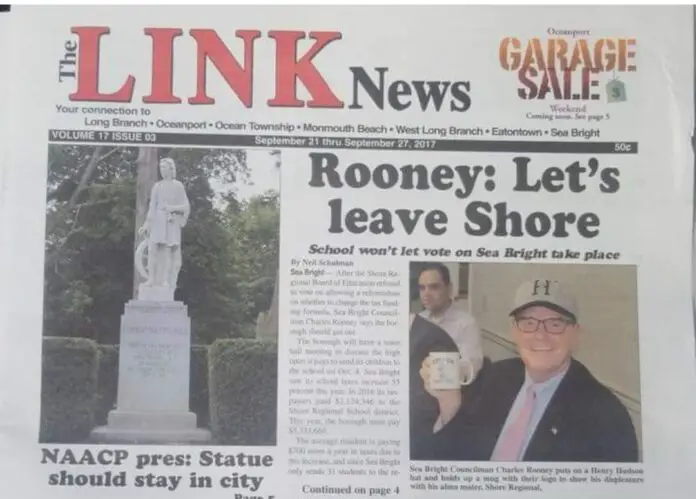
Back in 2017, Charlie Rooney, son of a former Mayor, was a Councilman in Sea Bright. He was signing and approving checks every month in the hundreds of thousands of dollars, all payments to Shore Regional High School for the education of the 31 Sea Bright kids in the school district.
Rooney was annoyed as hell over the high cost of education, and he and the rest of council tried to negotiate with Shore Regional.
There were meetings…
There were talks …
There were ways mentioned of how the tax formula could be changed so Sea Bright taxpayers would only be paying their fair share … not their fair share plus hundreds of thousands of dollars more.
In the end, and at the very last minute, Shore Regional said nope, we’re not going to allow any referendum to change the tax formula. Continue to pay up Sea Bright, we like your money $$$.
An Irishman who had seen his own father work so hard to maintain Sea Bright the fine community it is, Charlie was photographed on page one of The Link, still a leading local newspaper in the area, when Shore Regional’s decision came down. In the photo in 2017, he was wearing a Henry Hudson hat and holding a Henry Hudson mug, his personal way of showing his disappointment in his own alma mater, Shore Regional.
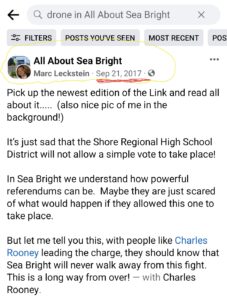
Councilman Marc Leckstein in that same newspaper, issued a warning to anyone smart enough to listen.
Leckstein said “With Charley Rooney leading the charge, Shore Regional should know Sea Bright will never walk away from this fight. It’s long way from over.”
So here we are. Four years later. And it ain’t over!
So that, residents of the Bayshore, is how the battle began to have Sea Bright sever its relationship with the school districts that were charging them thousands and thousands more for the same education kids in other towns were getting.
Maybe now, voters in Monmouth Beach, West Long Branch and Oceanport, you should be asking those officials from five years ago why they didn’t simply let the people have the right to vote on whether they wanted to help Sea Bright or not? Or did they all think, what the heck, Sea Bright is our absolute best customer, let them keep on paying the lion’s share.
Oceanport voters should be asking whether they should be paying for any legal action now that the law has changed and it looks very favorable to have a vote on whether Sea Bright should quit being your biggest contributor…in money, not students.
By the way, the thing that steamed Charlie so much was this. In 2016, Sea Bright residents were paying $2.124 million in annual taxes for education to Shore Regional. The notice for the next year was that rate was going up to $3.333 million. That’s a 55% hike in a year. That’s roughly $109 a year increase per each resident for the 31 children being educating. Given that only 31 kids were being education, that whopping amount comes out to $108,000 per student.
Now do you think regionalizing with Highlands and Atlantic Highlands is a prudent move?
And if you think Charley Rooney was mad then, Shore Regional, you can understand why he’s so vociferous in being a leader in the battle today.
Only this time, the state of New Jersey is backing Rooney’s idea. The Governor gave money to towns to study regionalization possibilities and probability and the way to accomplish it.
Do the people of Oceanport or any of the towns in the Shore Regional district think state legislators or the Commissioner who answers to them are going to oppose letting the people have their say? The law, S3488, was passed unanimously by both houses in the legislature; it was signed into law. Does anybody think it was all done so that things could stay the way they are?
Do these folks who are asking for state chastisement for towns who want to let their residents have a say in local government know what professionals participated in this from the very beginning? Do they have any idea about the legislators who wrote the words that are now law?
And Oceanport taxpayers, are you taking up the fight for Shore Regional so they can sit back, save money and wait to see whether your complaint to the Commission is effective? Or is there now a chance that the three towns who want to vote on something new, something refreshing and something legal will now result in correcting a wrong the state made decades ago.
Paul Zigo, history professor, author and military historian, does a magnificent job as founder and director of the World War II Era Studies Institute in keeping us mindful and knowledgeable of the Greatest Generation and that time in our history.
The institute he founded is dedicated to furthering knowledge and understanding of the second World War era and its impact on history.
Paul has authored several books on the era, and he himself is an army veteran who retired as a colonel after 30 years in service in the army. He is a founding sponsor the National Museum of the US Army.
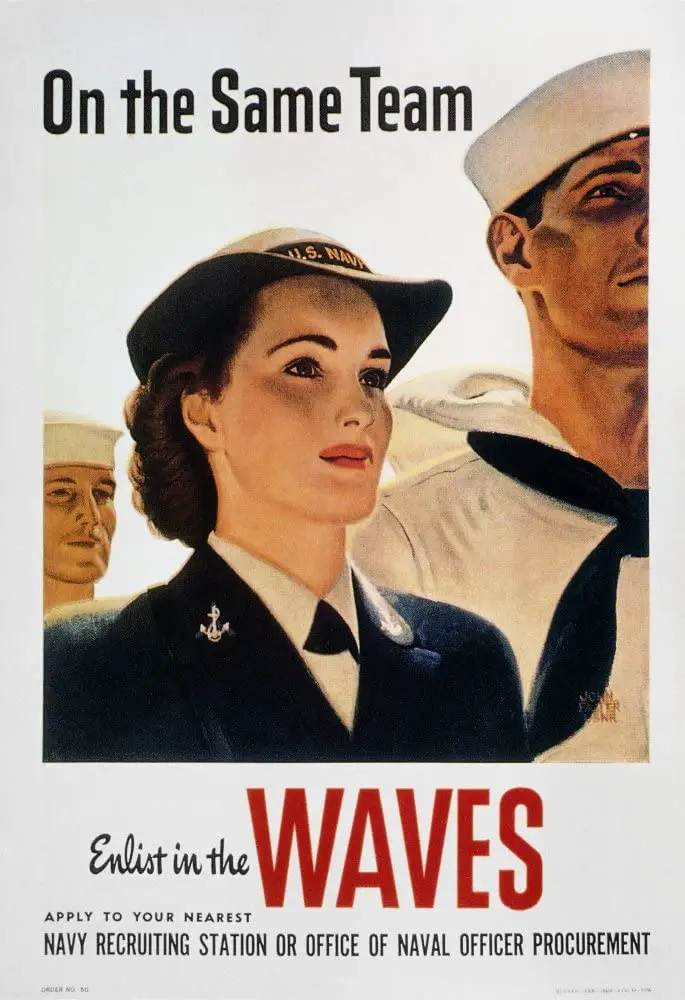
So, this week, when he reminded all of us who eagerly read his regular e-mails, that it was on July 30, 1942, that the WAVES were established, it’s worth a story to let others know how this group of very courageous women got together at a very dangerous time in history and defended the country in their own special way.
For one, you can thank Eleanor Roosevelt, wife of the President, for having a part in forming the unit. She’s the one who convinced Congress women should be authorized as a component of the navy.
Hence, on July 30, 1942, seven months after Pearl Harbor, the Women Accepted for Volunteer Emergency Service (acronym WAVES) was established. Emergency in their title meant women were accepted because of the unusual circumstances of the war. But at the end of the war, they would not be allowed to continue in Navy careers. Well, fortunately, that didn’t happen, and that’s the end of that story.
In spite of the very long name, this new unit was known from the start as WAVES, both for the acronym as well as an allusion to ocean waves.
Mildred McAfee was president of Wellesley College and she became the first female commissioned officer in the history of the Navy when she was sworn in as a Naval Reserve Lieutenant Commander and named the first director of the WAVES.
It was an all-volunteer service and women signed up for either the Navy or Coast Guard (SPARS) and went through a training program; if they chose to become officers, they had to attend an Officer Candidate Volunteer Program, basic recruit training, then midshipmen during their officer training and finally they became ensigns and were part of the Navy Reserves. They were different from WEACS; WACS, the Women in the Army served WITH the army, the Waves served IN the Navy.
WAVES did not serve aboard combat ships or aircraft and at first were restricted to continental United States duty. However, before the War was over in 1945, they were authorized to serve in certain U.S. possessions, some going to Hawaii, not a state at the time; but they never served in any other location.
Most of the first 27,000 waves did clerical work, but some had various duties in the aviation community, medical professions, communications, intelligence, storekeeper, science and technology.
It wasn’t until 1948 three years after the war, that the Women’s Armed Services Integration Act was passed and women gained permanent status in the armed services. The WAVES as such were discontinued and ceased to exist after that, though up until late in the century female Sailors were still identified as WAVES by the general public.
The WAVES even had their own official song, in addition to the Navy’s Anchor Aweigh, called WAVES OF THE NAVY
So Happy Anniversary July 30 to those brave women of the 1940s who became WAVES as well as Love, Safety, Admiration and Thanks to those even more brave women from the late 1940s on through the present who became, equal to their male counterparts, sailors and officers of the US Navy.
The Borough of Atlantic Highlands will be experiencing high heat temperatures in the 90’s with moderate humidity for the next several days. We would like to remind all residents to stay hydrated and cool. The Atlantic Highlands Senior Center will be open to all residents as a cooling center should it be needed. Thank You
It will be 12 years on Saturday, July 23 that Robert A. Bruno, Sr. died.
To everyone in Highlands, Atlantic Highlands and so many other places, he was Bob Bruno, or Bobby Bruno, that great, soft-spoken and soft-hearted husband, father, and grandfather who was always there for every Pop Warner football game, every fund raising event for any good cause and genuine nice guy. He was a Marine as well, serving on the Battleship Missouri during the Korean War, and a lineman for JCP&L company, rising to be a line supervisor for the company. You could even see his smiles when he was at the top of a pole making emergency repairs to ensure families and businesses always had the power they needed.
Bob went through some difficult times in his life as well, but always with a prayer, understanding and a sense that this, too, can be conquered and in the end, everything will come out right. And is usually did.
Bob’s daughter, Renee, died a couple of months ago, bot his loving wife Abyna is still as charming as ever and still living in the family home,.Along with Ayna, his daughter Kim, and sons Bob, Jr., Jerry and Gregory, all share some of the friendliness and warmth of their dad. And now there’s even another generation carrying on the Bruno genes and making people happy wherever they are.
Mayor Carolyn Broullon has included on the borough’s official webpage, the entire 21 page letter sent by attorneys for Highlands and Atlantic Highlands to Commissioner of Education Angelica Allen-McMillan, Ed.D, asking that the regionalization question be put on the November ballot.
The letter to the Commissioner had been sent last week with the approval and consent of Sea Bright and the three boards of Education. Broullon then posted the letter online without delay, to ensure every resident is able to see every facet of the situation that has been on mayors’ and board of education presidents’ minds for more than a year. In the case of Sea Bright, it has been the subject of debate, discussion, and futile attempts to accomplish an aim to help alleviate taxpayers in that community while still providing outstanding education for its residents in Pre-K-12 classrooms.
The letter was signed by Vito A. Gagliardi, Jr. of the Porzio firm which is the leading firm across the state in regionalization and represents Highlands in this proposal He sent it with the approval and consent of Jonathan Busch,Esq, . Matthew Giacobbe, Esq. Sea Bright Mayor Brian Kelly, Highlands Mayor Broullon, Atlantic Highlands Mayor Loretta Gluckstein, Dr. Tara Beams, Tri-District Superintendent of Schools as well as board presidents of Atlantic Highlands, Highlands and Henry Hudson Elisabeth Eittreim, Diane Knox and Mark Heter.
While the Commissioner has not yet responded to the request, teams representing all the involved parties are meeting to iron out the details of cost sharing for Highlands and Atlantic Highlands, both of whom will benefit financially with the addition of Sea Bright to a single board of education, since Sea Bright’s student population will not mean any new construction or additional faculty members.
In the letter, Gagliardi notes the pleasure of all involved in submitting the request for a referendum question to the Commissioner. To ensure she is fully supplied with all the necessary information for her to make a recommendation and report back to the community, the letter outlines the history of the request as well as the importance of allowing the public to decide what it wants. The letter also points out more information sessions are still being planned to include the final proposed funding formula so residents will know before they cast ballots specifically what a pre-K-12 regional school district would cost and save with the addition of Sea Bright in the district.
The letter points out that enlarging the current 7-12 regional district, and including grades K-6 as well as Sea Bright would create the first all-purpose district for the three communities. The letter explains not only would it incorporate the current three boards of education into a single board, but the petition also seeks to enlarge the regional district to include Sea Bright Borough as a member “if its withdrawal from the Oceanport and Shore Regional School Districts is approved by the Department of Education and the voters of the three towns.”
Under the proposal, the expansion and conversion of the current regional district to an all-purpose PK-12 district would occur July 1, 2023, if approved on the November referendum.
To ensure the entire idea is not lost, the letter also points out to the Commissioner that the immediate expansion, conversion and consolidation of the existing Henry Hudson Regional Tri-District would provide immediate budgetary savings due to stabilization of state aid under the most recent laws. It would also allow for added efficiencies that eliminate major obstacles in expanding educational opportunities for all children.
The letter suggests these benefits include moving grade six out of the existing elementary schools into Henry Hudson school . an idea deemed in order to align curricula and instruction including grade six students to participate in a more age- and developmentally-appropriate academic initiative, clubs, activities, and athletics. Such a move would also provide students with more appropriate social, emotional learning supports for middle school-aged students.
That would leave space in the elementary schools to expand preschool programs, specialized special education programming for students with autism, language learning disabilities, multiple disabilities or other specialized needs which may not be realized by the existing structures. Such a move would then reduce special education out-of-district costs, the letter points out.
Citing more benefits of an all-purpose regional school district, the letter highlights greater opportunity for staff development and growth, leadership opportunities, sharing specialized staff and consistency in procedures, with consolidation of collective bargaining agreements and alignment of schedules, policies and leadership.
There would also be immediate budgetary savings due to eliminating current duplicated services, and would align and share resources and services enabling the regional district to respond to future challenges.
Gagliardi also highlight the excellent of the current Henry Hudson tri-district, terming it “a true exemplar of a commitment to shared services,” since, though separate, the three boards share a Superintendent of Schools, a Director of Curriculum & Instruction, and a Special Services supervisor already.
Some of the districts have also shared a business administrator and use shared contracts for many of their staff, a procedure they have followed for more than a decade. Continuing this practice in a fully recognized PreK-12 district removes barriers that “have impeded common-sense educational planning growth and development practices…”
The Commissioner, whose permission is essential before any education project can be placed on a ballot, can either approve the project as committee, make recommendations under which she would approve it, or reject completely, meaning the regionalization question would not appear on the November ballot and local residents would not have the opportunity voice their opinion in the ballot box.
Because the bill approved unanimously by both houses of the Legislature last year, and signed by the Governor in January, is designed to enable a community like Sea Bright, which is not a member of the Oceanport Board of Education and has single vote on the four member Shore Regional district to seek a more equitable educational program with the consent of its voters, personnel involved with the regionalization question in all three towns are hopeful the Commissioner will respond favorably and in a timely manor so the question can meet the August 15 deadline to appear on the November ballot and additional educational workshops can be held to keep the public informed of the importance of their vote.