I’m not a lawyer. I’m not a feminist. But I am a woman and I work with an awful lot of lawyers in one of my volunteer positions that I participate in several days a week.
Yet I have never been so dismayed, so surprised, and so disappointed when I learned what the Machado Law Group appears to have done.
I have never heard or seen a lawyer who did not identify himself when talking about a case in which their firm is directly involved. I have never seen or heard of a lawyer directly involved in a case who would seek to get answers about things the opposing side is doing, thinking, saying or planning without identifying himself as a lawyer from the firm representing the ‘opposition.”
But I saw this with the Machado Law Group of Springfield. I saw it in the person of Christine McGee. Indeed, that is who this person who reached out to me is. There is a Christine McGee listed with the firm. That I saw on their website. But no where did I see, from posted minutes of Oceanport board meetings to websites from either the board or the law group, that this is the firm representing Oceanport.
How perfectly shameful. How devastatingly unethical. How cheap, low, and so beneath a professional.
And for feminists who have fought so hard, continue to fight so hard, and have made great achievements, what a tragic setback to their cause and goals to show how brilliant, capable, upright, educated and ready women are in the 21st century.
Christine McGee as a member of the Machado Law Group of Springfield, has done her profession, her sex, the Oceanport Board of Education, all of Sea Bright, Highlands and Atlantic Highlands, a terrible injustice.
I’ve seen released prisoners with higher standards of morals and integrity.
With fewer than two dozen people both on ZOOM and in person at the meeting, the planning board reviewed a number of recommendations they will have to the Mayor and Council before the public hearing and possible adoption next Thursday of an ordinance which would enable both retail and manufacturing cannabis operations in specific sections of the community.
The recommendations from the planners do not have to be adopted by the governing body; they are simply areas where the planning board members feel the governing body could incorporate specific items in the ordinance. The board had already determined cannabis businesses are in conformance with the borough’s Master Plan.
Council can react in several different ways at Thursday’s meeting, expecting to draw large crowds from residents on both sides of the issue. They can decide to withhold any further action on the ordinance until they looked more carefully into the planning board recommendations, they could decide they did not want to accept any of the recommendations and hold the public hearing and final vote at their meeting, they could hold the public hearing and delay their vote on the final approval of the proposed ordinance for another meeting, or they can decide they want one or more of the planning board recommendations included.
Should the Mayor and Council opt for that last possibility, or make any changes in the proposed code, the code would be ended right then, and a new process started. That process would once again include an introduction, referral to the planning board, public hearing and adoption, which would mean final action on a new code could be delayed until October or possibly November.
With a sparse crowd at the planning board meeting and no one wanting to be heard either in person or on ZOOM concerning the recommendations, Dr. Merissa Zuzulock and other members of the subcommittee which has reviewed the proposed code cited about ten suggestions they would make. These included consideration of limiting foot traffic, spelling out buffer zones, eliminating black shades be required on retail cannabis businesses, limiting the size of the businesses, including height restrictions for manufacturing, and granting conditional use for specific times to see how the new business fares. Members talked about the buffer distance in relation to the elementary school, and the impact on parking and additional law enforcement but made no specific recommendations any of those areas.
Planning board member John McGoldrick chaired the meeting in the absence of Chairman Douglas Pepe. The board unanimously agreed to have attorney Michael Steib write a letter by Monday listing the recommendations, with the plan to have that information to the Mayor and Council in time for the governing body to review it before Thursday’s public hearing and possible adoption.
That there will be a crowed at the meeting is anticipated in light of a recent gathering at the Senior Center in the Yacht Harbor called by a grass roots of residents opposed to any cannabis businesses in town. Councilmen James Murphy, Brian Boms and Steve Boracchia were all present at the meeting, with Murphy highly vocal in his opposition to any of the businesses permitted anyplace in Atlantic Highlands. The group has received donations from local residents, has had signs printed and displayed on residents lawns throughout the borough and has circulated petitions all in opposition to cannabis businesses in the borough.
Likewise, dozens of people in favor of cannabis have been at council meetings showing their support for some type of business, arguing a larger percentage of the local population voted in favor at the state election which made cannabis legal for sale, manufacture, distribution and use in the Garden State.
In other business at the meeting the planning board gave unanimous approval of a variance for the Paskewich property at 104 Asbury Avenue, and after presentations and hearings, also approved a minor site plan and use change for True North Management LLC at 68 First Avenue to permit another medical business within the complex of businesses already active in the building. Planners also approved a variance the Kelley property at 35 E. Garfield ave. enabling the Kelley’s to make renovations to a century old garage for personal use and storage.
When I got an e-mail from an attorney back in February, an attorney from a Springfield firm, I didn’t think anything of it. As a long time writer, and one who was born and raised in Union, right next door to Springfield, it did not even seem unusual.
Every day because of my blog, I get dozens of phone calls or e-mails, occasionally letters and texts, from people who have read my blog, researched me and had something they wanted to either tell me, ask me, or have me write. So this one was no different from so many.
It was certainly nice and friendly.
“Hi Muriel,
My name is Christine Magee, and I have seen your articles on the Highlands school district regionalization on various news sites. I found your contact information on your blog site and was wondering if you have heard any further updates regarding whether the Highlands or Sea Bright have submitted their petition to the Commissioner of Education for authorization to hold the referendum on the creation of the all-purpose school district. It is a story we are interested in following. Please feel free to give me a call at 973-232-5291 if you like. Thanks so much for your time!
Sincerely,
Christine Magee,
Associate, Machado Law Group
I had no way of knowing, and there was no indication in this very friendly letter, that the attorney who was reaching out for me, a reporter, actually is employed the Machado Law Group, the reported attorney for the Oceanport Board of Education. That’s the very same Board of Education from which Sea Bright wants to leave so it can become a part of a new, revitalized, and all-inclusive K-12 regional school district.
As I pointed out in a previous story, the minutes available on the Oceanport Board of Education webpage include the reorganization meeting of January 2022, when no attorney was named for the reorganized board.
After three attempts to obtain what should be information readily at hand in a board office, I OPRA’d the board. That’s when I learned the last time the Machado group was retained as attorney for Oceanport was for one year starting January 2021. Still my OPRA revealed the law group has been paid every month until July of this year, including $11,725.50 June 30 for ”Sea Bright legal services.”
Yet Christine Magee, the attorney in the Law Group, didn’t think it was important enough when asking me questions about the regionalization issue, to inform me, a reporter, she is a member of the firm representing an involved party?
Without any further knowledge about to whom I was now e-mailing, but being a reporter always willing to share information, we continued conversations over the next four months right up to two weeks before that “Sea Bright Legal Services” posted payment.
Never, in the course of all of these e-mails, did Ms Magee think it important enough to let me know she represents a law firm involved in the regionalization issue.
I responded to this e-mail highlighting everything I knew and promising I would give more information as I learned it … Not unusual for a reporter to do for anyone who asks.
The next e-mail came Feb. 23, minutes after my response in which I shared the information I knew and also gave my new e-mail friend the assurance I’d get back when I learned anything else. The response to that was “Great, thank you so much Muriel!”
But again, no mention her firm represents Oceanport.
In the next e-mail, in my attempts to be helpful to interested parties who might not be able to attend meetings, I asked Ms Magee, if she had copies of the resolutions she was asking about.
Her response to that was “Yes, I have the same for Highlands and Sea Bright. I have also been checking regularly to see if Atlantic Highlands posted any resolution on the same but, as you noted, there is nothing so far.”
I still did not know, and even had I thought about it, had no way of knowing she was in the law group representing Oceanport in what is a major question not only in Oceanport and Sea Bright, but Highlands and Atlantic Highlands as well.
Our e-mails continued. I was certainly helpful, typical for a reporter to tell anyone who asks any information she has.
In my next e-mail I shared more information and an opinion: “I just learned that all three resolutions have to go in together to the Dept. of Education, since the director won’t do anything unless there’s agreement first. Which to me seems like too much power to give to one group, rather than a majority. And I’m not sure AH will recuse. Tonight is a council meeting, so I suspect it will at least come up during the public portion. The delay rests on the fact the local board of education doesn’t want regionalization in my humble opinion!”
And that prompted a response from Ms. Magee “Interesting. I didn’t realize AH could have two potential recusals as well. I wonder if the delay in AH rests in part on their spouse’s commenting on the same. “
And in another e-mail, Ms. Magee wrote: “Wow, you are right, that is a lot of power to give to one group. Interesting to see how these proceed.”
Cynical though I may be as a reporter, I also have a high regard for attorneys. It would never occur to me that a professional, especially a women in the legal field since they have worked so hard to achieve equality there, would continue a conversation about some legal matters in which her law firm was involved without letting me know that indeed, that is why our friendly conversations started in the first place.
April was the first time I could have had some indication but even then, I never thought a professional attorney would not identify herself as a contractor with a board involved in the regionalization question.
The April 6 e-mail from my new VeniVidiScripto friend informed me that Ms. Magee “was at the Highlands town hall meeting last night. I thought your question was great, but it seems odd that they were not able to answer such a simple question as the timeline. It will be interesting to see how this matter progresses.”
To which I responded: “Ah, wish you had introduced yourself to me. Do you live here? I thought they answered the timeline question, saying 3 months is enough time to get it on the ballot. I did not know all the info that has to be included in the actual question though … interesting stuff.”
I do no know whether the law firm was reimbursed for this attorney’s presence at a meeting. She did not identify herself during that meeting. Or even to me, whom she obviously could identify since I spoke and would have given my name and address.
Yet, still I did not get any indication I was talking to a paid professional involved in the regionalization issue.
The response to my question? Christine Magee, a member of the Machado Law Firm which the Oceanport Board of Education says is its official board attorney, even without a resolution at reorganization saying that, responded “ I am from Plainsboro, but I work for an education law firm. So I am just interested to see how this all plays out.”
The attorney for the Oceanport Board of Education received more than $60,000 in payments from the Board for the first six months of 2022, even though there is no evidence the attorney was ever retained for services this year.
When three telephone calls to the board of education during the past two months failed to release any information on the Machado Law Group which had been hired by the board under a one year contract in 2021, VeniVidiScripto filed an OPRA request to get copies of the minutes the board failed to release despite those repeated attempts.
The OPRA request also asked for payments made to the law firm.
Under OPRA laws, the Board has seven business days in which to respond to an OPRA request and this board took advantage of each of those seven days before producing the information.
It showed there has been no action this year to renew a contract with the Machado Law Group. But the reports obtained through the OPRA request also showed significant thousands of dollars were paid to the law firm since the original contract ended in January 2022.
While minutes of the 2022 reorganization meeting showed there were appointments for other professionals, including an architect, auditor, broker of record and purchasing agent, there was no appointment of a board attorney. The 2022 minutes show numerous appointments for mandated positions a board of education must maintain, appointments that range from an indoor air quality officer (Spiro Katechis) to an anti-bullying coordinator (Megan Bonett). But there is no reference to the appointment of an attorney.
The minutes forwarded to VeniVidiScripto from Laura D Godlesky Ph.D., Superintendent of schools, and signed by Edmund Zalewski, custodian of records only showed that the Machado Law Firm was hired for one year in January 2021.
The minutes from 2022, which are available on the Oceanport Board’s website, do reflect that “All insurance, tuition contracts, and professional contracts currently in force are reaffirmed for the respective terms of the agreement.” However, it does not appear that that could cover the Machado Group inasmuch as their term of agreement ended at the reorganization meeting.
While the payments paid since January do not reflect much more information that the total paid for diverse vouchers identified at “legal invoice,” or “invoice,” or Legal services, or “attorney,” the Machado Group received $60,174.73 from the Oceanport Board of Education between January and June of this year. It does not appear there have been any payments for July of 2022.
It is interesting to note, however, that there were two payments in June. One payment which totaled $3704.25, was apparently for legal work done in that month. However, a second payment of $11,725.50, was made to Machado Group for “Sea Bright Legal Services.”
While the cover letter from Mr. Zalewski corrects my spelling of the firm group‘s founding member’s first name, from Isabel to Isabelle, the correction of numbers and or dates received through the OPRA request do not appear to be as completely accurate. Under checks posted, there is a check paid to the Machado Group totaling $3844.50 identified as a “legal invoice. ”
It was issued Feb. 16, 2022. It was for services 12/ 22.
Next:Has the Machado Law group been present at any of the school regionalization workshops in Highlands or Sea Bright?
“This is very good news for Atlantic Highlands,” said Councilman Brian Dougherty, after it was announced the borough has received two grants for Electronic Vehicle (EV) charging stations.
Announcement of the grants represents more than a year’s work by the borough’s Environmental Commission. These efforts intensified in January when Dougherty became a councilman and was named council representative to the Commission.
Commission Chairman Blake Deakin has been a long time researcher into EV chargers and has been in touch with a number of companies that supply stations. Last year, the commission chairman also presented a Powerpoint presenation that went back into the history of electric vehicles, their decline in use and their rejuvenation in the 21st century. The Powerpoint also supplied information on the kilowatt hours of batteries, the impact of emissions on renewable energy and the types of emissions, what the stations are, their benefits, deficits, and how municipalities can benefit in tax dollars. The presentation is available at
Dougherty declined to take credit for the grant awards, stressing the receipt of the grants was a team effort which included Deakin, Councilman Brian Boms, who was council representative to the Environmental Commission last year, and was helpful throughout the process, and borough administrator Robert Ferragina.
As announced at the meeting of the Mayor and Council last week, the grants were awarded as Tourism Grants from the NJ Board of Public utilities. Dougherty explained they are not matching grants, but rather will reimburse costs incurred to have EV chargers installed.
A grant for two dual-port Level Two charges, worth up to $9,000 in installation and ‘make ready’ costs was one of the two the borough received. The second grant is for up to $75,000 for a Level Three/Direct Current Fast Charger which would include all necessary electrical infrastructure to operate the changing stations, along with all the conduit and wire to the station locations, and all the concrete work to make the stations mounted along with any cellular repeaters if they are part of the installation.
Deakin, who has obviously done considerable study on EVs and their advantages and disadvantages, pointed out the differences and advantages of both a Level 2 and a Level 3 charger as well as other benefits of the EV car batteries.
Councilman Dougherty said the borough is waiting for additional instructions from the PBU to be contained in their official letter from the state on the grant awards.
Once the borough receives that, he said the Environmental Commission will schedule a workshop session during a Mayor and Council meeting to discuss the procedure for continuing to move forward and to explain the many benefits of EV charging stations. The borough would then have up until June of next year in order to complete the work so the money spent on the stations would then be reimbursed in full.
Dougherty explained why he thinks the grants are a boon for the borough. “The Route 36 corridor is currently an EV charger desert,” he said. “Aside from the stations recently installed at Bahrs Restaurant in Highlands, I’m not aware of any EV charging stations along Route 36 between Sandy Hook and the Garden State Parkway.”
With EV charging stations here, he continued, “Any visitors coming to our area to use the beaches at Sandy Hook or Sea Bright, for example, would have to venture over to Route 35 to find a charge for their EV. When these stations are installed in Atlantic Highlands, it would be a definite attraction for visitors to frequent our restaurants and shops downtown while their vehicle is charging. And, as we all know, once people discover how wonderful Atlantic Highlands is, they will come back.”
The charging station at Bahrs is reportedly offered at no charge to the customer, and charges at a comparatively slow rate and could mean it would take a minimum of ten hours to fill a standard EV. However, the restaurant could elect at any time to change its pricing schedule.
The borough charging stations could be set at the owner’s own price and the borough would receive a portion of that overall charge. Dougherty said the rates will be set by the terms of the contract in which the borough enters with whichever commercial EV charging vendor the borough selects. Since all that is still to be determined once the borough gets the necessary approvals to proceed with the work under the grant reimbursement.
Dougherty said, “We are not quite at that point yet, but will certainly be happy to share all additional details with the public as they become clearer.” However, the Commission is continuing to study the utilization rates of chargers in other towns which they have and will gather additional data and will incorporate assumptions into a revenue plan for this borough.
“This is not a political issue! This is a community issue! And when I feel my hometown is going to be negatively impacted, you bet I’m going to stand up and fight.”
That’s what a very angry and fired up Councilman James Murphy said this week when asked why he is opposing cannabis businesses in the borough of Atlantic Highlands.
The planning board meets Thursday night at 7 p.m.. to review what they have already ruled; cannabis is a permitted use under the Master Plan, but the planners may make changes or additions to the ordinance. Should they forward their opinion to the council that the proposed ordinance being considered needs no changes then the governing body will hold a public hearing Thursday, Aug. 11 at their 7 p.m. meeting and take a vote on whether cannabis businesses of specific types should be permitted in the borough.
Murphy is urging all residents to either attend the Council meeting via Zoom or attend in person to let the entire council hear what they have been telling him.
Murphy said he has been deluged with calls, comments, e-mails, and people stopping him on the street asking him to be sure to vote against the ordinance. “These people calling me aren’t republicans, they’re not democrats, they’re parents, they’re senior citizens, their young couples who just took out mortgages so they could buy a home here. They’re all saying the same thing,” Murphy said. “They’re all telling me that cannabis businesses will change the town, ruin the borough’s image, hurt local businesses, and end up costing taxpayers for more police, parking, sanitation, and lost revenue to businesses because people who love the looks of our town now won’t want to come here in the future.”
The councilman, whose own family has been here for three generations, and he is raising the fourth by raising his three children here, said residents have told him they don’t think the town is big enough to support a cannabis business.
“We’re not as big as Eatontown, we’re not spread out like Middletown, we’re a community of close knit families,” he said. “Our elementary school is right in the heart of town, our restaurants are so superb they draw diners from all over the county,” he continued. People who live here love it, want to stay, and want it to stay like it is.”
Because so many residents have contacted him and asked him to take action, Murphy said he is doing all he can to preserve the town, its image, and its beauty . But it is important for the people themselves to voice their opinions, he stressed, “and that’s why I want them to come out to the Aug. 11 meeting. Let them tell everyone what they have been telling me.”
He was one of the team who held a meeting last week of many who have complained to him and want to take action. “People have turned over money to this grassroots committee to buy signs, print posters, do mailings, anything that can be done make the people aware of what is going on.”
The councilman was also surprised at how many people do not even know that the possibility of cannabis businesses being within walking distance of churches, schools, parks, and residences could be a vote away at the Aug. 11 council meeting. “I have been going door to door and finding people who don’t even know this is happening,” he said, exasperated. “I feel an obligation to let people know what a change cannabis businesses will mean for our borough.” The fact so many turned out for that Monday night meeting, the fact people want to make donations or distribute signs or do something to be sure cannabis is not approved in the borough is enough to give Murphy the determination to fight any possibility the ordinance could be approved.
“While it sounds great the borough will make money from the taxation, the history of cannabis businesses in other states show it is a cash business. How are you ever sure you get the full tax represented by sales?” he asked rhetorically. “New businesses like this will mean more police, even if only to direct traffic, people complain about lack of parking now, yet in Eatontown they say there are lines waiting to get into the store there. What will happen to our other businesses if people don’t want to support them because they can’t find a parking place, or don’t like the crowds, or don’t think the town looks as beautiful as we know it now?
Councilman Murphy is not the only public figure who has spoken out and been active in opposing cannabis businesses in town. The Rev. Jarlath Quinn, pastor of Our Lady of Perpetual Help Church, has been to local municipal meetings citing the dangers of cannabis and calling on the council to think of its impact on this small hometown community. Former mayors from both political parties, Randi LeGrice, Richard Stryker, Mike Harmon and Fred Rast have all spoken out against any cannabis businesses in the borough, and their works were also echoed by the past two police chiefs, David Rossbach and Jerry Vasto.
Mayor and Council introduced an ordinance at its meeting last week designed to both assist veterans as well as facilitate sharing stories of their accomplishments and sacrifices as members of the Armed Forces.
The proposed ordinance would establish the Atlantic Highlands Veterans Affairs Committee and would include five volunteer members appointed by the Mayor with at least three of the members veterans of the armed forces.
Purpose of the volunteer advisory committee specifically is to relay questions or concerns of local resident veterans to the governing body and provide information on federal state, and local programs for which veteran residents may be eligible or entitled to participate.
The proposed code also calls for research and analysis of the needs of local veterans in order to make recommendations to the governing body so those needs could be addressed, as well as research and provide information to the governing body on the accomplishments of veterans so they can be recognized by the general public.
The appointees would serve three years terms once the founding members have established the system so the terms would be staggered rather than all re-appointments occur in any single year.
There would be no line item in the budget for the committee, however it would have the ability to request administrative or financial support for specific projects.
Public hearing on the proposed ordinance which was introduced unanimously, is set for the August 11 meeting
Looks like the Cannabis ordinance in Atlantic Highlands is going to be a political issue and there are bound to be more than a few folks taking advantage of it in the November election.
Heard there was a meeting last week to which a lot of political committee members and political leaders, including three council members attended.
Since I did not get an invite, nor did anyone mention it to me, can’t help but wonder if it’s because months before I had filed a civil rights complaint against the GOP Committee chair because of actions which seemed to be retaliatory to me for and earlier complaint? That’s the one I filed against the governing body for failing to provide for disabled persons to hear and be heard at municipal government meetings.
Since it was a personal issue, I have not mentioned it and certainly venividscripto.com never carried a story on it; however, not only have other folks mentioned it but they’ve even put it in writing! And the matter is still under investigation!
But that’s all another story…
This recent meeting that folks said was put together by a councilman and a school board member asked people to come out to work against Council voting for any cannabis businesses in town. Shortly after the meeting, signs too difficult to read unless you’re up close have been scattered around town urging people to attend the Aug. 11 meeting of the Mayor and Council to voice their opinions against cannabis businesses.
Also heard that political committee folks have been asked to contact the people in their political districts to put up the signs. Of course they certainly aren’t restricting themselves to their own district in asking folks to put these signs on their front lawns and there’s nothing the matter with that either.
All this when they also seem to think there aren’t enough votes in favor of cannabis to enable it to get approved anyway. So why all the fuss now if not for political reasons?
It doesn’t seem the people calling the meeting either have all the facts or know all the facts. Why would they not be urging residents to attend, virtually or in person, the Planning Board meeting on Aug. 4?
That’s the next place the question of what if anything will be allowed in town. That meeting is set for 7 p.m., and is supposed to be both in person and virtual. Under the laws which govern Atlantic Highlands, the ball is in the Planning Board’s court. At their last meeting, they said they would have some questions for the council. That’s why council could not hold the public hearing last month. If they make one change at their Aug. 4 meeting, then the governing body cannot act on the ordinance as presented. If they want to pursue it, they had to wipe out that proposed ordinance, with or without a public hearing, then introduce another one, and go through the whole process once again, including shipping it back to the planners to be sure they’ve included what the planners want in it.
If they do not make any changes, then the public hearing and final vote on the ordinance as it now sits on the council table can be voted on.
So wouldn’t it just make sense to attend the planning board meeting first to let those folks know what you’re thinking?
Fascinating what interests people .. While the councils here and in two other towns and the school boards here and in Highlands have been so forthcoming and so knowledgeable about the subject of regionalization, and have offered so many meetings and workshops for folks to answer questions, there haven’t been a lot of folks from this town coming out to listen, to learn or to give opinions. Yet that is an issue that will impact the education of children and the school tax…the largest part of the local tax bill…..for years to come.
People are talking about the impact on parking with cannabis, but the parking committee has been working long and hard trying to get some issues resolved. Yet it’s the rare person who speaks out on that at municipal meetings.
What’s happening with Mother Theresa school is another major issue, yet few stand up and ask at a meeting what’s holding up any answers?
All major issues. And few come out to talk about them. On the other hand, if it’s cannabis that gets the folks riled up enough to call a meeting and invite a lot of folks to it, and spend money on signs (Who paid for those?) and time to put them all around town, then that’s a good thing.
If it gets people to take a stronger interest in their town and take the opportunity to get more involved in having it stay the way they want, then it’s a shame it has to take a small group of people to stir up interest and take action.
This is the last of a series of stories about the bravery and heroic actions of the crew of the USS Cochise … a Yard Tug that possibly saved hundreds in the Bayshore area of the Jersey Shore…
In the wake of the fire aboard the tanker Sunoco and the aversion of a tragedy that could well have blown up a good part of the Bayshore were it not for the quick thinking and bravery of military personnel, the US Navy conducted its own review of the entire incident with an eye towards lessons learned.
There were four major lessons NAD Earle and its officers readily believed they could take from that Jan. 1, 1945 incident in Sandy Hook Bay where a sudden fire midships left a tanker derelict and heading for Earle Naval Ammunition Depot where there were four ships loaded with 16650 tons on ammunition.
In typical Navy style, commendations were recommended for heroic sailors, sympathy expressed for lost lives and medical assistance given for survivors … Then the hard work of ensuring it wouldn’t happen again got underway.
In his report and recommendations Dockmaster Commander John A O’Pray pointed out that there had never been any supplies of Foamite on the piers. It is only on the fire trucks, he reported to his superiors. His immediate suggestion, therefore, was that “the piers be supplied with Foamite for prompt emergency use.”
Nor is there any availability for voice radio communications between the Dockmaster’s office, the piers, and the yard tugs at Leonardo, he wrote.
But it appears he lost no time in getting this corrected even before even writing his report. “It is suggested,” the Commander wrote, “that the delivery of such communication equipment which have been ordered, be expedited in order that communications may be maintained between the piers and the tugs at all times for obvious security reasons.”
The third lesson learned was also already underway, the report continued. “It is the plan of the Dockmaster to have the Docking Pilots assigned to the pier area available al all times for the purpose of moving any vessel necessary during emergencies.” He put that plan in place immediately since, he wrote, “the fact that the pilots dispatched here from New York for this emergency did not arrive for approximately three hours shows that dependence upon outside pilots may, at some future time, prove disastrous.”
Commander O’Pray’s fourth and most important recommendation and lesson learned from the fire in waters close to Earle Naval Ammunition Depot seemed almost too obvious to him to report. Yet he did.
“It is also obvious that there is a great danger in having too many ships at the piers at one time and the difficulty in getting them away without adequate crews is too great a responsibility for this activity. It is therefore apparent that all ships should arrange with this activity, their liberty program in order that a necessary number of men be aboard at all times to handle the ships. “
Then he concluded as his final recommendation even during wartime, “This also bears out the idea that all ships should arrange to leave as soon as loaded instead of laying over.”
A serious accident had been averted for the Bayshore by swift action and swifter thinking. The Navy recorded it and routinely continued its mission of participating in a war in foreign seas while providing safety and security at home along the New Jersey coastline.
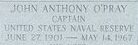
Editor’s Note: Capt. O’Pray went on to become a Captain in the Navy and lived another 22 years after the Sandy Hook fire. He is buried in Arlington National Cemetery, Virginia.
Whether BM1 R.L. Tooker every received a medal, or whether Seaman Second class Bruno Patruno was further recognized for his bravery are not yet known. VeniVidiScripto is awaiting a response from the Naval Archives in Maryland to report on that action but invites anyone who may know whether these sailors were honored, or whether they continued in their naval careers, to inform VeniVidiScripto so they can be recognized here, and perhaps also by local Navy, township, county or veterans organizations.
The four ships at the Earle Naval Ammunition Depot piers in Leonardo in the time after midnight on Jan. 1, 1945, were the SS John P. Harris, loaded with 6000 tons of ammo; the SS. Arthur M. Hulbert, with 4000 tons of ammo aboard, the SS Joseph Stanton with 1150 tons of ammo and the SS John Walker with another 5500 tons of ammo. So there were 16,650 tons of ammo sitting at the pier in Leonardo, a gale force wind blowing, a derelict tanker with 15,000 barrels of bensoil on fire in Sandy Hook Bay, and Sailors and Coast Guardsmen fighting the blaze that engulfed the boat with hoses whose nozzles were freezing with the frigid water and high winds.
Dockmaster John A. O’Pray had done all he could, summoned all his crews, taken every precaution possible and the piered ships’ crews were alerted to be prepared to get underway.
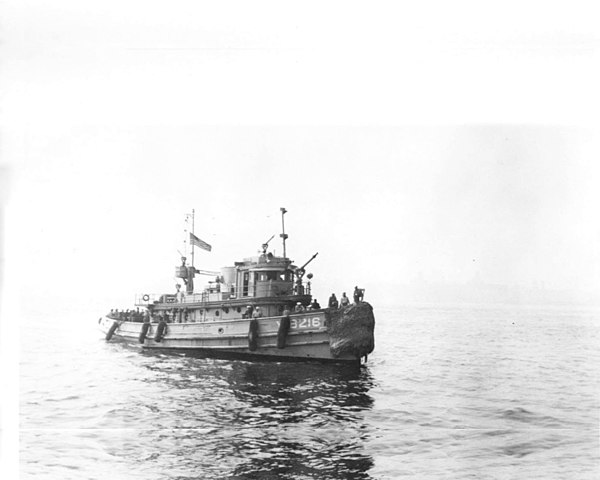
Out on the water, in the dark lit only by the flames of the burning barge-like Sunoco tanker, Boatswain’s Mate First Class R. L. Tooker was guiding his YTM 216, a yard tug, closer to the burning vessel. Recognizing the tanker was unmanned, drifting dangerously close to the Leonardo piers, and knowing the ships were loaded with ammunition at the Navy installation in the quiet neighborhoods of fishermen and clammers and their families, BM1 Tooker took the first action he thought would work.
The sailor rammed his little tug into the burning Sunoco to shove it away from the piers, away from land, and away from tons of ammunition.
His action diverted the course of the Sunoco so that she cleared the piers “by a scant margin”. He then continued to ram the stern of the vessel until she went aground. There is no doubt that this prompt action averted a major disaster at this activity.”
BM1 Tooker was recommended for “the highest commendation possible within the limits of this extraordinary display of judgment and heroism and given promotion fitting a man of such caliber”.
Still, this was not the end of the heroism aboard that little tugboat. Seaman Second class Bruno Patruno was in the boatswain mate’s crew. He also rescued one of the crew from the stricken ship. It was this boat’s crew , in spite of immediate danger and the tug being severely scorched, that removed two members of the Sunoco’s crew from the burning vessel and another crew member from the life raft.
At just after 3 a.m., two hours after the first alarm, the tugs were recalled to the base. They had remained on scene searching for more merchant seamen who had fled the flames and jumped in the water. But it was determined, given the ice and gale winds, that there was no further possibility of anyone surviving the icy waters.
The official log reports simply: Emergency secured at 0556.