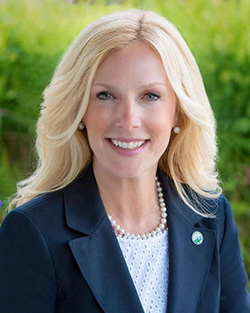
Monmouth County Clerk Christine Giordano Hanlon has created a COVID-19 Pandemic Archive to preserve important government records for historical purposes, and is requesting municipal and county government officials to submit documents pertaining to the COVID-19 Pandemic.
“The COVID-19 Pandemic is an historic event that will be of great interest to future historians, researchers, scientists, health and public policy experts, as well as government leaders,” said Hanlon. “It is critical that we take steps now to secure these records, and Monmouth County will be at the forefront of this preservation effort by maintaining these records in the Monmouth County Archives..”
The Clerk oversees the Archives, where countless county government records, both paper and digital, are stored and preserved. The Archives also houses county and municipal government records, newspapers, photographs, and maps.
To ensure as much information as possible about now Covid-19 altered precedent for government responses to crises, the clerk said , “we must preserve as much information as possible for future knowledge about this historic time period.”
Hanlon added that her office has designed a method for municipal governments to submit documents for preservation and will be reaching out to each of the 53 municipalities in the county to request participation.
For questions about the COVID-19 Archive, please email William.Elwell@co.monmouth.nj.us or call 732-431-7324, ext. 8745. To view an informational video about the County Archives and its collections, visit the website at MonmouthCountyClerk.com/Archives.
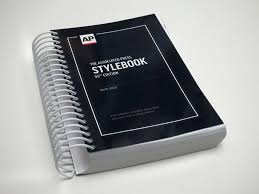
I am so happy I learned real journalism at my father’s knee as a child and honed it over the years, always taking advantage of the AP Stylebook for proper terms and usage, And because of how much I learned and how well it aided me in being successful, I’m even more delighted that in writing my own blog, I do not have to adhere to today’s AP Stylebook. Nor do I have to use new made-up words to draft my stories.
Some things have not changed. For instance, I always knew if I was writing about Queen Elizabeth, it was a capital Q, but not so if I were referring simply to the queen. The same with any of the other royals, be they king, prince, duke or whatever. Came in handy at the time of the queen’s death.
But now, if I were following AP Style, I cannot say not say pro-choice or pro-life or pro-abortion; I’m expected to say abortion rights or anti-abortion. Don’t quite understand why it’s ok to say anti-abortion, but not pro-life, but that’s what AP Style tells me.
Fortunately, AP still allows me to write ‘pregnant women” But, they tell me, if I REALLY want to be inclusive, then I should use the term “pregnant people.” That would ensure I’m covering all women, even those who may be pregnant but don’t identify as women…that means transgender men and nonbinary people, you understand.
It doesn’t matter that my heart breaks every time I see photos of dozens of illegal immigrants crashing our Texas borders in order to get here…AP says I can’t call them illegal aliens or unauthorized immigrants, or refer to them as illegal, or unauthorized. I should just call all these folks breaking our laws migrants or immigrants…even though they are not.
I’m happy AP thinks it’s ok to call Fentanyl a drug, the street drug that’s ten times more powerful than heroin and the leading drug of overdose deaths in the country. But that’s the same name I use for all prescriptions doctors write for legal purchases. I’m pretty sure they’re still allowing me to refer to Fentanyl as an illegal drug, though, at least they haven’t said I can’t.
I can still call a gun a gun, but I can’t call any guns assault rifles or assault weapons, even they look like assault weapons. I should be more specific…like
Identifying the function of a say, rifle, and identify it as semi-automatic rifle or automatic rifle. But of course to do that, I have to know how many bullets are fired, and if there’s an auto reload so it just keeps on firing when the trigger is depressed. When somebody does this a lot, I should call it a shooting rampage, and not say somebody went on a shooting spree. Kind of sounds like he went on a shopping spree or something fun like that.
When it comes to sex and gender I really get confused. For the last five years, the AP Stylebook has told me there’s such a thing as “cisgender “, which means the people whose genders match their sexual organs. I should use intersex for those whose external sexual organs differ from whom they think or feel they are. That’s because AP tells me gender refers to a person’s social identity, and is entirely different from sex, which just means the biological characteristics. So, to keep everyone happy, I really should never say both or either sex, or heavens, the opposite sex, since they all infer there are only two sexes or genders, I’m not sure which.
And to be really correct, I should simply say they. But not They is, which is what I would have used if I thought sex or gender was singular and that would make the pronoun ‘they’ singular. Nope, I still should say they are, but I haven’t figured out why. What happened to the days of subject and predicate agreeing? AP Style suggests use the print the name, rather than the pronoun if that’s important to you…or reword the sentence to avoid a pronoun altogether.
All of this is necessary, you understand, because in the 21st century, more young people are identifying themselves as non-conforming with what we all thought were two genders, so there is therefore a new need to change the language.
APSTYLE tackles the question head-on on whether MS, Mr., Ms, Mrs. or something else is the best courtesy title to use in writing. Their answer? In most cases, avoid any courtesy title at all. Change the sentence around so you don’t need a pronoun.
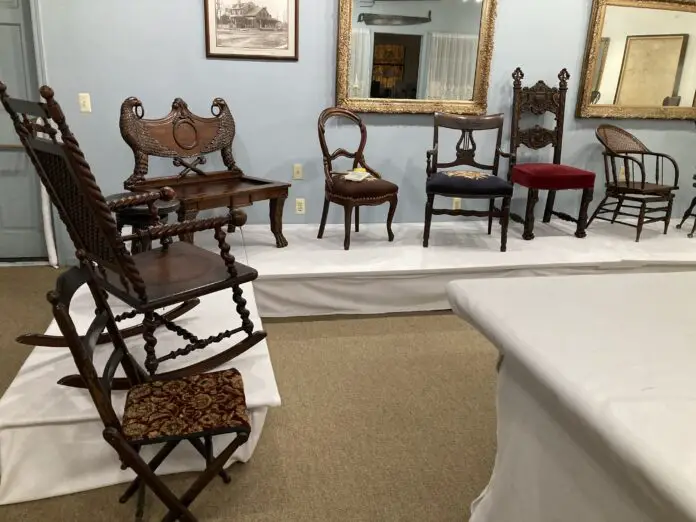
The Exhibit, sponsored jointly by the Eastern Branch library and the Shrewsbury Historical Society, features a variety of unique and everyday chairs from early 20th century as well as centuries before. An additional assortment of more than 30 other vintage seatings is also on display at the Historical Society, located at 425 Sycamore Ave., Shrewsbury, the Four Corners Historic area.
The Library exhibit also includes a collection of books and other sources giving in depth descriptions and further information about the manufacture of chairs, including information on woods and designs and specific uses.
The library exhibit is open throughout open library hours. The Shrewsbury Historical Society exhibit is open by appointment. For further information contact the Historical Society at ShrewsburyHistoricalSociety@gmail.com or by calling 732-530-7974.
Coordinators of the Library exhibit are Historical Society president Donald Burden, and Society trustees Robin Blair, GeeGee Blair, and Ellen Jackson, together with honorary life members Hudy and Stuart Buncher, with Eastern Branch librarian Kim Avagliano and reference librarian Debbie Alfano
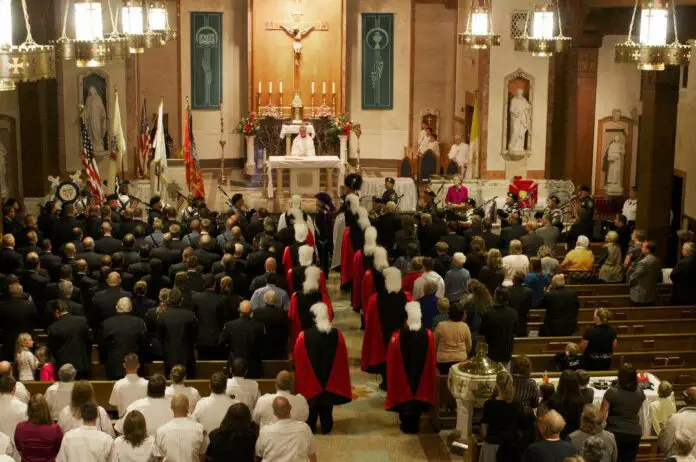
At least 14 members of the Knights of Columbus of the Rev. Joseph J. Donnelly Council had the distinct honor and privilege to set up and achieve an ambitious fundraising goal for the Blue Mass, said Michael Napolitano, Grand Knight of Council 11660 at Our Lady of Perpetual Help St Agnes Church.
The Knights of Columbus are one of the many local organizations and residents supporting the 20th annual Blue Mass which honors health, safety and emergency volunteers and police in the Bayshore, as well as Middletown fire companies from throughout the township and security personnel at Gateway National Recreation Area.
The mass will be held Wednesday , Oct. 19, at 7:30 p.m.. continuing a tradition started at St. Agnes Church two decades ago.
Napolitano said planning began in early August in order to have sufficient funds available in advance of the event. The Mass at St. Agnes brings hundreds of people and many join the volunteers at the Shore Casino following the mass. The volunteer organizations also donate to finance the event at the Casino.
“Rather than pat ourselves on the back, we take this opportunity to thank all of the people who generously donated in support of our local Police, Fire, EMS and Military First Responders,” said the Grand Knight, adding, “ and we are especially heartened to have seen this outpouring of support amidst the current backdrop of “woke” disrespect exhibited by a small but highly vocal minority.”
Napolitano also expressed thanks to the establishments who donated space in front of their stores in order for us to solicit donations on behalf of this event. These included Bayshore Pharmacy, Vingo Liquors, Sea Streak Ferry in both Highlands and Atlantic Highlands, 7-11 of Atlantic Highlands and Quick-Chek of Highlands. “Our thanks and appreciation go to all of them for participating in our effort and making it so successful.”
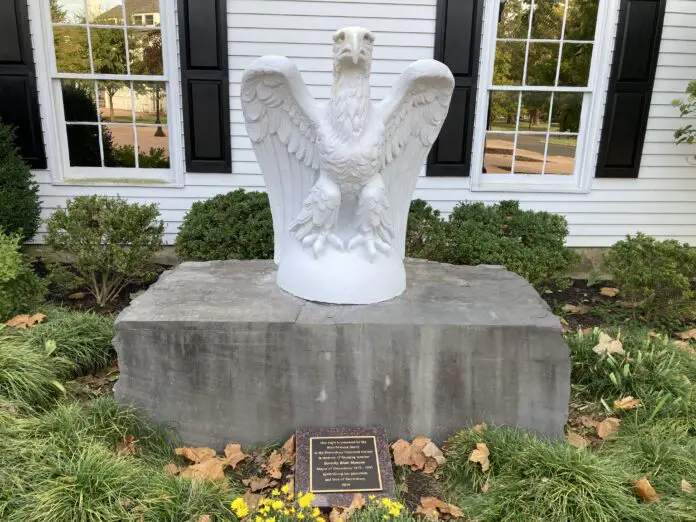
The restoration of the Dorothy Blair Manson Eagle, posted at the entrance to the Shrewsbury Historical Society on Shrewsbury Ave and Route 35, has been completed in time for special honors for Veterans Day, 2022.
Society President Donald Burden in reviewing the known history of the sculpture, it once adorned a building of the A. Hall and Sons Terra Cotta Company in Perth Amboy.
The company was the prominent terra cotta producer in the United States in the 19th century. It was famous for creating much of the intricate ornamentation found on many of the businesses in New York City and elsewhere.
The eagle at the Historical Society is terra cotta with a porcelain glaze and weights in excess of 800 pounds. It rests upon a pedestal weighing more than 1500 pounds.
It was relocated from the garden at former Shrewsbury Mayor Dorothy Blair Manson’s home on Buttonwood Drive. She originally purchased it from a local antique dealer. Manson served the borough as Mayor from 1979 to 1990.
Members of The Manson family gifted and dedicated the statue at the borough’s Community Day Celebration in October 2014. At the time it needed some minor repairs. Weather related issues hounded the eagle to the point it was necessary for a major restoration using a variety of epoxies, plasters, and high quality paints.
Now the Mason eagle will proudly hold court in its prominent position overlooking the Shrewsbury Historical Society and the Shrewsbury Municipal Complex.
The Atlantic Highlands Yacht Club presented a check totaling $33,065 to Randi Zamkotowicz, representing 180 Turning Lives Around at a gala ceremony at the Yacht Club at the Municipal Yacht Harbor earlier this month.
The check represented the proceeds from the annual Ms Race charity sailboat race sponsored by the club and co- chaired by Diane Kropfl and Emily Smith.
“The Atlantic Highlands Yacht Club has a long history of supporting our community and we are honored to be able to continue to support the important work of the “180 Turning Lives Around” program, “ said Yacht Club Commodore Frank Allsman, in making the presentation to Zamkotowicz.
“Since our founding in 1953, community service has been a core value of our membership. I could not be prouder of all of the efforts of our members and the positive impact of the work they do in our community,” Allsman continued.
The MS Race was held in late August, specifically designed to benefit and raise awareness for 180 Turning Lives Around, a Monmouth County based private, non-profit organization dedicated to ending domestic violence and sexual assault in the community.
All proceeds from the Ms. Race as well as other related special events throughout the year comprise the total presented at the presentation event this month, the 18th annual ceremony the result of the highly successful Ms Race.
In addition to being a traditional fund raiser for 180, this year’s race paid tribute to the life and legacy of Eileen Campbell, a longtime friend and supporter of 180 Turning Lives Around.
Winner of this year’s Traditional Non-Spinnaker division was the Tartan/3700 skippered by Kropfl, a co-chair of the fundraiser, with her experienced sailing crew that included Barbara Nevius at the helm. Celtic Star, a Sabre/34 captained by Sue Mulholland of the Keyport Yacht Club came in second and Laura Oncea on Confiscated from the Shrewsbury River Yacht Club finished third.
Top honors for the new Spinnaker division went to Ann Myer from the Raritan Yacht Club and Storm Trysail Club on her J/105 Magic. Magic and Aviato, skippered by AHYC Race Committee Co-chair Karen Harris, crossed the finish line in a photo finish with Magic’s finish time reported one second ahead of Aviato. They were followed by Elaine Haher and crew on her J/24 A Better Hair Day.
A record twelve teams of women sailors from five New Jersey Bayshore yacht clubs participated in this year’s race: Eduam, A Better Hair Day, Celtic Star, Confiscated, Witch of the Wave, Coda, Saint of Circumstance, Smoking J, Lady P., Magic, Vici and Aviato.
Friends, family and other guests and spectators gathered on boats and cheered the sailors as they made their way around the course just off the Yach Harbor and visible from its overlook location above the Shore Casino restaurant.
Following the race, captains and crew celebrated on their boats followed by the awards ceremony at the Yacht Club where Allsman recognized and praised the club racing event and its support for 180.
Awards were presented by 180 Executive Director, Anna Diaz-White, who praised the club and its members for supporting the charity and bringing total donations to $225,000 over its 18 year history..
“I had so much fun and enjoyed seeing all of the amazing women sailors supporting each other, dancing, and cheering and celebrating each other!, Diaz-White said to the group. “ This is what the Ms. Race is all about. Women being supportive of women, it was and is a moving and powerful thing to see.”
In recounting some history of the annual event, Allsman, explained that in the early days of the Ms Race, club members talked about making that specific race a charity fundraiser. Jodi Dash was a Ms. Race crew member and worked as an art therapist for 180. She suggested 180 and “it’s been a partnership ever since.”
In addition, Laura Kenneally reached out to the race committee to cross promote their charity event for 180 Turning Lives Around where they created and sold shawls to benefit 180. A shawl sale inspired by Stevie Nicks, a performer appearing at the Sea-Hear-Now Festival in Asbury Park.
Two of the shawls were purchased as gifts for Ms. Race Co-chairs Kropfl and Smith by Zamkotowicz on behalf of 180. She and 180 also commissioned two pieces of art from 180’s Amanda’s Easel program for the co-chairs as well. Both women, overwhelmed by the generosity of the charity, also expressed their deep appreciation of all those who made the race the success it was. .
The cochairs also noted special events are held each year for fundraising necessary to make the Ms Race event the success it always is. Some of these special events include the Home Goods and Nautical Sale hosted by the Ms Race committee in May as part of the borough’s Townwide Garage Sale and a display of Eileen Campbell’s artwork at the AHYC Art Wall with the sale of which designated to benefit 180.
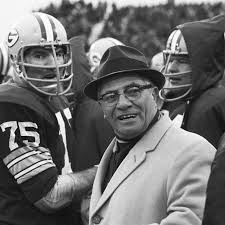
The Middletown Township Public Library (MTPL) just released a new history video about the life of Vince Lombardi and his ties to the township in which he is buried.
In “Vince Lombardi: The Man Behind the Legend”, MTPL staff explore the life of Lombardi outside of his fabled coaching career, with a focus on his association with Middletown Township.
The video, narrated by MTPL reference librarian Kate Hammond and written and directed by public information staffer Walter Johnson, looks at Lombardi’s marriage, his personality and how he dealt with others through interviews, research, biographical sources and archived news clippings.
Viewers will see the house in Fair Haven where Lombardi once lived, the school that his children attended and hear from Ed Cardoza, Superintendent of Mount Olive Cemetery on Chapel Hill Road near Route 35 where Lombardi is buried.
Produced by MTPL staff, this video will be the first in an “Around Our Town” series about Middletown history and landmarks. Those interested in viewing “Vince Lombardi: The Man Behind the Legend” are encouraged to visit the library’s YouTube channel, linked at mtpl.org.
For further information, contact Jenna O’Donnell at jodonnell@mplmain.mtpl.org or visit the library located at 55 New Monmouth Road.
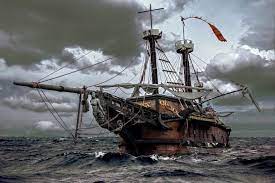
In fitting manner, coming so close to Halloween, the Atlantic Highlands Historical Society is concluding its Speaker Series for this year, which featured shipwrecks, on the topic of Ghost Ships.
Wednesday, Oct. 19, Society member Alice Kupper will present ghostly apparitions and stories of local and well known ghost ships at the Strauss Museum Mansion beginning at 7:30 p.m. The mansion is located at 27 Prospect Circle and the public is invited to attend.
There is no charge for the event, though donations are always acceptable and all are invited to bring a non-perishable food item or a baby product for the Atlantic Highlands Food Pantry.
Kupper’s talk will likely include stories about the legendary Flying Dutchman, a fabled ship dating back to the 17th century and doomed to sail the seven seas forever. She may disclose the story of what seeing a light on the Dutchman means for the future.
The speaker may also address the true story of the Mary Celeste, an 1800s brigantine that was found disabled and adrift near the Azores, with everything on the ship intact, including supplies, not with no human being aboard. The mystery has not yet been solved on what happened to the entire crew, none of whom has ever heard or seen again.
Kupper will most likely also address the area’s own Ghost ship that has been seen on the Navesink River.
ATL. HIGHLANDS – More delay, more confusion and more expense to the taxpayer was announced at Thursday’s meeting of the Mayor and Council when Council unanimously passed a resolution authorizing a financial advisor for independent financial advice before the question on regionalization for the school districts can make it to the ballot.
In response to questions from local resident Mark Fisher, borough administrator Robert Ferragina explained each of the municipalities involved must appoint a person or firm to, according to their resolution, to “prepare a financial structure and impact analysis on the proposed consolidation, examining the consolidation of debt, operating expenses and the impact of the regionalization on respective tax levies and tax rates that will be examined. The contractor will also provide guidance on municipal, school budget and possibly country tax impacts, along with student impacts,” though it is not clear what impacts tax levies and financial structures may be placed specifically on students.
The contractor will also prepare a statutory tax assessment distribution and fiscal plan “and other financial work as necessary.”
The borough retained Beneke Economics, and its members, Roert Benecke F.A., CMFO and Chelsea Gleis, P.P. to complete the work based on their qualifications, experience, compensation “and other factors and criteria.” According to the resolution, fees will be $150 per hour for the work, not to exceed $6,000, or 40 hours. There is no time set for when the work has to be completed.
“This is an excellent move,” said Councilman Crowley when the question came up of whether the added expense is mandated or suggested.
“It makes sense, in my opinion, “ said Highlands Mayor Carolyn Broullon, when questioned after the meeting if Highlands would go along with the recommendation. “ For Atlantic Highlands to have a financial person representing Atlantic Highlands for financial mediation and not a labor attorney.”
Atlantic Highlands has retained Matthew Giacobbe as their attorney for the regionalization matter. Giacobbe has said more than once said at public meetings or on ZOOM when he was unable to attend a meeting that he is a labor attorney, not a financial attorney.
Broullon said Highlands will nonetheless go along with the recommendation and Steve Cea of the Porzio firm will represent both Highlands and Sea Bright in the preparation of whatever structure and analysis are needed for the mediation.
The Porzio firm is the firm both those boroughs contracted for the original study and all the financial investigations and considerations. The Mayor noted that while she does not have his hourly rate their contract with Porzio includes all the professionals they used for the study.
The Highlands Mayor also added that she believes the current two studies should have been enough.
“It is ridiculous that we are fighting over future savings that we don’t know how much that savings will be,” Broullon continued. “ All of the financial experts projections were wrong for 2022 equalized value of all three Boroughs. That should have taught everyone involved that we need to set a funding formula, then adjust it as needed until we lock into a 10 year formula.”
Broullon pointed out that the new law allows for a financial person involved during the mediation, “ but again, only Highlands and Sea Bright are talking about this, it’s maddening, honestly. This should have all been done in August. “
It was not clear whether the new firm retained by Atlantic Highlands, Beneke Economics, can refer to any of the financial information previously obtained by experts for the boroughs and the schools in their comprehensive feasibility reports paving the way for the vote on regionalizing. Nor was it clear why the information provided in these reports, studies financed by Sea Bright and Highlands as well as the Tri-District, are not sufficient to proceed with mediation.
At the Atlantic Highlands council meeting , upon further questioning by Fisher, Ferragina said the contract is necessary since each borough, under the state regionalization law, should retain a finance expert before mediation can be started. Borough Attorney Jason Sena said the attorneys from both Highlands and Sea Bright have agreed to the new directive and will be recommending it to their governing bodies. The attorney for this borough on the regionalization question, Matthew Giacobbe was not present at the meeting.
No mediator has been named to resolve the issues between Atlantic Highlands and the other two towns so there is no date for when the question of a preK-12 regional district can be voted on in Sea Bright, Highlands and this borough.
Broullon exasperated by the continual delays and lack of action on a question many officials and residents anticipated would be on the November ballot so the residents could decide if they wanted regionalization, recalled that the entire planning, financial ramifications and keeping the public informed of the process blew up the process when Giacobbe sent Highlands an agreement that was either “take it or leave it, , share 50-50 between the towns forever or get out of it if Atlantic Highlands agrees. To this end, Sea Bright is currently in a bad deal they can’t get out of, the Highlands Mayor continued, adding “But I refuse to do that to Highlands. I do not understand why the neighboring Council thought we would ever agree to those terms.”