Continuing with the cooperative spirit among elected municipal officials and boards of education members that will hopefully put the question of school regionalization on the November ballot, the three boards of education approved their resolutions at a meeting last night that asks the Commissioner of Education to approve a Pre-K though 12 school district for Highlands, Atlantic Highlands, Henry Hudson Regional, and Sea Bright borough.
At a workshop meeting of the Atlantic Highlands Mayor and Council earlier Tuesday evening, attorney Matthew Giacobbe said he feels confident that the history making question before the Commissioner of Education should have a favorable response and be returned to the boroughs in time to meet the Aug. 15 deadline for putting the question on the ballot. Giacobbe said he felt confident the boroughs’ resolutions would be sent this week.
In the resolution adopted by the school boards last night, board members indicated that while they want to include Sea Bright in the new K-12 regional district, should anything detain that borough from being included, they nonetheless want to proceed with establishing a pre-K-12 regional school district with Highlands, Atlantic Highlands, and Henry Hudson.
Such action does not change anything other than eliminating the current boards of education and replacing them with a single board with representation from all school districts included in the new regional district. The number of board members from each town in the district is established by census figures from 2020 if approved in the November election.
Under the resolution adopted by the boards last evening, the resolution cites the many reasons why a Pre-K-12 regional district should be pursued on a referendum. It also notes the boards’ desire to proceed with the referendum regardless of any problems Sea Bright might have in its negotiations with Oceanport and West Long Branch, where Sea Bright students currently attend school. However, it includes the resolve that the members want Sea Bright to be included “at the earliest possible date,” it not at the onset of the new district.
The question on the ballot, as the resolution indicates, will provide voters “with the ability to decide how their tax dollars are best spent and how their children are educated”
The resolution also includes a caveat that approval for a vote was granted “ subject to agreement concerning apportionment of revenues and a cost-savings sharing plan. That cost savings is currently being negotiated between the two boroughs’ boards.
Concerning Sea Bright, the three boards resolved “that Sea Bright may join the expanded PK-12 Henry Hudson School District as soon as …permitted to do so,” but regardless, the plan for the three boards is still desirable with the expectation Sea Brigh would be included, if not immediately as soon as possible afterwards.
Clean Ocean Action (COA), the ocean advocacy concern non- profit organization based here, strongly objected to the Biden Administration’s “unreasonable and unjust” 45-day comment period for review of the 1400-page Draft Environmental Impact Statement for the region’s first massive industrial offshore wind (OSW) energy facility.
The project “Ocean Wind 1,” is proposed by Ocean Wind, LLC, a partnership between Ørsted and PSE&G, off the southern Jersey Shore.
COA called on the Administration for an additional 60 days for review and comment in a 10-point letter to Michelle Morin, Chief of the Environmental Branch for Renewable Energy at the Bureau of Ocean Energy Management (BOEM) – the federal agency leading the review process. The letter also referenced over 1,330 citizens (at the time of the letter), who in less than one week’s time, signed a petition organized by Clean Ocean Action calling for more time, and many of whom added their own powerful statements of concern.
“This time frame for review is outrageous considering the unprecedented industrialization of both the ocean and Jersey coastline. In fact, the fast-tracking of due process as well as the speed, scope and scale of the industrial expansion in the region is reckless and suggests an unfair Administration bias toward the offshore wind industry, instead of to the natural resources and ecological assets the ocean holds and which the government is entrusted to protect. Show us where such a massive industrialization of an ecosystem has been allowed, and how it resulted in a positive outcome for people and the planet,” said Cindy Zipf, Executive Director of Clean Ocean Action.
“If offshore wind is so wonderful as supporters suggest, it should stand up to careful review and scrutiny,” she added.
In a letter submitted to BOEM today, COA outlined ten reasons for the extension request, including the size of the technical document and the precedent-setting nature of the proposal. Clean Ocean Action is also urging organizations and residents to submit their own letters to BOEM requesting a 60-day extension to the public comment period.
“BOEM is not limited to this 45-day time period, which is wildly unrealistic, unjust, and poses undue challenges for all parties interested in providing thorough feedback on this unprecedented document and project, “said Zachary Klein, Esq., Policy Attorney for Clean Ocean Action. “In the name of transparency and good and fair due process, COA strongly urges BOEM to extend the comment period an additional 60 days.”
“It is essential that offshore wind energy, if done, is done right, and done right from the very beginning,” said Kari Martin, Advocacy Campaign Manager for Clean Ocean Action. “While green energy, the potential risks to the ocean and marine resources are great and grave, especially considering the cumulative impacts from 24 other offshore wind projects and sold lease areas in the region. Too many questions must be considered and answered. We encourage people to sign the petition to demand more time, attend the public hearings, and submit comments on this new, large-scale industrial use of the ocean in the region.”
A petition, launched by COA both digitally and on-paper, is collecting signatures of residents who support a 60-day extension of the existing public comment period. In one week, the petition collected over 1,330 signatures (to date). The petition will continue to gather supporters.
Clean Ocean Action is also calling upon residents, groups, businesses, and local, state, and federal officials to attend the three virtual public hearings to be hosted by BOEM on July 14, 20, and 16. Pre-registration is required; to register, go to this BOEM website. Also, people are urged to provide oral comments during the public hearings (5 minutes maximum) and submit detailed comments to BOEM by 11:59pm on August 8, 2022.
For more than 37 years, COA has defended and protected the ocean from pollution and harmful industrialization to ensure a healthy ecosystem and clean ocean economy. Clean Ocean Action (“COA”) is a regional, broad-based coalition of conservation, environmental, fishing, boating, diving, student, surfing, women’s, business, civic, and community groups with a mission to improve the water quality of the marine waters off the New Jersey/New York coast.
I knew I would be getting it, but still it’s a wonderful surprise when you get a gift certificate…for any amount…to spend as you like! That’s what happens at Bayshore Pharmacy if you belong to their Shopper Rewards Program.
You get a card to let you know you’re a member then you show it every time you buy some of those terrific gifts or other things at Bayshore. Then lo and behold! They keep all the records and all of a sudden, send you a gift card that you can spend in the store! Of course the note with it also tells you they offer shots for flu, shingles, pneumonia, whopping couch, Hepatitis, Meningitis and of course the dreaded Covid, but that isn’t as much fun as walking through the gift section and finding something you just have to buy!
It’s like going into Jaspan’s the Hardware Store! I might be off a bit, but it seems to me and everybody else who shops there, that everybody on this staff knows exactly where everything is in this store with thousands and thousands of items, and then they even suggest which of the several items that would work for you would work best. On top of that, they’re friendly, pleasant, patient and treat you like you’re the only customer in the store! What class!
Or Renaissance where no matter who is managing all those wonderful shops inside those red doors that particular day, it’s just like talking over a neighbor’s fence with an old friend. And there are so many neat things to find. There is bound to be something new every day! Once again just like at Bayshore or Jaspan’s. you always find something that you really need, even if you didn’t know you needed it. What fun!
And of course Strada is the perfect place for appetizers or pizza and a relaxing cocktail or glass of wine, either inside or just outside the door giving you a great view of First Avenue and all the folks walking, talking and shopping there!
Registrations are being taken now for the 18th annual MS Race sponsored by the Atlantic Highlands Yacht Club.
Set for Aug. 20, the race is chaired by Diane Kropfl and Emily Smith.
A major event of the active Yacht Club, the MS race is an annual charity sailboat race designed to benefit and raise awareness for 180 Turning Lives Around, a Monmouth County based private, non-profit organization dedicated to ending domestic violence and sexual assault in the community .
All proceeds from the Ms. Race as well as other related special events throughout the year are donated to this organization.
The theme of the 18th annual event is “The 2022 Eileen Campbell Memorial Race”. To honor the woman who participated in every Ms. Race since its founding in 2005. Eileen was Co-chair the past five years. She was instrumental in making the Ms. Race what it is today, surpassing more than $200,000 in donations for 180 since the race’s inception.
Participation in the race is comprised of female skippers and crew and promises to be the largest event to date with a fundraising goal of $22,000.
A multitude of racing and cruising vessels ranging from 24 to 45 feet in length are expected on the water with the support of Yacht club members and the race committee.
Race organizers plan a full schedule of events for the day, culminating in a celebration that evening and an awards reception. The Ms. Race co-chair invite all women sailors with their boats and crew, to participate in the fund raising cause.
With a goal of expanding participation for women and girls of all ages, the Ms. Race committee is partnering with AHSEP, the Atlantic Highlands Sailing Education Program to further promote participation of young women in sailing.
This year’s race will be a Pursuit Race where slow and typically smaller boats start the race first followed by fast and normally larger boats. The first boat crossing the finish line wins the race.
There will be two divisions this year with both Non-Spinnaker and Spinnaker boats invited to participate.
For more information about this year’s race as well as registration information, contact the Ms. Race planning committee at ahyc.ms.race@gmail.com.
The Atlantic Highlands Yacht Club (http://ahyc.net) was founded in 1953 and is located in the Municipal Harbor. The club holds racing events throughout the season, and inquiries about membership are welcome.
The Ms. Race (http://www.facebook.com/MsRaceAHYC) was inaugurated in 2005 by a group of female sailors who regularly participate and crew in the AHYC Wednesday night race series. The goal of the committee and the race is to support and promote the participation of women in the sailing community. The NYJRA New Jersey Yacht Racing Association recognizes the Ms. Race as the best all women’s race in New Jersey and awards their woman’s racing trophy to the winner of the Ms. Race.
“We are confident we will have the petition from all six entities to the Commissioner of Education and get her decision in time to have the regionalization question on the ballot in November,” attorney Matthew Giacobbe said at the Mayor and Council’s workshop meeting last night.
Giacobbe said all six groups working on the regionalization, the three boroughs, and three boards of education in Highlands and Atlantic Highlands, are working in unison to have the final question presented to the Commissioner, because they are all in agreement they all want this to be a “Win Win Win situation” and not a win or lose vote. The boroughs must submit any question for the November ballot to the state by Aug. 15.
The attorney, who is representing Atlantic Highlands in the question of regionalization of the school boards and Sea Bright, also noted the vote and decision will make history and “towns all over the state are looking at you” to see how it will be decided.
Borough Administrator Robert Ferragina added that the borough administrators of all three towns and their financial advisors had a meeting that morning with another planned though as yet unscheduled, to work out final details on the wording of the question. This is to ensure the single question submitted to the Commissioner has the support of all entities involved. The two boroughs are working on a cost sharing formula that ensures financial benefits to both, he said.
There is no doubt approval of a regional district including Sea Bright will reap financial and educational benefits for all three municipalities and their residents, so how the additional income coming into the current three schools will be split between the two towns is an issue on which both towns have to reach an agreement.
Giacobbe said the question which will be on the ballot will be a simple yes or no question, and will include the cost sharing benefits to both towns inserted once the question is approved by the Commissioner but before it is placed on the ballot. He reiterated that with the reports he has received from the cost sharing meetings and discussion, he anticipates having the question to the Commissioner’s office no later than the end of this week.
The question, when approved by the Commissioner, will be the same for voters in Highlands and Atlantic Highlands because of the cost sharing, and somewhat different in Sea Bright, since no funds will be going to that town. All three towns must approve their individual question in order for it to become reality.
Regardless of what the local officials send to the Commissioner, she will then review it with state attorneys and regionalization professionals and review all the supporting information which accompanies the request for approval, Giacobbe said. She can either approve the question, decline to approve it, or make suggestions as to how it should be worded to get her approval for it to be on the ballot.
School Superintendent Dr. Tara Beams, well versed on the specifics of the regionalization issue and how it impacts the educational aspects, fielded several questions on those issues from the fewer than 30 persons who attended the workshop session. Both she and Mayor Loretta Gluckstein said once the question is approved for a November vote, there would be numerous meetings by the various entities in order to provide the voting public with all the information necessary to cast ballots.
The question will be worded in a way that if voters vote yes it will mean a regionalization of the elementary schools and regional high school, together with Sea Bright, as a single entity under a single Board of Education. A no vote would not allow the two elementary schools and Henry Hudson to merge into a single district without the inclusion of Sea Bright.
With approval of a new regional district, a single board of education would oversee education, with the probable breakdown giving Highlands and Atlantic Highlands each four votes, and Sea Bright having one vote on the nine member board. That figure is determined, not by the number of students in the school, both Beams and Giacobbe said, but by the number of residents in each town based on the 2020 census. Currently, Highlands has 5 votes, and Atlantic Highlands four on the Henry Hudson Regional Board of Education.
Dr. Beams also detailed some of the other areas the current districts are exploring for additional financial aid from state aid stabilization grants. There is no discussion nor would there be any changes in the make-up of the current three school buildings, and with a relatively small influx of students with the addition of Sea Bright, “we won’t be fielding a football team for next season” in the district which has never had a football team but has excelled in a number of other sports including gymnastics, track and basketball..
In response to questions, both Giacobbe and Beams explained that under current law, if regionalization is approved, it is stabilized for a minimum of ten years. Should any towns want any change after that, they would have to initiate an entirely new process similar to what is happening now under the law which the state legislature approved unanimously last year. However, the school superintendent said the board would be working throughout that ten years to ensure the educational standards as well as the financial benefits remain satisfactory to all communities.
Should any of the towns have a disaster…a devastating hurricane in Sea Bright was used as an example…the towns are still obligated to pay their share of the school budget. Giacobbe pointed out that in times of disaster, the state and federal governments come in with assistance since the school district payments must be made by each town, even in cases of tax collection delinquencies.
“I am confident we will be timely in getting the question to the Commissioner in plenty of time for her to make the decision and have it on the November ballot,” Giacobbe said one again as the close of the nearly two hour session.
If you’re into sky watching, Wednesday night should be a highlight in your night viewing fun. It’s a Super Buck Moon.
The full moon in July is called the Buck Moon, simply because that’s the time of year when the male deer have their full growth antlers, an annual event since they shed and regrow them every year and they’re generally bigger and better, I suppose.
A super moon occurs when the moon’s orbit is closest to earth at the same time that the moon is full. When the pair happen simultaneously, the moon appears to be brighter and larger than at other times.
So that’s what’s happening Wednesday night and what will be visible depending on cloud cover and storms.
The brightest will happen at precisely 2:29 Wednesday afternoon, so of course not visible since the moon is still below the horizon in the afternoon. But you might be able to see it if you search the southeast sky just after sunset.
Hopefully you sky gazers can enjoy this one. And what’s more there will be another one on August 22. That moon is called the Sturgeon Moon, so named because of the great number of huge freshwater fish found in the lakes and rivers of North America. This year’s Sturgeon moon is also a Blue Moon, as in ‘once in a blue moon,’ but more about that in another story.
And there will also be lots of meteor showers going on in the sky starting this week and continuing until the beginning of August. You get to see them best the nights there are no moons.
The monthly Prayers on the Porch get together started last year by several local residents will be at 6:30 Tuesday evening, July 12, at 17 Harborview.
The informal session of local residents meeting on a neighbor’s front porch or front yard for half an hour simply to pray was started by Mayor Loretta Gluckstein and several other residents who are members of a variety of religious sects or none at all in the area.
The informal sessions generally attract more than two dozen residents, and offer the opportunity have others pray for each personal intention and gives each of those present the opportunity to offer prayers for friends, neighbors or strangers.
Everyone in the public is always invited to attend, and encouraged to bring another friend.
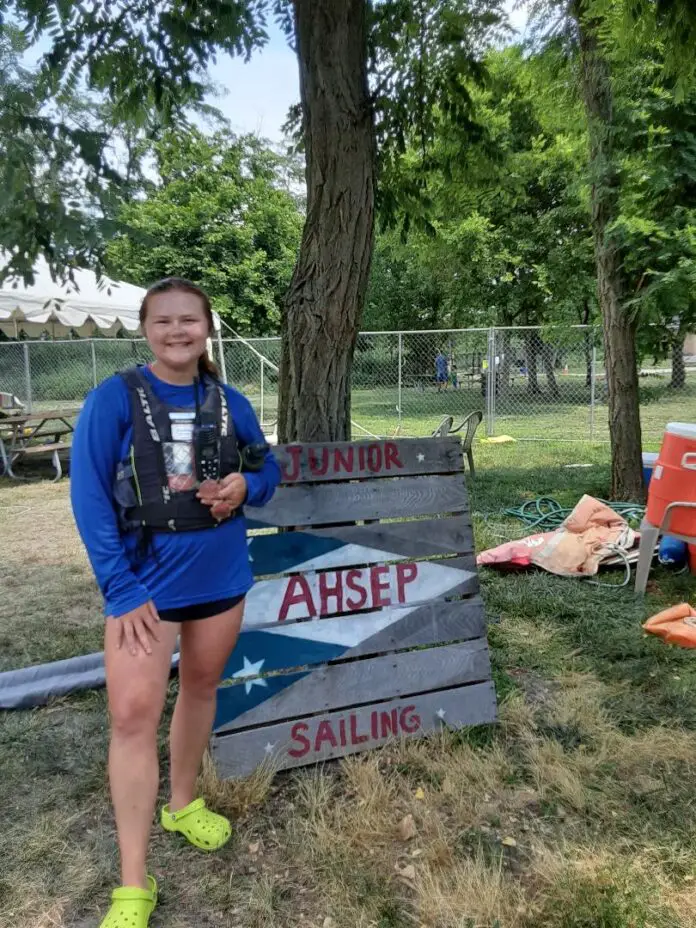
The Atlantic Highlands Sailing Education Program, AHSEP is well underway at its new location at Popamora Point, Highlands, and Program Director Sarah Milne is enthusiastic about the high standards of sailing knowledge young sailors are getting in the program.
The Program includes two week sessions where students between the ages of 8 and 15 are separated by experience into three different divisions.
The Novice program is open to youths as an introduction to sailing, where students learn the basics of sailing, including safety, boat nomenclature and the various intricacies of rigging, sailing knots, capsize recovery, and teamwork. The program is geared to that teen who has never sailed or only has limited experience or participated in one class previously.
The Intermediate class focuses on sailing skill improvement and is open to teens between 8 and 17. During these classes, both on land and in Sandy Hook Bay, students learn more advanced sailing skills, more skilled teamwork and crew responsibilities, and enhanced boat performance as well as an introduction to racing. This class is open to students who have completed several other AHSEP courses in the past and are comfortable sailing solo and competitively.
The Advanced class is for graduates of the intermediate program and continues to enhance their skills in both racing and boat handling. It includes on-the-water coaching and instills more confidence in sailors ready to face heavier wind conditions.
AHSEP even offers a Parent or Guardian orientation class to ensure parents know the intricacies of the program and the benefits for students to enroll. All classes included both Chalk Talk, sessions on land, as well as as sailing in the bay.
Now in the first of the three separate weeks of sessions, applications are still being taken for the remaining season.
Milne herself is a graduate of the program and enjoyed it so much and gave her so much confidence that she is back as the instructor and Program director. The attractive vivacious young woman just earned her degree in accounting from Providence College in Rhode Island and in the fall will begin her financial career at Ernst & Young. But for the summer, she is concentrating on the sailing program at Popamora Point.
The program is sponsored by the Atlantic Highlands Yacht Club and Club members Sue and Wayne Tidswell and Christopher Stone are co-chairmen of the non-profit organization that runs it. Mary Guerrera is in charge of the program and offers the orientation and information on all aspects.
The program is taught by US Sailing certified instructors using US Sailing’s proven techniques. Students do not need to own a boat, as they are provided in the program in cooperation with the age and skill of the students, with three classes of boats generally used, including Optimist, single sailing small boats for novice class, 420, two person boats which are used in high school racing, and Laser which are one person boats with a weight minimum because of wind conditions and balance, as well as Sunfish.
Persons wishing to know more about the program or to donate to the 501c (3) organization, can contact AHSEP at PO Box 43 Atlantic Highlands, NJ 07716, or make donations through PayPal or check.
Further information on the program is available at www.ahsep.org
The Public hearing on the cannabis ordinance is still on schedule for Thursday night at the Mayor and Council meeting, after the Planning Board ruled the other night it is in keeping with the Master Plan.
The governing body had to submit the proposed ordinance 9-2022 to the planning board for its review to see if it is in conformance with the borough’s master plan.
Although planning board members agreed by unanimous vote it is not inconsistent with the Master Plan, several questions were raised among themselves and by several residents who spoke during the public portion. Planners made no recommendations to the governing body at this time, but all indicated they wanted to have more conversation over some aspects of the proposed ordinance.
Councilman Brian Dougherty, the governing body’s liaison to the board, gave a brief history of the state law allowing six types of cannabis businesses as well as the borough’s actions in respond to the new law. Dougherty also noted that approximately 75 per cent of borough voters approved some type of cannabis business within the borough and the new proposed ordinance is the result of meetings and discussions based on the new law and local opinion.
Councilwoman Lori Hohenleitner, who also worked on the proposed code, was present at the meeting to provide any response to the planners and to thank them for their efforts in reviewing the proposed code and the locations in which any businesses would be situated. One of the issues raised during the planning board meeting is the portion of the ordinance on darkened storefronts for any proposed cannabis business. Resident Mark Fisher said he disagreed with that proposal, because it is unfair to any new cannabis business and indicating his belief that “it should be treated like any other business.” Fisher also questioned why the proposed code includes definitions of types of cannabis business which would not be permitted in the borough.
Both retired Henry Hudson teacher Vinnie Whitehead and the Rev. Jarlath Quinn, pastor of Our Lady of Perpetual Help-St. Agnes parish, spoke against allowing cannabis businesses at all. Whitehead defined it as an entry drug and cited future problems for young adults who begin using it too young indicating it causes lack of motivation and other problems. He also cited the dangers of promoting cannabis use in various forms which are appealing to younger people.
Fr. Quinn questioned whether leaders considering cannabis businesses in the borough and citing the amount of revenue which would be gained from it have taken into consideration the added costs it would also generate, both in additional law enforcement and traffic. He questioned whether such business would have an impact on property values and the location of businesses in various areas of the borough. “It cannot be a good attraction for the town,” the pastor said.
Zack Brown, agreeing with concern for children, said that given the restrictions of the new law he feels confident that there would not sufficient protection and adherence to the strict regulations since businesses would be in fear of having their licenses revoked. He also noted he has not heard any objections or issues raised over the presence of a brewery in close proximity to the elementary school.
Thomas Broadbent noted new businesses will be required to have security guards, and questioned the presences of weapons particularly in areas around the elementary school.
Planners agreed to take all comments into consideration and both the council members present at the meeting and board members agreed to further discussion of the proposed ordinance after its public hearing Thursday night.
That petition filed by the Oceanport Board of Education last month seeking to prevent Sea Bright, Highlands and Atlantic Highlands voters from deciding whether they want to form a school regionalization district argues the resolutions approved by elected officials of the boroughs and boards of education are all invalid.
Only the Oceanport Board of Education has the right to seek such action, the petition charges.
“It appears that this is a very transparent attempt to delay the issue as long as possible to prevent the voters from their right make their own choice on the ballot in November,” was the immediate reaction of Kerri Wright, a principal in the Porzio law firm that has been representing the boroughs in their efforts to provide quality education for its students at an economic savings for its taxpayers.
VeniVidiScripto filed a Freedom of Information request with the borough of Highlands to secure the petition filed by Oceanport against that borough, Sea Bright, Atlantic Highlands and the Henry Hudson Regional, Highlands and Atlantic Highlands school boards.
In response to the OPRA request, the borough released the complete 133 page petition filed by Isabel Machado, board attorney for Oceanport school board, and signed by Mark A Patterson, President of the Oceanport Board.
Although the petition indicates Machado filed the petition on behalf of the entire school board, minutes of the board’s last meeting June 22 do not indicate any action was taken at that meeting or any vote taken by the board on the question of having its attorney file a petition. It appears that the filed petition was e-mailed to Patterson as Chairman of the Board, but not to any of the board members.
The next scheduled Oceanport board meeting is the July 27.
The purpose of Oceanport Board’s executive session at the June meeting, while specifying in the regular meeting minutes three possible reasons for their sessions, they do not identify specifically why the executive session is called. Nor do they appear to approve minutes of their past executive sessions.
Referring to the 133 page petition by the Oceanport board, Wright indicated she believes any action like that would be considered “highly premature.”
With many steps that must be completed before the question is on the ballot, including getting the approval of the question by the Commissioner, Wright said “We feel confident the voters of the three towns will have the opportunity to vote in each town on this all important issue.” She added that the Porzio firm will be filing a response to the Oceanport petition shortly.
“At this point,” Wright pointed out, “Oceanport appears to simply be challenging the fact each of the towns and boards passed resolutions with their intention to do something. There is nothing before the Commissioner of Education.”
While each of the six official elected boards has passed resolutions asking the Commission to enable them to put the question on the November ballot to create a K-12 regional school district including Sea Bright, Highlands and Atlantic Highlands, the actual petition including the request to put the specific question on the ballot has not yet been forwarded to the Commissioner.
As planned and reported representatives of each of the three communities have been in meetings and discussions which are continuing this week to ensure all agree on the specific wording that will appear on the ballot. Town officials have also noted the Aug. 15 deadline for having a question put on the November ballot and all have indicated confidence they will meet that deadline.
In the 133 pages filed with the Commissioner, Oceanport argues that only a board of education, not a borough, can enter into a resolution to form or enlarge a school district and have the question put on the ballot.
It further argues that the resolutions adopted by the elected governing bodies of Highlands and Atlantic Highlands are also invalid for two reasons: Sea Bright is included in their regionalization proposal and Sea Bright cannot act since it does not have a board of education, and also because laws the petition cites from several years ago do not authorize a regionalization question on a November ballot but rather only on special election ballots in specific months, November not included.
The law enacted this past January, S3488, was designed to enable communities like Sea Bright to take action if they so choose.
It further argues the school boards in Highlands and Atlantic Highlands also passed invalid resolutions since the Sea Bright governing body has no right to pass a resolution calling for the withdrawal of its resident students from Oceanport and Shore Regional schools.
The Shore Regional Board of Education, which is comprised of representatives from Sea Bright, Monmouth Beach, Oceanport and West Long Branch, has not taken any action nor entered into any communications with the neighboring towns on the question at all since its action five years ago in not allowing a vote in Sea Bright to change the method of funding education.