Contrary to what has been announced previously, the Tri-District Board of Education have now posted the full Feasibility study report on the Tri-District web page.
For those interested in reviewing the more than 100 pages of the report before tomorrow night’s 7 p.m. meeting at Henry Hudson Regional School, visit the Tri-District webpage and see the report under undated Regionalization news, May 2022.
I can only hope that all those residents of Highlands, Atlantic Highlands and Sea Bright who are able to walk, drive, or somehow get up to Henry Hudson Regional School at 7 Wednesday evening make every effort to do so. It’s the school regionalization question and the report, finally, commissioned by the tri-district.
My pain and fear is that the elderly, the handicapped, the disabled, and those who cannot go because of family or work obligations find some way to get to see and hear exactly what the tri-district plan is. A plan that not even those board of education members who approved and brag about it have yet seen. They will see it for the first time tomorrow at 6. IN executive session.
This is the 21st century. First of all, let’s embrace the technology of it beyond fancier cell phones, faster cars, more appliances that take the work out of housework. Let’s embrace the technology of the21st century that lets a disabled person participate in a public meeting, have their say on what they are going to have to pay for, and even ask questions. It was magically done when the Governor mandated it during Covid; it can be accomplished in schools where they are smart enough and spend enough money gearing students for college, life work, and great things for the future. Surely, they could also accommodate the people’s right to know.
As a journalist, I readily admit to being a cynic…it makes for a better journalist. And I have to admit, the secrecy, the stories true or untrue, about when the tri-district report was supposed to be done, is done, or will be done have added to my cynicism.
Add to that everything that has happened because there are two reports: the Porzio report, long since released, long since available for discussion, is the topic at meetings, and long since available to read at home; and the tri-district report, which I repeat, the board of education members who authorized it haven’t even seen yet! That’s tomorrow. At 6 p.m. In executive session. Only if a quorum of the members of each of the three boards show up for it. Nor are they going to approve or disprove it tomorrow night. They can’t. They’ve advertised they aren’t taking any action at the meeting.
Nor can even the mayors, let along the mayors and council, or horrors, the taxpayers, be in on tomorrow’s meeting. No sirree, that’s in executive session, just for the three boards’ members. But only if each has a quorum there.
So let’s take a look back at the history of this regionalization question and how it’s impacted our charming communities and wonderful people.
Two towns, Highlands and Atlantic Highlands, have members on council, or board of education, who may or may not recuse themselves from the question that will impact the area for generations to come. In Highlands the councilman whose wife is a board member doesn’t quit going to meetings or taking action where he can and should; he simply recused himself when he perceived a conflict of interest on one matter…regionalization. He didn’t quit doing what the people elected him to do.
In Atlantic Highlands, there are a couple of different ways that same possible conflict is being handled. In one case, a wife of a councilman simply quit her board position, quit the position she was voted into and promised to do for three years and made it clear she did it so her husband the councilman could vote on regionalization…the right thing to do, she said. Don’t think there would be any surprise if she ran for that position in November, if all the questions on regionalization should be off the board and council tables. But that’s a personal opinion and time will tell. She was a good, a hardworking, and a very involved and concerned board member… Up until she quit.
The other council/husband and wife/board member possible conflict, there’s been total silence. Both spouses have apparently participated in every discussion among their respective elected officials, and no one knows if either, both, or neither will either quit as the other Atlantic highlands board member did, recuse as the Highlands councilman did, vote and become involved, or do something different.
Doesn’t the public have the right to know all this? Should not the tri-district have involved their attorney..is there one attorney for all three boards or does each have its own…. long before this to get some of these easy questions answered for their members before all gathered into discussion?
That raises another question. Does the wife, who can attend tomorrow’s meeting, share the report with her husband? Does the husband share the information with the rest of Council? Do husband and wife go quietly and happily to bed and never discuss anything about the meeting? Who knows?
The cynic in me wonders whether it is all part of a pre-planned conspiracy for other action should the regionalization with Sea Bright get approved on a ballot and board members don’t want to act in a way the voters want. So they challenge the voter action in court. More delay, more tax dollars spent, more lack of action at the local level. A decision ultimately made, perhaps, by politicians far removed from our quiet, beautiful, friendly, close-knot communities.
Then there’s another question about makeup of the boards of education and councils…
They’ve changed since the plans were first discussed. Even the school districts’ regionalization committee has changed since it all began. A new board member has been appointed in Atlantic Highlands and has only been there a month or so. Is he as capable of answering questions put before him at the Wednesday night informational meeting? Is every board member on all three boards prepared to answer? They haven’t yet voted to accept what they spent the money on. For that matter, will the public be allowed to ask questions, make statements, seek more information? Will all the experts be there who drew up the plan so they can explain in detail the resources they used to devise it?
There are those in Sea Bright who say officials thee have never been asked to provide anything information about money, future projections, possible new construction, proposed master plans, or anything else that might impact long range planning. How can experts include that community in their study if they don’t have sufficient information? Yet Dr. Beams said yesterday Sea Bright is included in one plan being presented Wednesday night.
I am not advocating waiting because there’s no rush, as one very likeable and knowledgeable former board member said. I don’t have the trust in state government she has, and do not want the state to make decisions in the future that these very terrific communities could make for themselves with a vote in the ballot box. I am not advocating waiting for some time in the future or more months of workshops that would delay a November ballot if there is proof, and the Porzio certainly appears to show that proof, that money will be saved, taxes will be lowered and education will be enhanced and even more comprehensive, coordinated and more inclusive than it is. Hopefully, Tuesday night the board members who authorized the study and the people of all the towns who are eager to hear, will get similar or even better ideas from this second report.
And to the votes, taxpayers, residents, of all three towns. It is up to you to attend the meeting, inconvenient as it may be, get all the facts you can, and ready yourself to make a decision you can live with and in which you can be proud to say you participated. Otherwise, you have no right to complain if taxes are high, education is low, or politicians who don’t know us make the decision for you.
Do you want to know who you are? Don’t ask. Act! Action will delineate and define you. Thomas Jefferson said it first.
The tri-district boards of education are meeting in a special session tomorrow evening at 6 p.m. at Henry Hudson Regional School in anticipation of Wednesday’s public meeting at 7 p.m., also at Henry Hudson, to release the tri-district study on regionalization.
The meeting, which was called for the three boards of education by Schools Superintendent Dr.Tara Beams, will open formally then immediately go into executive session to discuss matters under attorney privilege. No action will be taken at the meeting.
At the same time, the Atlantic Highlands Borough Council announced there will be a meeting of the borough’s governing body on June 6 at Borough Hall at 7 pm. to discuss regionalization. That appears to be a meeting similar to what both Highlands and Sea Bright have held in recent months explaining and outlining the Porzio report commissioned by the boroughs.
According to Dr. Beams, both Tuesday’s and Wednesday’s meetings require a quorum of each of the boards of education in the tri-district, Highlands, Atlantic Highlands and Henry Hudson. Should fewer than four members of the Highlands Boad of Education, or five members of each the Henry Hudson and Atlantic Highlands boards of education fail to attend, there would not be a quorum to hold a meeting.
The superintendent did not indicate whether Highlands Board member Melnyk or Atlantic Highlands Board Member Murphy will be in attendance or recuse themselves from the meetings. Both women are married to men who serve on their municipality’s governing body. Councilman Melnick recused himself earlier on a regionalization vote in Highlands; neither Councilman Murphy nor Mrs. Murphy has given any indication yet whether either of them will recuse for a similar possible conflict of interest.
Dr. Beams said this week in contrast to what she and others have said at earlier meetings,” our study was always going to be completed in May. This is well ahead of schedule as the timeline originally approved by the Boards of Education prior to my arrival and approved by the Department of Consumer Affairs had a public presentation of the study scheduled for September 2022. We have always maintained we would present the study and its findings in May.”
In response to questions about whether the completed study will now be presented to the public before it has been accepted by the tri-district, the superintendent said “The Board’s only way to get the information as three full Boards, due to the Open Publics Meeting Act, is in this manner. (to hold the special meeting in advance of the May 25 meeting.) So, the Boards will consult with our legal counsel tomorrow on the legal pieces of the study, legal process, etc. and then the full presentation of the study must be in a public session, which is occurring Wednesday.”
Dr. Beams said “The study will present all of the findings of the study, which include the consolidation of the three existing districts and the inclusion of Sea Bright. It will outline the educational opportunities, financial analysis, potential savings, etc. and present the legal analysis of the process that the Boards would undergo as well as some other legal questions related to regionalization. The presentation will then include the recommendation on regionalization.”
She added that “Once the Boards have reviewed the study and the recommendations, we will hold subsequent meetings in June based on advice from counsel at which the three Boards will need to come to a consensus on if they will be moving forward with the recommendations in the study. If all three Boards agree, they would then take the appropriate action on the necessary steps for approval from the appropriate state agencies to move forward with a referendum vote.”
With the Tuesday meeting in executive session, which means not open to the public, and the Wednesday meeting only being presented at Henry Hudson with no virtual access available, it will be necessary for local residents to attend Wednesday’s meeting at Henry Hudson in person in order to hear the report and have the opportunity to ask questions if there will be a public portion of that meeting. Once this study is released, local residents will have the opportunity to review both the tri-borough commissioned Porzio study released months ago as well as the tri-district study being released at Wednesday’s meeting.
Any decision on whether a regionalization question will be on the ballot in November enabling the public to vote their choices, it must be approved by the state Commissioner of Education and approved for position on the ballot by Aug. 15.
With volunteers from Henry Hudson Regional High school student members of the Leos, the youth group of the Lions Club, MAST cadets at the Academy of Science and Technology at Sandy Hook, and Rumson Fair Haven High School members of their Veterans Appreciation Club volunteering Saturday with members of American Legion Post 141 of Atlantic Highlands in placing hundreds of American flags on the tombs of veterans of veterans of all wars from the 19th century to the present at Bayview Cemetery, it is a good time to repeat the story of the cemetery, the people who founded it, and the Medal of Honor recipient who is buried there. This is one of the stories in one book I co-authored, “Hidden History of Monmouth County” which was first published in the Atlantic Highlands Herald in 2016.
Heroes Are Buried Here
By Muriel J. Smith
Especially around Memorial Day, perhaps after the parade or before the back-yard barbecue. Or maybe in the evening before the sun sets. At any time, you want to take a step back in history and see first had reasons for appreciating our military men and women, it might be a nice idea to take a stroll through Bay View Cemetery. There are more than 300 souls buried there who joined whatever forces were helping defend the United States at that time in their lives. Perhaps it’s time to give special recognition to names that are still familiar in Monmouth County, like Stryker and Cassone, Luke and Swan, as well as those not so familiar, like Rekzregel or Sory, or Hay.
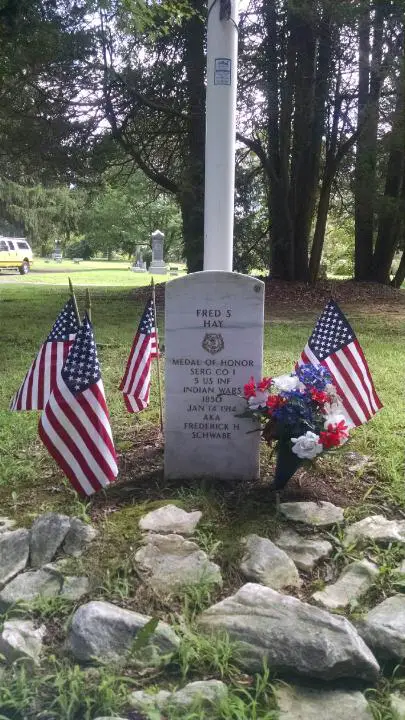
Hay. That’s Fred Stewart Hay, aka, as his tombstone says, Frederick H. Schwabe. That’s his small, plain white stone just beneath the American flag as you enter the cemetery. By either name, Fred Hay or Frederick Schwabe is a hero. Our hero. More than that, he is a Medal of Honor recipient, one of just over 3500 or so in the nation since it first honored heroism and bravery in the Civil War, one of only 426 who earned the honor during the Indian Wars, that series of conflicts that lasted from King Phillips’ War at the start of the 19th century for almost the next 100 years.
He served with Company I of the 5th US Infantry and rose to the rank of Sergeant while serving. According to Medal of Honor records, Fred was born in 1850 in Stirlingshire, Scotland, and entered the US Army at Fort Leavenworth, Kansas. At some point after his enlistment, Fred was in a small cavalry unit escorting a supply train to Battle Creek where they were to meet up with General Nelson Mile’s forces camped there. Miles, who himself also received a Medal of Honor for earlier action in the Civil War, was in desperate need of supplies and anxiously awaiting the train at Battle Creek. On Sept. 9, 1874, as the train came out of a canyon on the Upper Wachita River in what was then Texas, now Oklahoma, it was attacked by a large war party of Kiowa and Comanche warriors. Heavily outnumbered, according to reports, the American soldiers fought valiantly for an entire day and the train successfully moved towards its destination. Hay, as a sergeant, was one of six soldiers cited for their gallantry that day, the commendation simply statin “for gallantry,” absent of all detail.
The battle continued for another two days, and in addition to Hay and the other five who earned honors on the first day, another seven soldiers were also cited for their continuing efforts before the train finally reached the 650-man force and General Miles.
Sgt. Hay lived through the Civil War and for many years after, dying Jan. 14, 1914, at age 64. When he came to Monmouth County, where he lived here, or why his family chose this serene, locally significant cemetery for his final resting place, still remain mysteries. Medal of Honor records show the Medal was issued to him at Upper |Wichita, Texas Sept. 9, 1874.
In fact, within the confines of Bay View Cemetery, it is still unknown the site of his actual remains. Because of that, the Cemetery Association, wanting to be certain his memory is honored, thought it important every visitor to Bay View knew about the Medal of Honor recipient. So, they placed his stone at the entrance. The tall American flag that waves behind it is tended by the Atlantic Highlands American Legion and Veterans of Foreign Wars posts.
Capt. George Porter is also buried at Bay View Cemetery. Capt. Porter fought at the Battle of Mobile under Admiral Farragut during the Civil War and had begun his career in the Navy as a signal boy, a title considered so important that it is engraved on his tombstone. Right up there with his rank of Captain, he the notation, “the only signal boy in the US Navy.”
William Sory is probably not the only Confederate soldier buried at Bay View Cemetery. Born in Virginia, Sory was a private in the CSA, CO. G, part of the Virginia Infantry. One wonders what brought a Confederate to the North to finish out the rest of his life after battling those who live here. Retired Cemetery manager, Walter Curry, said it is believed there are some other Confederate military members who fought for the South also interred at Bay View.
The list goes on, and each veteran’s story is important, whether known or committed to the ages.
The cemetery itself has a fascinating history, a well-cared for, beloved resting place for generations of families from the Highlands, Atlantic Highlands, Leonardo, Navesink, Belford, and Chapel Hill areas. It started, according to author Thomas Leonard, in his ancestor’s law office in 1889 when a group of residents saw the need for a burial ground and formed a company to purchase the land. Attorney Leonard became the secretary of the first company y, with former Judge Sickles the chairman of the new Bay View Land Improvement Company, LTD. The cemetery association was organized, and 52 acres of land carved from R.A. Leonard’s farm were purchased for $13, 300. Each of the partners agreed to purchase a lot in the cemetery, and that was the first money raised towards maintaining and improving the land.
A quiet, thoughtful visit the cemetery gives time and opportunity to think about the men and women buried there, not only the veterans but other ancestors of families who still take pride in calling the Bayshore home. Take a good look at the names on the gravestones, names that still resonate. Look for the final resting place of Mayor Everett Curry who tended this cemetery for so many years before his son Walter took up the mantle. Both Currys seemed to be on a first name basis with all who are buried there, Everett lovingly tendering the graves for 20 years, until 1994, then son and also a former Atlantic Highlands council member Walter Curry, coming on board as assistant in 1978, then assuming the position full time in 2000.
– From The Atlantic Highlands Herald, May 26, 2016
Former Mayor Don Burden, who is also president of the Shrewsbury Historical Society, will give a talk along with two other professionals on the wedding gown collection the Society has, a small part of which is currently on display at the Eastern Branch Library on Route 35.
That talk will be via zoom on Thursday, June 9 at 6:30 p.m., Registration is available by visiting the Shrewsbury Historical Society site or the MonmouthCountylib.org site.
But the former mayor, historian and author also has a fascinating story to tell of a recent visitor to the collection at the museum which will probably not be one of his topics at the Eastern Branch Library program.
It’s the story of the visit from the Bunny.
In his routine affable fashion, Society President Burden had agreed to meet a couple from out of state to see the historic Bridal collection early one recent Sunday afternoon.
He arrived shortly before the 1 p.m. appointment, opened the door and prepared to welcome them. When they had not arrived within 15 minutes, he busied himself with some chores, leaving the door open as a sign of welcome. Minutes later, when he heard a noise at the door, Burden hastened to extend his welcome and invitation into the museum.
However, it was not the couple who had asked for the appointment. It was a rabbit. A small brown, wild bunny.
The little mammal of the Leporidae family had simply walked in the open door.
The unexpected visitor took President Burden by surprise and he dodged slightly to the right. That gave the inquisitive little bunny enough space to hop on past his surprised host and scamper into the main room of the museum, the focus of the unique bridal gown collection.
In quick pursuit, and now not thinking this was such a cute little furry bundle of nature, President Burden managed to spot the little “damn monster!” just as it ducked under one of the very historic dresses in the collection.
That called for a broom with which the rabbit chaser managed to move him from beneath the folds of the fragile dress. But not to be released. No sir, young Mr. Lagomorpha scampered under the raised platforms where all the other gowns were on display. And once again, the furry mammal went out of sight.
Changing tactics, the rabbit hunter opened the museum’s back door, grabbed a snow shovel and began beating on all the platforms in his effort to have his visitor reappear, say thanks for the visit and scamper.
It worked. Bunny Lagomorpha re-appeared, just long enough to be seen scampering out the door into the wide open spaces.
President Burden says he learned two lessons from the experience. One, he won’t leave the door open any more.
And two! Even visiting rabbits think a trip to the Museum is a must to see the outstanding display of wedding history.
There’s one final chapter to the Bunny story. That dress the bunny ran under when he first came into the museum? It belonged to a woman had a long and happy marriage and the couple had one daughter. The daughter was born on Easter. Throughout her life they have called her….you guessed it…Bunny!
Oh. And the couple from out-of-state arrived shortly after. No scampering under dresses or platforms for them. They simply spent an hour learning firsthand some of the fascinating stories about the ladies who wore the dresses and the care that has been taken by the Museum to restore and maintain them in their original beauty.
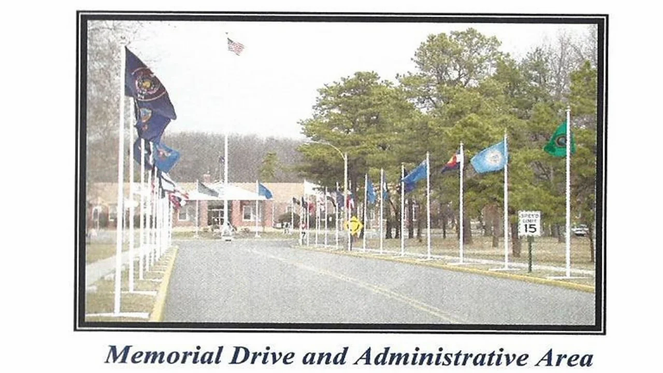
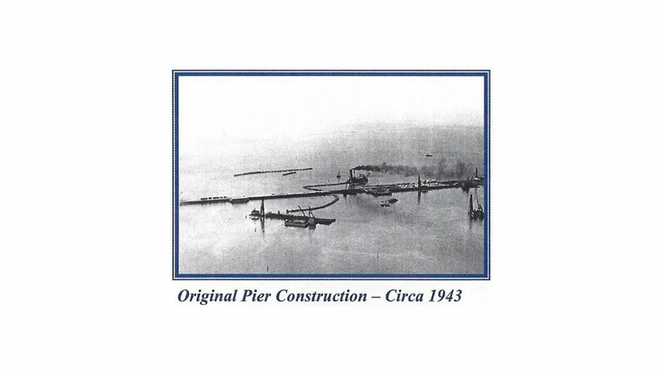
After flying over the area and seeing all the “swamp and jungle” as they referred to the site in Colts Neck, 12 miles from the sea, the Navy thought that would be a more suitable location. A railroad could be built at the waterfront on a smaller piece of land in the Bayshore, disrupt fewer people, and thereby restrict the construction to a minimum of developed property. Thus was the start of a second naval base in Monmouth County; it was named for Ralph Earle, a graduate of the Naval Academy in 1896 and Chief of Ordnance during World War I. It was first known as Naval Ammunition Depot Earle, with a clear mission to support all the operations conducted by the Department of Defense through the Navy. As an ammo site, the base is responsible for storing, repairing, developing and maintaining some of the most advanced weapons used by the US Navy troops, making it an essential base. PHOTO: Train Operations on the pier. A brief summary of the early history of Earle has some fascinating descriptions and information. It was described as “largely oak forest and woodland swamp, glen paradise for deer and other game. Pheasant and fox, deer and rabbit dwelt here in a world of their own, with only the baying of an occasional hound or the tread of an occasional hunter to astound them into seeking cover.” The officer writing the summary in the 1940s went on to say that “even now, …we can smile to see a hen quail, like a plump little bandy-legged woman, waddling over the crusted snow to our charitable handout of bread crumbs, her little family aligned behind her.” Or, on summer nights “we may stop breathless, as a stag, head lifted at the sound of our voices, stands in majesty, silhouetted against the rigid moon atop a magazine.” That was a description of the Colts Neck portion. For Leonardo, the writer continued. “skirting its shores had stood a cluster of gay little houses of prostitution, to which harried New York business ladies were wont to retire during the summer months in order to play their trade in a cooler, quieter atmosphere.” Today, NAD Earle is now Naval Weapons Station Earle, and its mission is still the same. The vitality of the base is evident in the quality of leadership that is assigned to command the 11,027 acres spread over five municipalities…Middletown, Colts Neck, Howell, Wall Township and Tinton Falls, including the approximate 20 mile rail and road line between the waterside and administrative side of the base.
When they hear that, the folks in the Bayshore think of “the pier,” that magnificent three miles of pier, wye, and trestle that every fisherman yearns to be on. The folks on the western side of the County think of 201 Route 34, Colts Neck, the entrance to the beautiful, wooden and very quiet neighbor that is also home to a number of other contractors as well as military serving aboard this very historic base. But to everyone, NWS Earle is a force in war and peacetime, and has been ever since it was first built in 1943 to answer to the war that was supposed to end all wars. The truth is, it was really long before the start of WW II, both Army and Navy officers knew there should be a base to load and unload explosives somewhere in the port of New York area, in an area close to roads and rail. Strangely enough, it was the Army who first came up with the idea, and the first to suggest Port Monmouth and Spermaceti Cove as sites that should be considered for a permanent location. The Navy also considered the issue,and decided that yes, an ammo load and unload site in the New York area was essential to the nation’s security, and yes, the south side of Sandy Hook Bay would be the ideal spot. But the Navy also had strong feelings about disrupting so many homes in Port Monmouth to accomplish their goal and suggested instead a unique
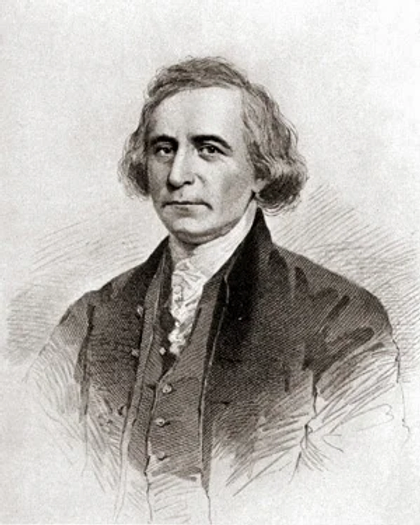
There are so many people through the centuries who are connected with Highlands and all of Monmouth County we sometimes forget how much pride we can take in our ancestry and the earlier settlers of the area. is one of them. Born in New York and educated at Princeton, where he roomed with James Madison, Freneau was known as the Poet of the Revolution, and actually in some circles is known as the Father of American Literature. He kept other good company during his Princeton years..the likes of Aaron Burr, William Bradford, later US attorney general, William Patterson, later Governor for whom the northern NJ city is named, Henry Lighthouse Harry Lee and Hugh Brackenridge, with whom he wrote what is regarded as the first book of narrative prose written in the United States. The oldest of five children, his mother educated him so he could be a minister, and while Freneau dutifully studied theology, he was more drawn to literature. Then when the Revolution broke out, he used his wit and poetic ability to bring the era’s politics into the poetic world and educate the people on the American Whig Society. His style was eclectic and he could write satire and comedy as well as patriotism and inspiration, be it for the Revolution or the sea, recalling the time he loved as a sea captain visiting islands and writing naval ballads. Freneau married a Monmouth County lady, and built the family home in Mount Pleasant on his wife’s 1,000 acre estate, the community now known as Freneau. He tried a variety of different jobs and occupations during his life, decided early on he did not like teaching, but was drawn to editing and newspapers. He worked for a while as a trader during the sea captain days, and as a farmer. And when he was in the New Jersey militia, captured, and imprisoned on a British ship, he even wrote about that, pouring a large dose of bitterness into what was otherwise beautiful poetry. Later, at the suggestion of friends Madison and Thomas Jefferson, he even started his own newspaper in Philadelphia, the National Gazette. Purpose of the Gazette was to uphold Mr. Jefferson’s beliefs and counter the pro-Alexander Hamilton press. He was also working for Jefferson during his presidential years serving as clerk for foreign languages within the office of the secretary of state. Later, still in Mount Pleasant, he published The Monmouth Almanac that printed stories about everything from the solar system to Freneau’s own essays. Lofty, deep, funny or strange as some of Freneau’s works were, his Naversink is the poem best remembered and appreciated by folks in the Bayshore. In five stanzas, he wrote about the beauty of “these, hills, the pride of all the coast,” the valley, “these vales, impervious to the wind…:” what the hills saw….”a thousand sails your hazy summits greet,” the Revolution, “you saw the angry British come, you saw him, last, retreat.” He even incorporated Joshua Huddy’s hanging in the poem, referring to “Where forests round them rise, Dark groves, their tops in æther lost, that, haunted still by Huddy’s ghost, the trembling rustic flies.” Freneau never made much money for all his writing; he sold off much of his farm to pay debts, lost the house to a fire in 1818, and worked as a laborer whe he was in his 70s to pay his taxes. In his 80s, he applied for a veteran’s pension which was granted, the grand amount of $35 a year. But he never lived to collect it. Philip Freneau, the Poet of the Revolution, the poet who wrote of those Highlands hills “Let those who pant for wealth or fame pursue the watery road; Soft sleep and ease, blest days and nights, and health, attend these favorite heights, retirement’s blest abode!” died of exposure in a blizzard in December, 1932.
Calling on my friends who love doing historic research about our area and its people. Norine Panacker, who lives in Middletown, is researching her family history and is trying to learn more about her grandma, Katherine Styble Cisek. What she has learned so far is Katherine lived with her family in Brooklyn where the family ran a hardware store in the early part of the 20th century. Catherine married John Siecinski in 1914 and by all accounts were a delightfully happy and devoted couple. Apparently at some point Catherine, who was Polish, became an au pair for the William Treat family who summered in Atlantic Highlands or Highlands. She was the nanny for the three Treat children, Sanford, Florence and Grace. The Treat family had a long history in America, and Norine is wondering if anyone knows where the family lived or summered here and if the house is still standing. She would love to see the house and rekindle some wonderful memories of her grandma. If you have any hints or know anything about the Treat family, please let me know so I can pass it on. Some of my most learned historian friends have not been able to uncover much or a connection between the Treat family and either Highlands or Atlantic Highlands, other than they do not appear on the 1940 census, leading several of us to believe perhaps they summered in the hills in one of the two towns. Mr. Treat, we learned, was the president of Hull, Grippen & Co., a New York based hardware and furnishing store in the city in the late 19th century, so possibly the same business the Ciseks were in. The company had a reputation particularly for dealing in stoves and cooking ranges, with one of the owners holding several patents for ranges, stoves and fireplace grates. By the 20th century, the firm was more involved with builders hardware and contractor supplies. Mr. Treat apparently lived in Richmond Hill, graduated from Yale Business School, and went into the hardware business with his uncle before coming to New York. His son, Sanford, who was an army officer stationed at Fort Dix during World War I, and later became vice president and manager of Hull, Grippen. Corinne shared this lovely note with me which many of you might find of interest to read now in the 21st century. It’s dated 1928 and was written by William Treat’s widow, Sanford’s mom, showing a warm relationship between her and Catherine.
I think every historical society in Monmouth County is contributing something very special by researching, preserving, then keeping residents and visitors alike aware of just how special history is here in Monmouth County, dating back to the Lenni Lenape tribes as well as the important role the county played in the Revolution. Highlands is fortunate to have not one, but two local societies since the Twin Lights Friends concentrate on the lighthouse itself and the Highlands society does so much to preserve the history of the borough. Both are terrific, as is the Atlantic Highlands Historical Society which maintains the Strauss house so beautifully and does so much to keep that borough’s history alive. And of course my friends in Middletown do so much for their Historical Society as well and offer great speakers and great information virtually during the Covid pandemic. But I’d also like to heap praise on the
and the creative ways they preserve history and raise funds to do all they do. That bridal display of last year was nothing short of spectacular and drew crowds of admirers even wit h the pandemic when they had to wait patiently for their turn to see the beautiful array of wedding gowns and wedding memorabilia from three centuries. That Society also received the prestigious William G. Pomeroy Award earlier this year which is enabling them to install a roadside marker identifying the borough’s historic Four Corners. You know where I mean. That is a site on the National Register of Historic Places also known as the crossroad of civilization in Monmouth County, and it includes the Allen House, the Wardell House, the Shrewsbury Historic District and Christ Church at Route 35 and Sycamore Avenue. There are more than 93,000 properties on the National Register, including buildings, sites, districts, structures and objects. But it’s up to the individual unit to provide the roadside marker to recognize the sites. That’s where the Pomeroy Foundation comes in, helping historic societies with some funds. In the case of Shrewsbury, they received an $1,100 grant. That, coupled with the borough council approval, means the Society can purchase the sign and have it installed on the southwest corner of Broad St. and Sycamore Avenue. Congratulations Don Burden and all your hard working society members. What a great achievement