The Highlands Historical Society did what it does best last night. It gave the opportunity for everybody to get on a zoom call and tell their own memories of Highlands and how living here, summering here, working here, or bringing up families here has impacted their own life.
It was an opportunity for out of state former residents to see each other on the screen, if not in person. For some, it was 30 or more years since they’ve seen former friends or adversaries, and it was an opportunity to share common, happy memories. There may have been disagreements over politics or municipal procedures in the past, but gathering together to recall the Highlands in which they lived, none of those things is remembered. Just the good times. And the good people.
It was an opportunity for everyone on the call to see once again what makes Highlands so special, and the conversations, laughter and recalled memories over nearly two hours showed exactly what does make Highlands so special. It isn’t Conners Hotel that is really special…it’s Duke, and Jackie, and Bobby and Bill, the Brothers Black, that those on the ZOOM meeting remembered…how Bill made the best prime rib and most spectacular lobster, how Jack fed dinner to everyone who waited or bussed at the hotel before their work evening started.
It wasn’t Bahrs Restaurant that made Highlands special, nor the fact it is the oldest still operating business in the borough. It was Buddy and Peg Bahrs, Ray Cosgrove, and all the members of the Bahrs family that made the restaurant so memorable. The same with the Stowaway and Sonny and Evelyn Vaughn welcoming guests to that wonderful dining room and superb dinners, or the Bremekamps at the Careless Navigator who out out the best hamburger or shrimp sandwich ever.
It was the opportunity for Vince Mendes, from his home in the south, to remind listeners just how much his granddad, Haik Kavookjian did for the town and for some on the meeting to learn more about the very generous, wealthy man who never wanted any limelight but always wanted to help. Vince’s story on his granddad’s ploys that got a post office to the borough was great.
It was great fun to hear Bill Wilson talk about what he went through to get that clam depuration plant a reality and to hear his pride in being a part of Highlands. Bill’s got plenty more stories to tell and hopefully will be on future ZOOM meetings to share some of them…even the ones that are rarely repeated in public!
So that’s what history is all about. Not so much the buildings or the architecture, not so much about the good and the bad, simply the people. The buildings are just the part of the story that generate the memories that keep Highlands above and beyond other communities. It’s the people.
Walt Guenther is a wealth of information about the borough and its people and places. His research is impeccable and fascinating. President Sheila Weinstock reminded everyone how successful Walt’s walking tour of the downtown area was, and excited everyone with her promise it’s going to be bigger and better in the future.
The president is offering more ZOOM sessions like this to give more folks both from here and now from so many other states the opportunity see faces they might never have seen again were it not for the technology that allows and encourages ZOOM meetings. If you’re interested, let the Highlands Historical Society know you like the idea, you’ve got stories to tell, you have memories you want to share. It’s a good idea to be a member of the Society to share these stories, but it’s not a requirement…though once you feel the enjoyment of sharing your own story you might want to become a member.
To everyone in Highlands he was he guy who was always around, the waterman who was always happy to help someone, the native who knew everyone and everything about what used to be Middletown when his family first settled here.
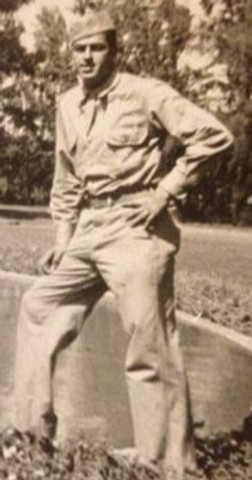
To the US Army, he was Elmer Layton, a top secret Courier for the United States when he served in the Army Air Corps during World War II.
There aren’t many stories about Elmer’s war years, other than fun and heartwarming memories he and other soldiers from Highlands shared with their families, both in letters sent from foreign places and conversations once back home.
There is the story about how, as a courier, Elmer traveled around Hawaii with his briefcase shackled to his arm. He was also being armed with orders from his Commander that he better never come back without it, or at the very least, his arm better be missing with the briefcase if he did.
Or the time the battery on the Harley he traveled on throughout Oahu bounced off the bike, and without any money, he had to hitchhike back to his station. From what the family remembers, of all the places on the island during the war, Elmer used to say he liked Kahuku airfield the best. Located at the north end of the island, there were many underground bunkers there, and he liked how desolate and protected the area looked at this time of war.
There is also the heartwarming story late in 1944, when a group of military heroes from Highlands all had the chance to get together when all were stationed for various times in Hawaii. There was a time in 1944, at the beginning of December, that Highlands natives all of whom volunteered to serve in the war had the chance to get together. There was a reunion of sorts among Elmer, Arden Bedle, Harry Rubley and Ardeth Canan, who served in the Nurse Corps. It was Rubley who wrote about the get together to his mom, and she spread the news so all would know each of the fighting patriots was safe. It must have been a memorable Christmas for them all.
After returning from the war and settling back in Highlands, Elmer was also a hard working volunteer for Columbia Hose Company No. 1 of the volunteer fire department, and at one time also served as state delegate along with the department’s vice president, Sherman Smith.
Nor was Elmer the only hero in his family during World War II. His sister Dena, later Dena Layton Kadenback Parker, was an air raid warden in town, one of the many volunteers who patrolled the streets and beaches at night, assuring all window shades are secured tightly so as not to let any light be seen. Air Raid wardens along the Highlands waterfront also had to keep watch at sea for any lights or signals of any time that enemy submarines or ships were in the area.
For historians, Elmer’s family’s deep roots in the Bayshore can be traced back to a King’s grant of 240 acres to a grandsire in what is now the Chapel Hill area. The Layton Family graveyard is located just off Kings Highway, and Elmer’s ancestors Hannah and Anthony, who were both born in the mid-18th century and died in the early part of the 19th century are buried there. Elmer himself grew up in a house that used to be a grocery store and is no demolished at 99 Bay avenue.
She wasn’t a politician, a banker, a religious leader, a grocery store owner. But she was a huge influence on my life as a young mother. She was always a neighbor and she was always there if she were needed, to babysit or simply to give advice.
Pauline and Andy Homiak lived two doors away from us on Huddy Avenue for the first five years of my marriage. She was probably in her late 40s or early 50s then, but to me, an 18 year old bride, I thought she was old. She had bright red hair, a mouth that could make a priest shrink, and could be so loud when she was angry at something you’d swear the knick knacks on the living room shelves were rattling . I know Chicken, our little mongrel dog, would shake and run into a corner to hide when Pauline yelled.
Pauline was a McGrail as well, one of those great wonderful families that filled the town with Irish love, laughter, religion and everything else that’s good. Her mom lived on Second St. and her brother lived on Linden Ave…her nephew is the wonderful Rev. Marty McGrail at the Church on Bay avenue in Highlands. Her sons Andy, Michael and Jimmy were always around, always great kids, always close to both their mom and dad.
Big Andy worked at Fort Monmouth and Pauline was a stay at home mom, and close to all the McGrails.
Pauline loved my girls, Kathy and Michelle, who were both born in the years we lived on Huddy Avenue. I’d bring them over to Pauline’s little front porch on warm days, so she could chat with them, hold them, love them, and tell me everything I was doing wrong as a mom. As Kathy got to be three or four years old and the Homiaks moved one house closer to us so they were then next door neighbors, Kathy could even walk over to Aunt Pauline’s by herself and loved to sit and chat with her.
Jimmy, my husband, as near perfect as he was, also could make a priest shrink when he spoke. “God damn it” was a single noun in his vocabulary, and meant everything from “Boy, that was great!” to “What the heck did you do that for?”
So it was natural that Kathy, a quick learner, would pick it up as well. At Aunt Pauline’s, she would say it often, whether she was happy or upset about something. Pauline told me that all the young mothers read Dr. Spock, the pediatrician so highly regarded for all those years. She told me Dr. Spock said you should not reprimand a youngster for using bad words. Instead, the good doctor said, one should simply create a phrase and every time the child used the bad words, you should substitute the new phrase. Pretty soon the child would get the message and stop saying the old phrase.
So how could I challenge Pauline and Dr. Spock? I agreed to quit yelling at Kathy for her mouth and try substituting “Or for Pete’s Sake!” Even though I didn’t even know a Pete other than Pauline’s brother!
So this went on for a couple of weeks. Every time Kathy said God damn it, I said, “Oh for Pete’s Sake,” and refrained from washing her mouth out with soap or yelling at her. Then a few weeks after we started, there was the transformation! Kathy was annoyed at something and burst out, “Oh for Pete’s Sake!”
I was delighted! I was thrilled! Kathy was saying “Of for Pete’s Sake” all the time. I loved Pauline’s advice and I quickly became a follower of Dr. Spock. Here I was, a young mother of two adorable little daughters and I was smarter than a four year old! It was amazing!
My pride in myself did not last too long! Kathy was over her Aunt Pauline’s with me one day, and Pauline said, “Kathy Smith, why do you always say, “For Pete’s Sake?” And with all the wisdom, beauty, confidence and intelligence of my beautiful first born, she wiped out my whole sense of pride and confidence.
Looking up at Aunt Pauline, Kathy giggled and said, “Because my mother doesn’t like me to say “God damn it!”
I threw my new Dr. Spock book away. But I learned so many other lessons from a wonderful neighbor and a dear friend.
Ah, the political parties definitely took sides in deciding local issues, but they did it with courtesy and politeness in the old days of the 1970s. Take the second time in his many years as Atlantic Highlands Mayor that Dick Stryker vetoed an action of the governing body….but he was voted down by the majority party, which, even though he was Mayor, was not his party!
And that’s how the borough authorized spending $72,000 for planters and islands in the harbor parking lot rather than installing electrical power to the piers, and making some repairs to piers and more.
It all started when the Mayor sent the administrator, J. Leonard Clark, a letter explaining the money could best be spent on repairs and maintenance, and “islands and planters seen unnecessary at this time.”
When the mayor’s letter was read at the meeting Council took sides, with Councilmembers Helen Marchetti, Jack Kelleher, Herb Moore and Peter Donoghue ready to fend off every argument Dick Stryker made. And Walter Curry and Bob Schoeffling, himself later to be mayor, didn’t have any power, since four votes were sufficient to overturn the veto, and those agreeing with the mayor couldn’t stop it.
Dick argued the money the other council people wanted to use came from a capital improvements budget that was set up to ensure there was money in case of a winter storm, or hurricane, or some other catastrophe. Pete countered there wasn’t enough money there to finance any of that anyway, so let’s just get the planters and islands. He made his suggestion “with due respect” to the mayor’s opinion…do you even ever hear that anyplace these days?
When Dick said more than 200 people objected to the expenditure, Jack said, of course with the same due respect, the people really wanted more organization in the parking lot so the islands were necessary. Neither Helen nor Herb said anything, but it was clear they were on the side of Jack and Peter.
The Mayor’s veto was overturned, the planters and islands were approved, and fortunately, there wasn’t a major storm or hurricane that screamed out for $72,000 in capital improvement funds.
And when the meeting was over? This council left their differences of opinion at the table. And no one recorded whether they all met at the Shore Casino, or one of the other establishments in town, to share a drink, talk about their families, the latest national news or some sports event and renew their friendships, their work behind them and left on the council table.
Even before the American Revolution, the name Scudder was highly revered and respected throughout the eastern part of the continent that would become the United States of America, though there are varying accounts of when the Scudders first arrived and from which part of the British Isles they emigrated.
What is certain is that two Scudder brothers arrived on these shores in the 17th century, landing in Massachusetts, where one settled, while the other moved on to Long Island and was well established there by 1630. That brother, Thomas, was a miller in Huntington, Long Island, married and had a son named Jacob. Jacob grew up on the Island until he moved to what became known as Scudder’s Mills, just southeast of Princeton, NJ. He and his wife, Abia, later settled near Monmouth Court House, a name used to describe the county seat at Freehold, where they raised their three sons and three daughters. Nathaniel was the eldest of the half dozen and was born May 10, 1733, most likely at Freehold, although historians disagree on whether there or on Long Island.
Nathaniel was in the fourth graduating class of the College of New Jersey, now known as Princeton, in 1751, and immediately launched into the study of medicine. During his years as a physician, Nathaniel was highly regarded and respected, and had an extensive practice through the Monmouth County area. Early accounts describe him as enjoying “the respect and confidence of the people of that part of the State on account of his varied learning, strong powers of mind, genial disposition and purity of life.”
Nathaniel married Isabella Anderson, the only daughter of Colonel Kenneth Anderson, the year after his college graduation, and following a charming and whirlwind romance. The History of NJ Medicine records the courtship and romance as told a century later by Dr. Scudder’s granddaughter, Maria.
Seems the beautiful Isabella, a member of an old Scottish family that came to the colonies during the Scottish troubles of 1715, came to church services on horseback, and was quickly seen and appreciated by a young college graduate, Nathaniel Scudder. She alighted from her horse and fastened him to a tree before walking into the church. The daring young medical student went up to the horse, disarranged the equipment and entangled the bridle before he, too, went into church. When service was over, and young Isabella went back to her horse, only to be chagrined by the entanglement, Nathaniel suddenly appeared, quite dignified and graceful, and offered to come to her assistance. He righted all the reins he had entangled, then assisted the young lady into the saddle. He mentioned to her that since they were both traveling in the same direction, a distance of some four miles or more, he felt the need to travel with her and offer her protection. She acquiesced to his gallantry, Nathaniel mounted his own horse, and the two rode off together, the beginning of a courtship that culminated in a marriage in 1752 and ultimately the birth of three sons and two daughters.
The young Dr Scudder had a lucrative and popular medical practice in Monmouth County, but also displayed his strong belief in a free nation separated from ties to England, as well as his belief in a strong religious foundation. He was a member of old Tennent Church where he apparently challenged Thomas Paine of Common Sense fame on a religious matter. Scudder bested the gifted New Englander in the verbal controversy.
But as the colonies grew closer to war and New Jerseyans heard reports of the British soldiers taking over and burning Boston, Dr. Scudder was among the first to become involved. At a meeting of citizens held in Freehold on June 6, 1774, a full two years before the Declaration of Independence, Dr Scudder took a leading role and drafted resolutions of sympathy for Boston and support for the cause of freedom.
His involvement in the freedom cause came quickly after that, and he was named to numerous positions of authority and leadership. He became a member of the local committee of public safety, then a delegate to New Jersey’s first provincial congress which met in New Brunswick. He became speaker of the legislature within two years, and when the first Monmouth County regiment of militia needed more men, Nathaniel hung up his stethoscope and signed on. He became a lieutenant-colonel in the First Regiment of Monmouth militia under Col. George Taylor, whose father, Edward Taylor, owned Marlpit Hall.
By November 1776, five months after the Declaration was signed, Lt Col. Scudder was promoted to colonel and took charge of the regiment whose soldiers came from the Freehold and Middletown area. Taylor had resigned his post to join the Loyalists.
It was neither glorious nor safe to be a rebel anywhere on the continent, but particularly in New Jersey, where lived the highest concentration of Loyalists among all the colonies. Families were torn apart by the differences of opinion on whether this far flung child of England should remain loyal to the King, albeit laden with heavy taxes and no representation in British government or take on the world’s strongest nation and fight for independence. Loyalists, some of whom remained soldiers simply to act as spies and report troop movements to the British generals, burned or otherwise destroyed the homes of their rebellious neighbors and former friends, took their cattle and destroyed their crops.
Nor could the rebels honorably call themselves an army. They had no uniforms, received little or no pay, left their own families and farms to take up the cause, and were often armed only with make shift weapons. But Scudder, as others like him, saw it as a worthy and honorable cause and bore all the burdens of leading an upheaval never before known, all for the cause of freedom from British rule. There followed a period known as the Tory Ascendancy, and unfortunately, Scudder, in command of Monmouth Militia troops, had little success. The militia dissolved.
With no troops to command, Scudder attached himself to a Pennsylvania Continental regiment; some other troops also followed. Thus, began a month long, but highly successful action to put down the Ascendancy.
Within a few weeks, the Monmouth militia was reconstituted and spent the next month encamped on the hills of Highlands, with a mission to guard Monmouth County against a British invasion by their troops stationed at Sandy Hook. But by February, Scudder’s militia was involved in the Battle of Navesink, surprised by the British and falling to them with the loss of more than two dozen militiamen killed and another 70 captured.
Dr Scudder resigned from the militia to devote more time to rising in the political field, where he felt he could do better as a legislator. In 1777, he was elected a delegate to the Continental Congress, but did not attend a session for nearly a year because of his militia obligations. Throughout his two one-year terms in Congress, Congressman Scudder also missed a number of other meetings because his duties; he was a member of the committee dealing with the quartermaster service, a position which required a considerable amount of personal travel time. He declined to accept a third term, indicating the heavy burden his time away from home placed on his modest estate in Freehold made the obligation too demanding.
Records show that in actuality, Col Scudder was not even in the militia in June of 1778. At the time of his 1777 resignation to focus on politics, he relinquished his post as colonel of the first regiment to Asher Holmes. As it happened, he was at home enjoying a Congressional recess in the summer of ’78 when British General Charles Lee began his march through Monmouth County. Scudder decided to join the fray so close to home, an encounter which became known as the Battle of Monmouth, the battle historians later called a turning point of the war.
While it was never seen as a clear-cut victory, the British fled Freehold under dark of night while General George Washington was preparing an early morning attack. Routing the British after Washington’s stunning losses in New York gave those who yearned for freedom the boost in morale they needed to continue waging the war.
With his retirement from Congress in 1779, Scudder devoted full time to his military duties. He also served on the NJ Council of Safety, where part of his obligations included fining or jailing captured Loyalists in areas, Monmouth among them, where there were no courts. He also served as the county’s representative to the Privy Council, the Upper House of the NJ Legislature.
That he knew his life was constantly in danger as a soldier was best evidenced in a letter her wrote his son, Joseph in 1780. Joseph was a law student in Philadelphia and the worried father expressed concern for his son’s future. He signed it “with every sincere wish and prayer for happiness both here and hereafter, your most affectionate and careful Father..”.
Ironically, Nathaniel Scudder, doctor, Congressman, New Jersey Assemblyman, local leader, soldier, patriot, came through the war years unscathed. Until 1781.
Still affiliated with his old friend from the Monmouth Militia, General David Forman, he was assisting the general in repelling Loyalist raids on bayshore lands. The pair had formed the Retaliators, a vigilante group of patriots viewed as both illegal and dangerous, known for taking strong actions against Loyalists and suspected Loyalists. When a party of refugees landed at Sandy Hook and made their way undiscovered to Colts Neck, where they took six prisoners, the alarm was sounded at Freehold, and Dr. Scudder responded. Knowing the direction, the refugees would head, he told his family that a battle was “expected at Long Branch. I will go down and bind the wounds of the poor fellows.”
With other patriots from Freehold, Dr Scudder took off in pursuit of the Loyalists, in an effort to rescue the prisoners. Near Black’s Point, now Rumson, Dr. Scudder and General Forman were standing on the river bank talking when a shot was fired aimed at Forman. But, as the general told it later, he had taken an involuntary step backward, describing it as “the most fortunate step of my life.” The bullet that missed him, struck and fatally injured Dr. Nathaniel Scudder. It was four days before the Battle of Yorktown and the surrender of the British to their American foes.
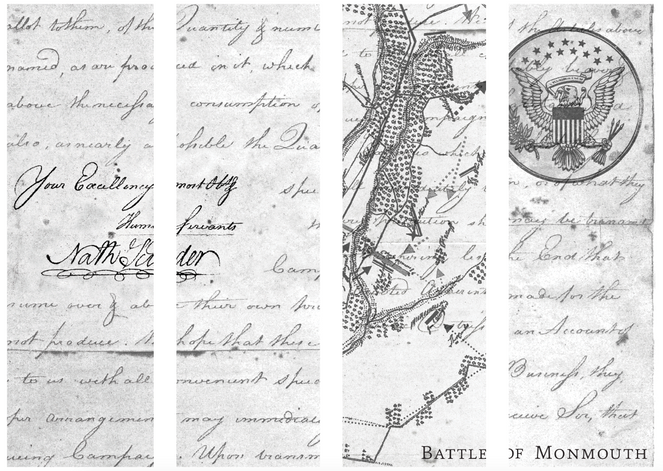
Colonial Scudder thus became a casualty of the war, the only member of the Continental Congress to serve with the militia and be killed by the enemy. He is buried in Old Tennent Church cemetery, Manalapan. At the Freehold Borough Hall, the second- floor meeting room is dedicated as the Scudder Room and a glass wall, designed by local designer Nelson Kuperberg, depicts Scudder’s writings, a scene from the Battle of Monmouth and the map of the area.
The wall of glass in the Scudder Room (above) depicts some of the accomplishments of Monmouth Court House native Nathaniel Scudder (1733-1781). The first two panels exhibit some of the writings of Congressman Scudder as a delegate to the Provincial Congress of New Jersey in 1774. He was a member of the state general assembly and speaker in 1776, and a member of the committee on safety. Notice his signature in bold. The third panel depicts the Battle of Monmouth, in which Scudder served as a colonel in the First Regiment of the Monmouth Militia in 1781. The fourth panel depicts the Articles of Confederation which Congressman Scudder signed for the state of New Jersey as a member of the Continental Congress in 1778. The Seal in the upper right hand corner represents his service in Congress from 1777 to 1779. A graduate of the College of New Jersey, which he later served as a trustee, and a practicing physician, Col. Scudder was killed at Blacks Point, while resisting an invading party of the British Army Oct. 17, 1781. He is buried at Old Tennent Church Graveyard and is the only member of Congress to have been killed during the Revolutionary War. The glass wall was commissioned by Mayor Nolan Higgins in 2015, designed by Nelson Kuperberg of the Freehold Historic Preservation Commission and created and dedicated by the Mayor and Council with Dr. Scudder’s descendant, David Fisher of Germany, attending, in 2016..
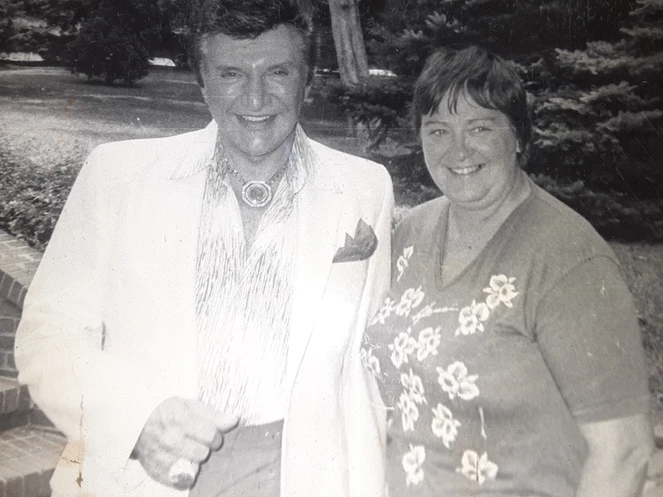
In the 1960s and 1970s, The Garden State Arts Center had entertainers who performed three, four, five or seven nights a week, staying in local hotels during their stays. In the case of top entertainers, the lead act in any show, there was always a press conference and a luncheon the afternoon of the first evening’s show. Two of the most entertaining and friendly entertainers at those luncheons were Johnny Cash and Liberace, both of whom appeared at the Arts Center several times. Liberace always made time for photos with the reporters, and always have them the newest album of whichever young talent he was featuring on his program. I covered most of Liberace’s appearances at the Art Center, and always loved the per-performance press conferences. This is my review in The Courier from his Arts Center performance in August 1979.
HOLMDEL – Liberace is fantastic. It makes no difference that he has been at the Garden State Arts Center every year for the past ten years. It makes no difference his show varies little from year to year, except in the splendor of his costumes. What matters is that Liberace loves to perform, loves to play the piano and loves to sop up the adulations of the audiences. It all makes for a most enjoyable evening.
At the Arts Center every night from now through Saturday, Liberace comes on state at the very beginning of the show, resplendent in a Norwegian blue fox cape with a 16 foot long train that coordinates with his silver and white sparkly studded tuxedo. He doffs the cape almost immediately and makes six other changes through the course of the evening, each of them more spectacular and more sparkling than the one before. His candelabra is alive and well and still ensconced on his Steinway, his jokes are the same as previous years and his repertoire of tones is basically a repeat.
But that’s the stuff the Liberace fans love. He’s found himself a tidy little niche and he’s not about to rock the boat. You know the joke about how he laughs all the way to the bank? Well, this week, he said he’s bought the bank. And he joked, he’s looking into the Arts Center because he likes that too.
For the serious music lover, Liberace is a talented enthusiastic musician. You could tell without his mentioning it that Chopin is his favorite composer; his rendition of a Polonaise is unforgettable. And he really doesn’t need the colorful and electronic-inspired Dancing Waters to enhance his renditions of the Waltz King, Straus. But it is an attractive addition. His Gershwin is flawless.
Yet even with his bent for the classical, and his obvious enjoyment of it, Liberace can swing into Eddy Duchin or modern day tunes with aplomb and talent. And that’s where his show differs; as talented and polished as he is at the piano, he really does seem to improve every year. His show is a study in musical excellence with a variety that’s unbeatable and matchless.
As always, Liberace brings new talent with him, and he’s excelled in that this year, too. Young Marco Valenti is an Italian tenor with a personality to match his talent. He’s sensational. And it doesn’t make any difference whether you like opera or not. When you hear his arias from Rigoletto and Pagliacci, you might become a devotee. Light and moving, no heavy opera, but definitely outstanding. He’s exciting, dynamic and the possessor of a gorgeous resonant voice.
The real excitement, however, comes in the form of the Chinese acrobats of Taiwan, a talented bunch of youngers and not-so-youngsters who put on a mini-circus right before your eyes, complete with a lady magician who makes a gorgeous young lady disappear under silk scarves. The young man who climbs atop six chairs perched atop four empty bottles on top of a little stand takes the prize for putting electricity into the air and exudes a personality even more charming than his graceful balancing talent. There’s a beautiful colorful dance with scarves and a glittering dragon, some highly talented unicycle rides and an awful lot of enthusiasm in the Taiwanese performances.
There’s no doubt about it; Liberace knows the audience comes to the Arts Center to see a show; he guarantees they get it.
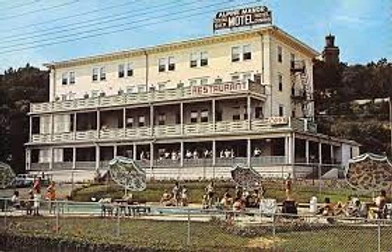
It was the winter of 1976, and in addition to Bahrs, the Alpine Manor and Sonny and Evelyn Vaughan’s Stowaway Hotel on the corner of Highland Avenue and Portland road were two of the most popular restaurants in the borough. Situated by the Highlands Sea Bright Bridge, the two stately hotels were landmarks in the borough until the late night fire that completely destroyed the Alpine Manor. The story in The Courier showed the cooperative work of the volunteers from Highlands and the surrounding towns that prevented a far more serious fire. The Alpine Manor had been sold three years earlier by the Giarmita family, who had made it one of the finest restaurants in a borough filled with fine restaurants. This is the story I wrote for the Courier in February, 1976.
HIGHLANDS – Still smoldering late yesterday were the ashes of the Alpine Manor, Route 36, a Bayshore landmark since it was built in on the hill beneath the Twin Lights.
Patrolman David Gilson, fire investigator for the police department, said firemen would probably be on the scene all last night as small fires continued to flare up in the rubble that remains of the three-story frame structure.
Patrolman Gilson said the blaze, believed to have started In a first-floor dining room at the north corner of the building, broke out shortly before the alarm was turned in at 10:30 p.m. Saturday. The fire burned fiercely all night, creating huge clouds of smoke that hampered efforts of firemen from here, Atlantic Highlands. Middletown Sea Bright and Monmouth Beach.
“The peak of the fire came at about 1 am. The flames and smoke were going up 100
feel into the air,” the police officer said.
Nine known residents of the building, which provided rooms for transients and welfare recipients, were evacuated, Patrolman Gilson reported. “We’re pretty sure that’s all, but you never know, ” the fire investigator commented. He said that efforts were still being made to compile a list of all those known to have been resident in the building at the time of the fire. A final list has not yet been made, he said.
John Vlahos. who bought the 50 room hotel three years ago and lived in an upper floor apartment, was in New York City at the time the fire broke out, Patrolman Gilson went on. The hotel owner was out of town again yesterday, seeking advice of his attorney and Insurance agent. The dining room, bar and most of the hotel’s guest rooms had been closed for some time, with only a number of upper floor rooms and apartments occupied, Patrolman Gilson explained.
Five persons. Including a special officer on duty at the scene, were taken to Monmouth Medical Center, Long Branch, treated for smoke inhalation and released. As the fight against the fire progressed through the night, two firemen were treated at the hospital for minor cuts and bruises, he said. Assisting at the scene were the Highlands, Atlantic Highlands, Sea Bright, Monmouth Beach and Middletown First Aid Squads. Patrolman Gilson said the true value of the fire loss cannot be determined until the ruins cool enough so a further investigation can be made, but he called the building a “total loss” and estimated the damage as “in six figures.
Patrolman Gilson praised the efficiency of the mutual aid arrangement among area fire departments which brought badly needed out of town equipment to the scene promptly Saturday night Under the agreement two aerial trucks were supplied by Atlantic Highlands and Belford. as well as additional apparatus from Sea Bright, Middletown. Monmouth Beach and Atlantic Highlands. The police fire investigator also praised the fight against the fire as a “well organized” operation directed by Chief George Connell” and commended the actions of County Fire Marshal Walter Holtz and his assistant. Frederick A. Leggett.who took overall control. Patrolman Gilson said he will direct an intensive investigation of the causes of the blaze as soon as the fire is completely out and the rubble
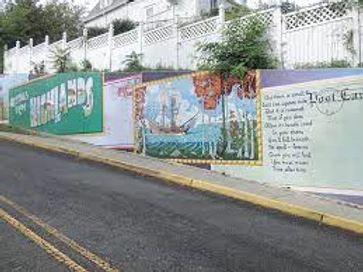
Looking back over some of the millions, yes, literally millions, of words I wrote for The Courier over nearly a quarter of a century, it’s great fun to see the names and stories of dear friends and recognize once again how very clever they are and what wonderful neighbors they have been. The Mike Kovic family in Highlands is just one example of a pair of pretty wonderful parents who did an outstanding job raising wonderful offspring…anyone admiring the wall on Miller Street hill already knows the talent of son, Jimmy and everybody in Highlands in the 1970s and 1980s knows how terrific the entire family is.
A story in The Courier in January 1976, told the story of the patriarch in the court room.
Mick Kovic had to appear before Municipal Court Judge on a complaint about his dog running loose.
First of all, Judge Kenneth Walsh, who generally sits in Middletown, had to appear instead of long time Municipal Court Judge Ronald Horan, because it was determined there was a conflict of interested between Mike and Ronnie. Probably because they were good friends.
Secondly, Mike had received his complaint through the mail from the police department, along with a copy of Clancy the dog’s license number as proof, police pointed out, it was indeed Clancy, a Dalmatian, who was running loose back in August.
Not so quick, argued a very astute Mr. Kovic, as he set about explaining his innocence, and Clancy’s, to the judge.
In the first place, he argued, I had three Dalmatians at our home this summer. How would the officer know it was specifically Clancy who was out and about at 3 a.m.?
Then he went on to explain to the listening Judge. You see, Your Honor, Clancy is an old dog, she’s 10. “And she’s got arthritis real bad. She’d never walk down that hill because she wouldn’t be able to make it up again.” The Kovics live on Miller Hill, the charge was for a block below on Highland avenue. The officer was relying on the statements of a passing motorist in a white van who said it was Kovic’s dog.
The Judge checked the record and found indeed that since 1975 not one, but three Dalmatians were residents in the Kovic home, all properly licensed, and the charge couldn’t very well stand. Besides, said Judge Walsh, if Clancy is 10 in dog’s years, then she’s in her 70s as we see it. “And I know I wouldn’t be able to make it back up that hill, so I can see where Clancy couldn’t either.”
Writing has never been work for me because I enjoy it so much, and had great English, French and Latin teachers in high school who also made it easy to expand my vocabulary and know the meanings of so many words.
But the greatest joy in writing is when it brings pleasure, happy memories, or enables a person or family to be able to take some pride in others know some of the special things about someone special in their own family. That’s why features stories on people have always been my favorite kind of writing.
That’s also why The ABCs of Highands was such an easy book to write because it’s simply telling stories about some pretty terrific people. I found people like reading nice stories about nice people and many called, wrote, or e-mailed me to let me know their favorites.
Certainly one of the most popular of all the people in that book is Ralph the Shoemaker.
Whether people knew Ralph well or just because they dropped a pair of shoes off to be repaired, polished, or given new life at the hands of a master craftsman, everyone felt a little better about himself and about life, because of the few minutes he may have spent with Ralph. So just to make everyone feel a little better in this rainy weather, just to let somebody feel a little better about himself and perhaps get a warm, fuzzy feeling from a happy memory because of meeting Ralph, I’m including one of the stories from by book: R is for Ralph.
More than a Shoemaker or Cobbler
He wasn’t involved in politics. He did not teach in the school nor preach in the churches. He didn’t hold a big professional job or have a lot of money. He did serve in the military and was a member of American Legion Post 143. And when his son was in Boy Scouts, he went to all the parent meetings, shared all the work of merit badges and played an important role in the scouting family.
But none of these things mattered to the people who met him. It was how Ralph the Shoemaker made you feel that you remember.
Ralph Carone was simply the kind of person who touched everyone’s lives and made each a little better for having known him.
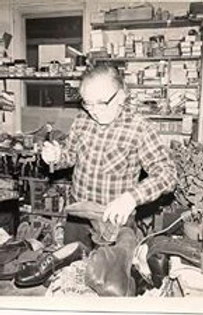
The Brooklyn-born shoemaker had his shop at 228 Bay Avenue. Actually, it was more a hospital where everything from boots and shoes to baseball mitts, belts, purses and gloves were lovingly and tenderly patched, sewn, polished, remade or given a new life for the owner.
Oh, and Ralph was so good at his trade! He would look at that worn-out, unpolished, scraped up pair of shoes, hold one in his hand, push back a little on those eyeglasses teetering at the end of his nose and smile, look up and say, “sure, these aren’t bad. They just need a little help. I’ll have it done tomorrow… tomorrow, unless you’re in a hurry?” He’d just stand there, perhaps wipe his hand on that dye and polish stained apron, smile that soft smile that let you know he was a man you could trust, no matter what. And if you took too long to answer, he’d add, “well, if you need it today, we can do it right now.”
Ralph the Shoemaker was a craftsman beyond compare. But more importantly, he was the soft leather that soothed souls, the warm smile that brought comfort, the good friend to all who was as comfortable as an old slipper.
Ralph learned his trade from his Italian family and first worked at his first shop in Highlands on Valley Street. He married Dorothy Perry, former wife of Burt Perry from the merry-go-round ownership and raised her son Arnold as well as the two youngsters, Kathy and Bob, whom he and Dorothy had during their long and happy marriage.
Best known for his quiet manner and ready smile by generations who depended on the cobbler’s expertise, Ralph set up his crowded, messy-appearing and sweet smelling shop three steps down from the screen door leading to the couple’s home at the back of the shop. It was set with his sewing machine at the front window just to the right of the door from street side, so he could look up and wave to every passing kid, smile at the baby in every baby carriage and greet every walker who passed by with a smile and a soft hello. Everyone knew his stool as well. It was always right there, ready for him to sit down at that front window.
Behind the sewing machine at the window and the stool, there was Ralph’s workbench, his tools scattered but apparently precisely where he wanted or needed them, a little cash register where he always seemed to have the right change, a rag to wipe his hands before he picked up the shoes you ordered for repair, and pieces of leather, laces and other accoutrements of the trade. On the other side of the tiny shop, with a small aisle in-between where customers could walk in, or Dorothy could step out the family home door to say hello, were the racks and racks of shoes, boots and everything else made of leather. All repaired, all neatly aligned, all ready for pick-up by another satisfied customer.
What was missing were receipts. Tickets. Little pieces of paper that identified a particular pair of shoes as belonging to a particular customer. There was no need for that kind of fluff. Ralph Carone knew every customer and every leather or leather-like item that was brought in by that customer for repair.
Even families like the Dempseys and Ptaks, with ten or more kids in the group, knew that Ralph Carone not only knew which family brought in the shoes for repair, but which youngster in that family owned them! Soldiers stationed at Fort Hancock or airmen on the former Air Force Base on the hill knew that if they were transferred or called to duty before picking up a pair of shoes they left for repair at Ralph’s, they would be right there when they came back months or years later. And Ralph would remember the soldier who left them and tell him how happy he was he made it back home.
The kids in town remember how they could bring a beat-up, ragged, or old hand-me-down baseball glove and Ralph the Shoemaker would make it perfect. The teenage girl knew he would have that broken heel on her highest heel repaired in plenty of time for that night’s special dance or date.
The smell of the shop stayed with everyone! There’s something about worn leather, fresh polish, a coat of wax and a smiling shoemaker that seemed to melt away every problem, end every worry, and for just those few minutes, allow a visitor to feel cozy and comfortable. Ralph Carone, Ralph the Shoemaker, had the knack for fixing broken hearts and leathered souls as well as shoes.
There were the regulars who simply stopped for conversation with Ralph. His close group of friends must have resolved every problem in the world during those afternoon chats he shared while continuing his work. There were the more affluent people from “up North” who would come down for a visit or a weekend, and bring their supply of fancy shoes for Ralph, because nobody in the big city seemed to be able to do the job as well.
It is difficult to say how Ralph made a living for his family, though it was obvious they were well loved and well cared for, wanting nothing. Because for the customer nothing ever seemed to cost more than a quarter or fifty cents.
The Reverend Martin McGrail, who grew up in the town, went off to the Navy, came home and later founded a ministry where he could stay in town and administer to its people, remembers a time when he was a kid. It was the 1960s and cleats on shoes were “what the cool guys wore.” Marty wanted to be one of the cool guys like Johnny Marconi and his older cousins. So one day Marty took two soda bottles back to the store, got his ten cents deposit for them, then went to see Ralph. The shoemaker knew exactly what Marty wanted, and knew he wanted to be man enough to pay for it himself. So Ralph the Shoemaker took the kid’s ten cents and put cleats on his shoes. The young preacher was beside himself with joy and happiness worth far more than the dime Ralph had reluctantly taken from him for the job. The euphoria lasted, as Marty once said, “until I got home and my mother removed them saying, ‘No cool cats in my house!’ “ But Ralph the Shoemaker gave a kid a memory that lasts a lifetime.
Karen Mount Tailor, another native who stayed on to become a borough clerk in the 1980s, remembers mostly Ralph’s soft-spoken manner and great smile, as if he were always happy. She and Ralph and Dorothy’s daughter Kathy would walk to school together every day, and Karen looked forward to starting each morning stopping to meet Kathy and Ralph wishing them both a good day. Stories that are never forgotten.
Even those who didn’t grow up with Ralph fixing everything leather for the entire family, Ralph the Shoemaker was a master shoemaker. Ted Jasper, a police officer, remembers Ralph as the go-to guy for everything leather because “this guy could sure work miracles with rawhide.” Another unforgettable memory.
Few even remember Ralph and Dorothy taking a vacation or holiday. The shop was simply always there, that comfortable spot where you could walk in with a greeting to share or a pair of boots to be fixed. Where you could find that old pair of shoes you dropped off a couple of months ago still sitting there, now shiny, clean and fixed, just waiting for you to come pick them up. Dorothy was there often sweeping up the dirt from shoppers and the dust from the shoes, and Ralph was on his bench sewing and smiling. Some do recall one week back around 1985 when the Closed sign was up on the door for a week.
Ralph Carone died in 1996, after working in his shop for 60 years. But to the locals, there aren’t many who cannot still imagine the aroma of the strong sweet smell of newly polished leather, see an old sewing machine or hear the whir of its motor without smiling a bit and remembering a time a long time ago when Ralph the Shoemaker gave new life to more than run down heels or tired soles.
EDITORSNOTE: If you’re interested in purchasing a copy of The ABCs of Highlands, and reading more stories about the People, Places and Things that made Highlands great, go to Book Sales
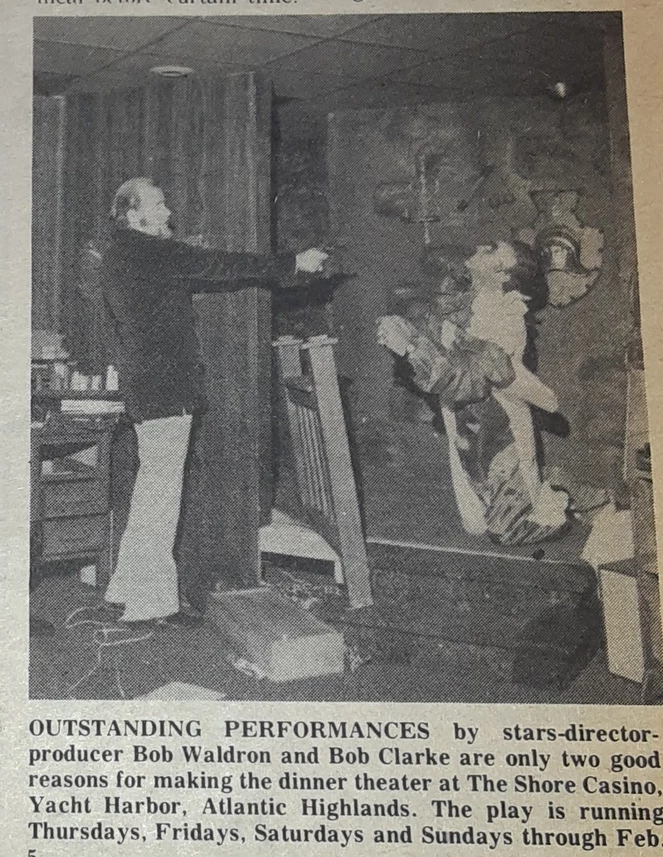
While I was associate editor, later editor of The Courier in the 1970s and 1980s, we often asked young college students to cover entertainment in Monmouth County and write their reviews for The Courier. Here’s one written by my daughter, Kathy Smith, in 1976 when she was a freshman at Cedar Crest College in Allentown, Pa., but home frequently, especially when some of her favorite people were performing in one of her favorite places.
By Kathy Smith
ATL. HIGHLANDS – For those who have never been to a dinner theater at the Shore Casino, this is the month to do it.
Sleuth is a play in two acts by Anthony Shaffer that opened under the direction of Jan Edward, hailed as one of New York’s brightest young directors and recently the director of the Shadowbrook presentations.
Although it played to a sparse audience the production is a superb rendition of an excellent play.
The two main characters are portrayed by Robert Clarke and Robert Waldron who all but steal the show. The two also produced the presentation and have given the world an excellent example of how well their talents blend.
Clark sets the mood as Andrew Wyke, a well-to-do writer whose specialty is detective stories. He reads from his manuscript and as always the police are stumped by obvious clues. Enter the amateur sleuth who is in all Wyke’s books, discovers the clues and cracks the case to the derision of the hapless police.
Clarke’s British accent is convincing if you assume it isn’t the real thing in the first place. His ability to establish mood is remarkable. He is intent, conniving, pensive and petrified all with startling conviction.
Costar Bob Waldron is equally talented and equally pleased with his work. Neither overshadows the other although both excel compared to the other three characters in the mystery. Waldron’s most impressive quality is his facial expressions. Don’t miss them, they’re phenomenal! His face turns various shades of red with each mood, and his eyes reflect his thoughts of Milo Tindle, a travel agent interested in Wyke’s wife.
Inspector Doppler, played by Bret Rowan Lord was also convincing coming close to the performances of Clark and Waldron. He is a clever detective in the play with a cunning mind and probing eyes. His main concern is with an alleged murder. He feels certain of the murderer’s identity and confronts him with the evidence. As in Wyke’s books, clues are obvious and riddles provide hints.
Trowler Brando and Daron B. Walter are Detective Sgt. Tarrant and police constable Higgs. Both are believable and enjoyable but fail to be fully brought into the spotlight because of the overwhelming performances of the two main characters.
Basically, the play concerns itself with two murders and a jewel robbery. The suspect couldn’t be the butler, there isn’t one, and surprises are abundant throughout the two acts, even though clues are obvious and will distributed throughout the play.
Sleuth is definitely the hit of the evening at the Shore Casino and well worth the ticket price alone But the added bonus of a Shore Casino dinner make it the most enjoyable bargain of the century. The entire evening is excellent with unforgettable entrees, waitresses pleasant and friendly and the show is superb.
The setting is a British country home and is perfect to the smallest detail A stone wall provides the backdrop and a coat of arms completes the look. Books are cluttering the massive desk, Goldfish are even swimming happily in an aquarium.
To say more would ruin the full effect of the play, since the element of surprise is important. Curtain time is at 8:30 (7:30Sundays) and dinners are served from 7.We’d suggest arriving close to 7 so you can enjoy a leisurely meal before curtain time. Another idea is ordering a bottle of wine for sipping pleasure during the play. Naturally there are no orders taken during the presentation, but the waitresses are busy and efficient during intermission.
And after the show, the actors mingle with the audience, getting their reactions and opinions and answering their questions.
An awesome experience for those who like to chat first hand with the stars.
The play is an absolute must if you like great enjoyment and this cast deserves a good audience. They really give their all. Make your reservations, see for yourself, and you’ll agree.